Back to News
News AlertWorld Unicorn
Space Tech and PropTech Redefine the Billion-Dollar Elite
V
Author
Vishal Sable
Published
July 17, 2026
Reading Time
4 MIN READ
Spread the Word
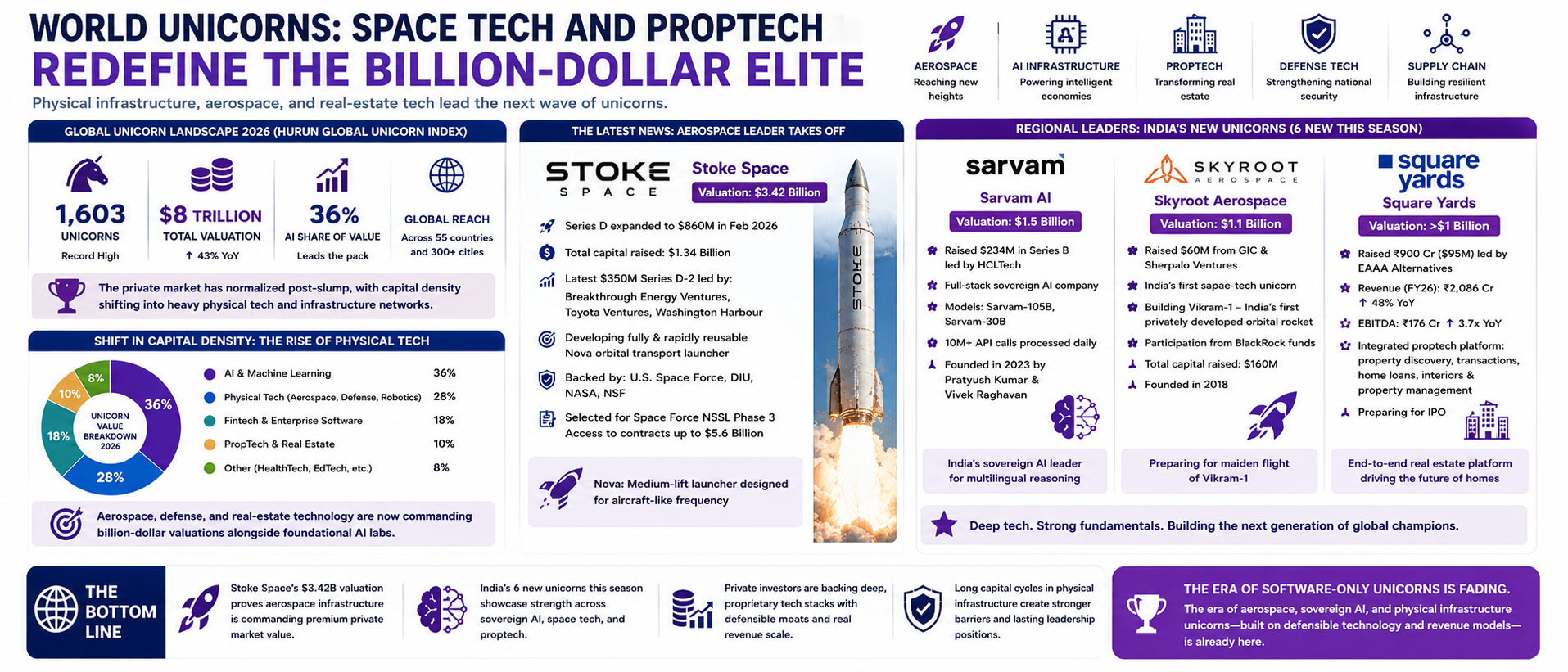
The exclusive $1 Billion "Unicorn Club" is expanding rapidly, but the capital density is shifting directly into heavy physical tech, aerospace, and supply chain infrastructure. Global unicorn tracking indicators confirm that the private market has normalized post-slump, heavily rewarding infrastructure networks. According to the Hurun Global Unicorn Index 2026, the world now hosts a record 1,603 unicorns with a combined valuation of $8 trillion—up a staggering 43% on the back of AI. While AI leads with 36% of unicorn value, the most significant shift is the rise of physical tech—aerospace, defense, and real-estate technology are now commanding billion-dollar valuations alongside foundational AI labs.
The Latest News
Aerospace champion Stoke Space has officially scaled its private valuation to $3.42 billion as it accelerates testing for its fully reusable Nova orbital transport launcher. The company dramatically expanded its Series D funding to $860 million in February 2026, elevating its total capital raised to an impressive $1.34 billion. The latest $350 million Series D-2 extension was led by Breakthrough Energy Ventures, Toyota Ventures, and Washington Harbour. Stoke is developing the fully and rapidly reusable Nova rocket, a medium-lift vehicle designed to operate with aircraft-like frequency. The company has been funded by the U.S. Space Force, DIU, NASA, and the National Science Foundation, and was selected for the Space Force's National Security Space Launch Phase 3 program, opening access to contracts worth up to $5.6 billion.
The Regional Leaders
In regional ecosystems like India, the unicorn pipeline has welcomed six new members so far this season. Leading the pack is Sarvam AI, India's full-stack sovereign AI company, which crossed the $1-billion valuation mark after raising $234 million in a Series B round led by HCLTech at a post-money valuation of $1.5 billion. The company has developed foundational models including Sarvam-105B and Sarvam-30B for multilingual reasoning and edge deployment, and its inference platform now processes more than 10 million API calls daily. Founded in 2023 by AI researchers Pratyush Kumar and Vivek Raghavan, Sarvam has emerged as one of the most closely watched names in India's AI ecosystem.
Space pioneer Skyroot Aerospace became India's first space-tech unicorn after securing $60 million in fresh funding from GIC and Sherpalo Ventures, lifting its valuation to $1.1 billion. The Hyderabad-based startup, founded in 2018, is preparing for the maiden flight of Vikram-1—India's first privately designed and developed orbital rocket. The round also saw participation from funds managed by BlackRock, bringing Skyroot's total capital raised to $160 million. The company has nearly doubled its valuation in approximately 30 months.
Property technology powerhouse Square Yards joined the ranks after a successful ₹900 crore ($95 million) funding round led by EAAA Alternatives, with participation from global corporate credit manager Muzinich & Co, at a valuation exceeding $1 billion. The company reported revenue of ₹2,086 crore in FY26, recording a 48% year-on-year increase, with EBITDA rising 3.7-fold to ₹176 crore. Square Yards now offers an integrated real estate platform spanning property discovery, transactions, home loans, interior design solutions, and property management services, and is preparing to launch its Initial Public Offering. The company took between eight and 12 years to cross the billion-dollar mark, illustrating the long capital cycles required for physical infrastructure businesses compared to AI-native startups that achieved unicorn status in under three years.
The Bottom Line
July 2026 marks a definitive shift in the unicorn landscape. Stoke Space's $3.42 billion valuation signals that aerospace infrastructure—fully reusable rockets designed for aircraft-like frequency—is now commanding premium private market value alongside foundational AI labs. In India, the emergence of six new unicorns this season—led by sovereign AI builder Sarvam at $1.5 billion, space pioneer Skyroot at $1.1 billion, and proptech platform Square Yards at over $1 billion—confirms that private investors are rewarding deep, proprietary technology stacks across aerospace, AI infrastructure, and physical real-estate automation. The era of software-only unicorns is fading. The era of aerospace, sovereign AI, and physical infrastructure unicorns—built on defensible technology and revenue models—is already here.

Vishal Sable
B.Tech AD @ shri balaji institute of technology and management
Engineering and tech journalist. I love exploring the impact of emerging technologies on global defense, sovereignty, and everyday life. Always looking for the real story behind the headlines.