Back to News
News AlertWorld Unicorn
Sustainable Cash Flow over Paper Hype
V
Author
Vishal Sable
Published
August 8, 2026
Reading Time
4 MIN READ
Spread the Word
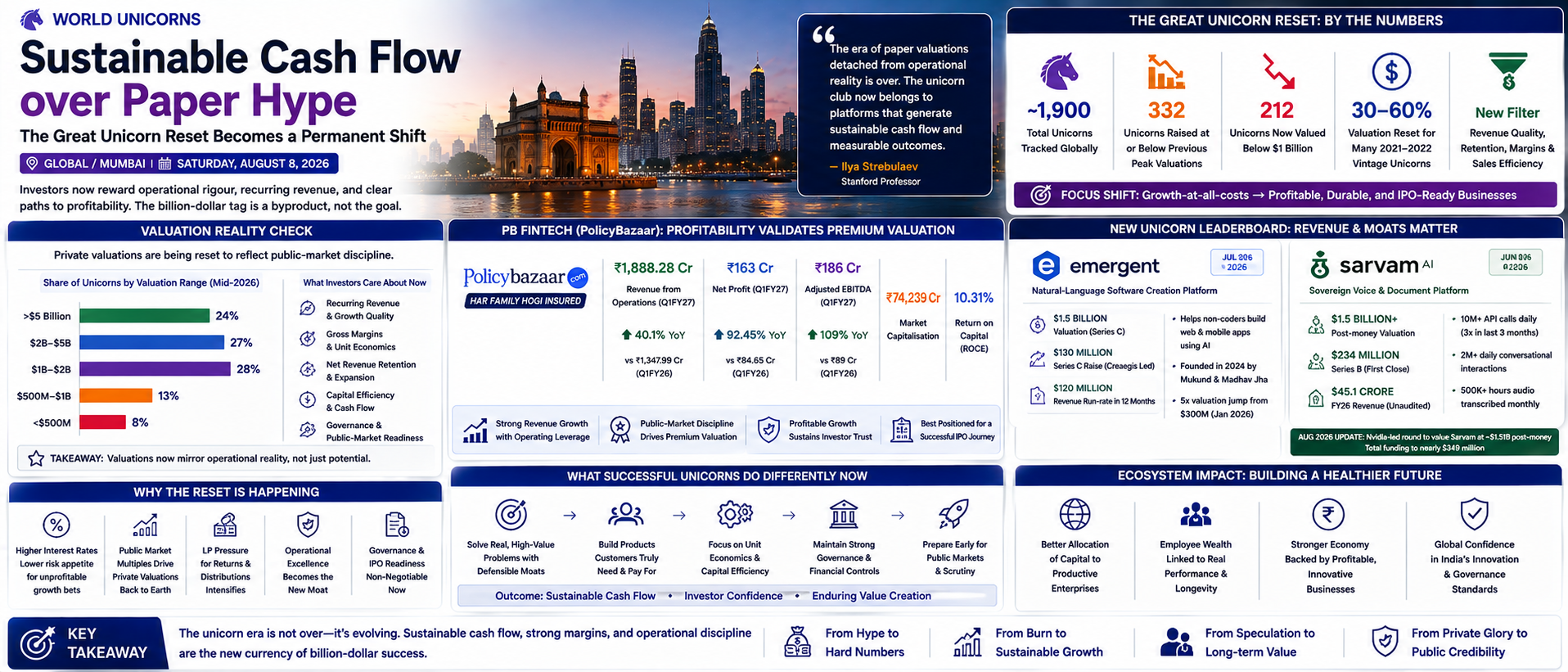
The private-market reckoning that began in late 2025 has now crystallised into a permanent structural shift, as late-stage valuations heavily favour revenue-generating entities over speculative apps, and investors increasingly treat the billion-dollar tag not as a trophy but as a byproduct of operational rigour. The "Great Unicorn Reset" has filtered out companies built on growth-at-all-costs narratives, leaving behind a leaner cohort of private titans that can demonstrate recurring revenue, healthy gross margins, and clear paths to public-market readiness. Data from Stanford professor Ilya Strebulaev's unicorn database shows that out of roughly 1,900 tracked unicorns globally, 332 had raised money at valuations at or below their previous peaks by mid-2026, with 212 valued below $1 billion. The same billion-dollar mark now means little without revenue quality, retention, gross margin and sales efficiency.
PB Fintech, the parent company of India's leading digital insurance marketplace PolicyBazaar, exemplifies this new valuation paradigm with numbers that speak louder than any paper markup. The company reported a 40.1 per cent year-on-year jump in revenue from operations to ₹1,888.28 crore for Q1FY27, compared with ₹1,347.99 crore in the same quarter last year. Net profit nearly doubled, soaring 92.45 per cent to ₹163 crore from ₹84.65 crore in the year-ago period. The company's adjusted EBITDA advanced 109 per cent year-on-year to ₹186 crore. With a market capitalisation of approximately ₹74,239 crore and a return on capital employed of 10.31 per cent, PB Fintech's performance validates that public-market discipline—not private-market hype—now dictates which companies command premium valuations.
The leaderboard of newly minted unicorns reinforces this preference for tangible revenue and defensible moats over speculative consumer apps. Emergent, a natural-language software creation platform that helps non-coders build web and mobile applications using AI, achieved unicorn status in July 2026 after raising $130 million in a Series C round led by Creaegis, valuing the company at $1.5 billion. The startup, founded in 2024 by twin brothers Mukund and Madhav Jha, reached a $120 million revenue run-rate within a year of its public launch, making it one of the fastest unicorns in history. The round quintupled its valuation from January 2026, when it raised a $70 million Series B led by SoftBank Vision Fund 2 and Khosla Ventures.
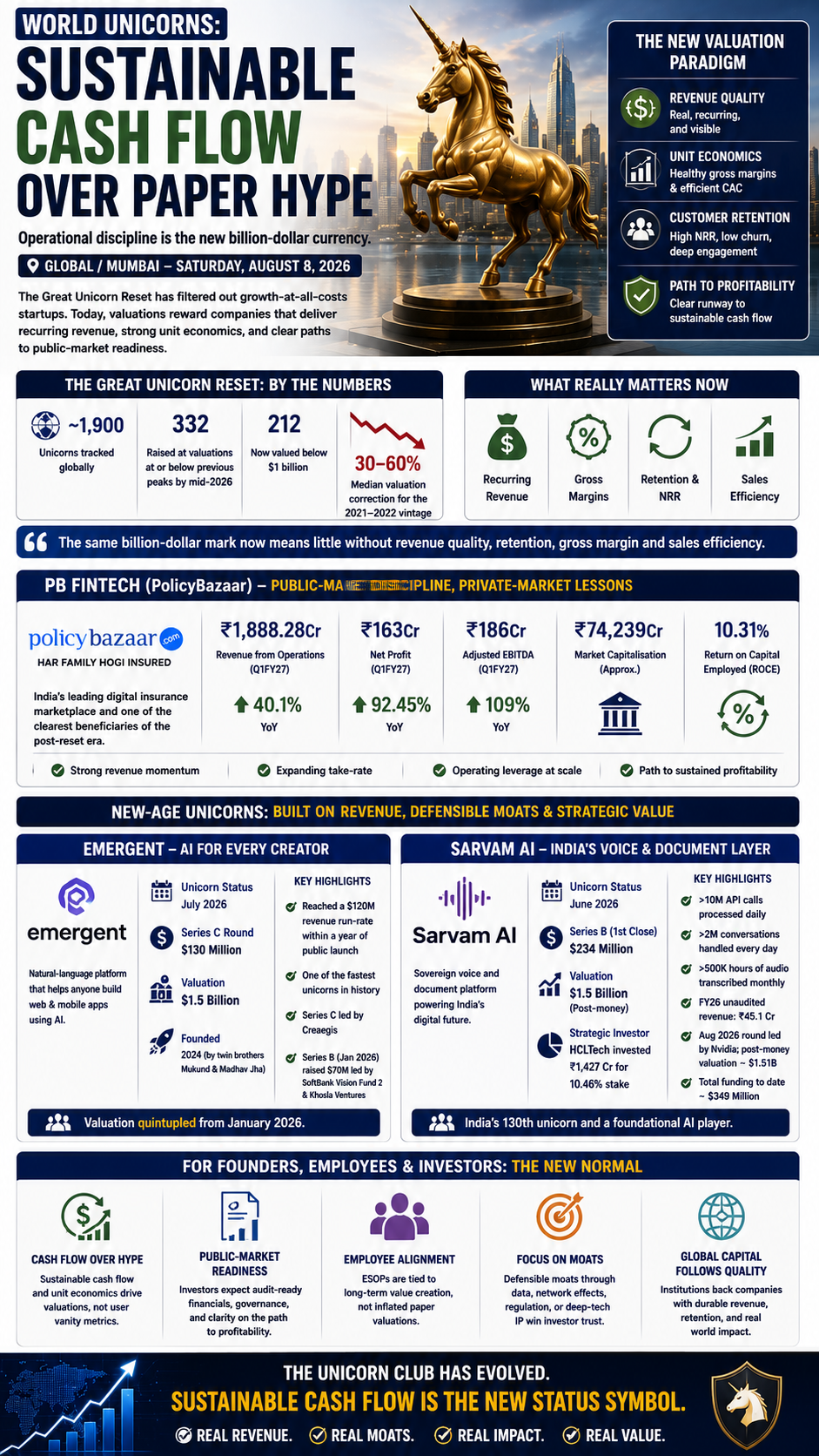
Sarvam AI, Bengaluru's sovereign voice and document platform, joined the unicorn club in June 2026 after raising $234 million in the first close of its Series B round at a post-money valuation of $1.5 billion, becoming India's 130th unicorn. The round was led by HCLTech, which invested ₹1,427 crore for a 10.46 per cent stake, marking one of the largest strategic investments by an Indian technology major in a domestic AI venture. Sarvam's inference platform now processes more than 10 million API calls daily, with usage having tripled in the past three months; its conversational AI systems handle over two million interactions every day; and its speech models transcribe more than half a million hours of audio each month. The company reported unaudited revenue of ₹45.1 crore for FY26, underscoring that investors are betting on the strategic value of building foundational AI capabilities in India rather than on near-term earnings alone. A subsequent funding round in August 2026, reportedly led by Nvidia, is set to value Sarvam at approximately $1.51 billion post-money, bringing its total funding to nearly $349 million.
For founders, employees, and investors alike, the message is unambiguous: the era of paper valuations detached from operational reality is over. The unicorn club now belongs to platforms that can demonstrate sustainable cash flow, disciplined unit economics, and genuine customer willingness to pay for measurable outcomes. As the public-market IPO pipeline begins to absorb these reset unicorns, the global economy stands to gain not speculative flameouts but profitable, enduring enterprises that reward patient capital with consistent performance rather than volatile headlines.

Vishal Sable
B.Tech AD @ shri balaji institute of technology and management
Engineering and tech journalist. I love exploring the impact of emerging technologies on global defense, sovereignty, and everyday life. Always looking for the real story behind the headlines.