The Deep Work Era: Why Google’s Gemini 4 Argon Just Redefined the AI Engineer
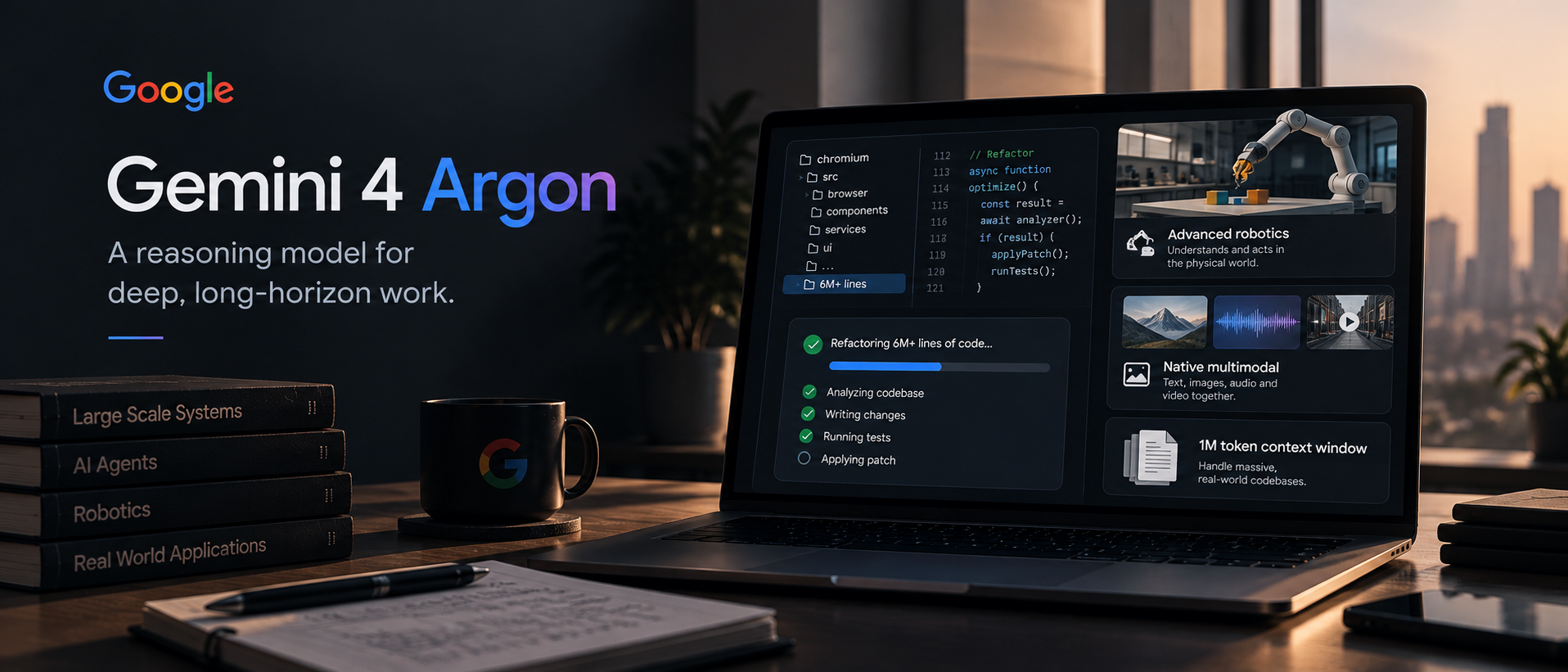
For the last few years, the technology industry has judged artificial intelligence by how quickly it could generate a paragraph of text, draft an email, or produce a simple code snippet. But with the release of Google’s new Gemini 4 Argon model, the core metric of success has fundamentally shifted from generating immediate text to executing months of complex engineering work completely autonomously. This is no longer just a digital assistant living in a chat box; it is a persistent, reasoning digital worker that is already untangling millions of lines of legacy code and operating physical robots in dynamic 3D environments.
On October 13, 2026, Google officially launched Gemini 4 Argon, making its latest frontier model globally available to developers and enterprises via the Gemini API in Google AI Studio. This release is not merely a fine-tuned update of a previous iteration, but a brand-new foundation model built on a massive, sparse mixture-of-experts (MoE) transformer architecture. It features deep native multimodal support for processing text, images, audio, and video simultaneously, handling an enormous 1-million token combined context window. The model is currently accessible for Google AI Ultra subscribers through a new advanced interface called Google Antigravity, and it is also being deployed to Pro subscribers within the Gemini app and the new AI Mode in Search.
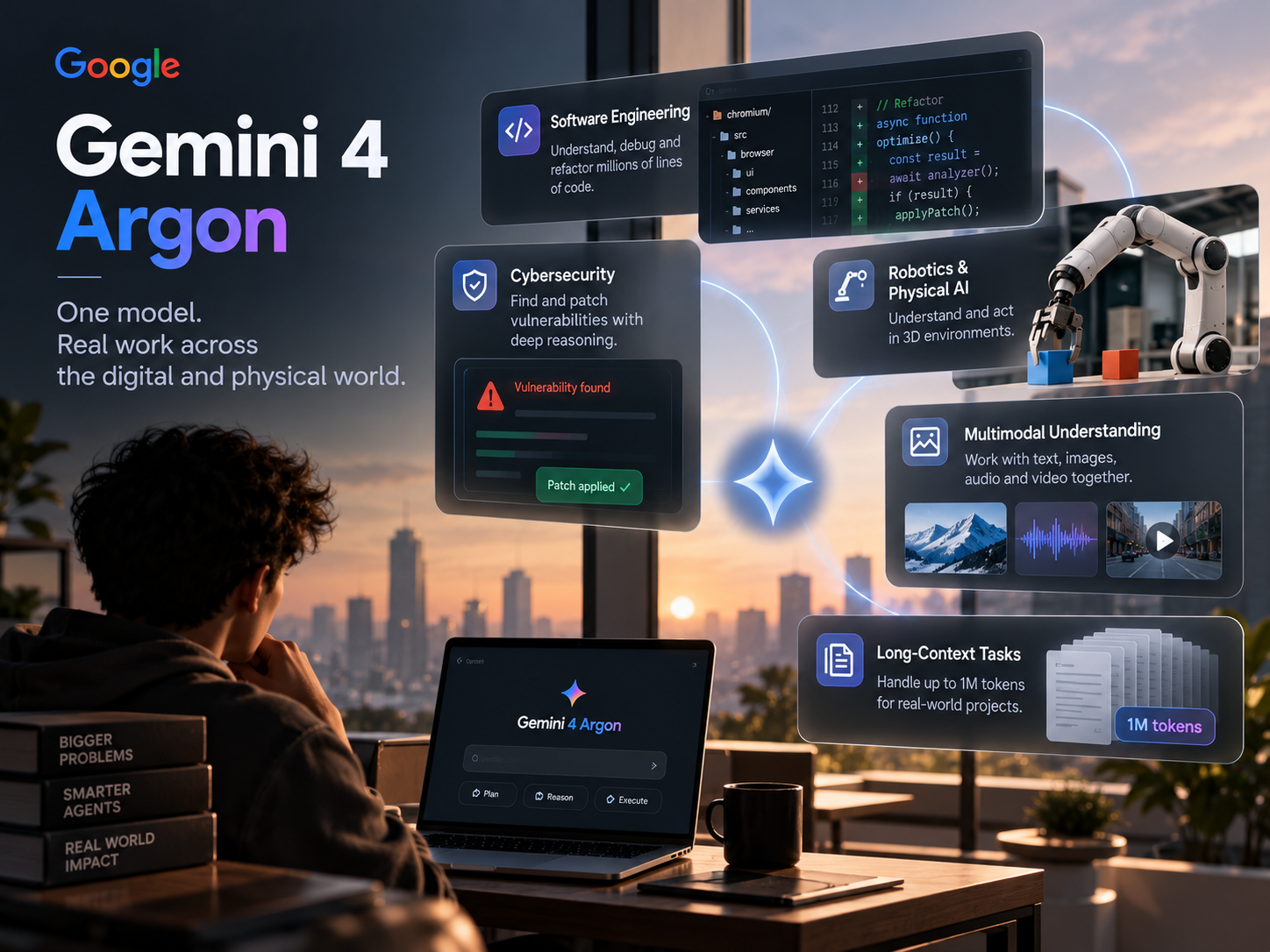
The defining technical feature of Gemini 4 Argon is its profound ability to perform deep work on long-horizon tasks without needing constant human supervision. Developers can explicitly configure the model’s thinking_level parameter, allowing it to maximize its internal reasoning depth before it even attempts to execute a prompt or output a solution. This architecture is designed explicitly for multi-file root-cause debugging, patching critical cybersecurity vulnerabilities, and executing formal mathematical reasoning. Instead of prompting the AI turn-by-turn, Google encourages developers to align on a goal upfront and let the model's Managed Agents run autonomously to write code, verify work, and call tools.
To prove this capability, Google’s own Chrome team deployed Argon against its most difficult engineering problems. The AI was tasked with untangling a massive 6-million-line legacy folder buried within the Chromium browser's sprawling 40-million-line codebase. By piping multiple clean code changes simultaneously and testing its own hypotheses, the AI completed an architectural refactor across hundreds of files in just a few weeks—a task that would have manually taken human engineers several months to finish.
Why It Matters For the global enterprise and IT outsourcing sectors, Argon represents a fundamental shift in how complex digital labor is valued and deployed. The model currently ranks number one on the Vals Index, a critical benchmark measuring AI performance across vital economic sectors like finance, coding, legal analysis, and tax work. However, the true disruptive potential of Argon lies in its ability to step off the screen and into the physical world.
Google is aggressively pushing Argon far beyond traditional software by integrating it deeply into the robotics stack. On the Embodied Reasoning (ERQA) benchmark—which rigorously tests a model's ability to understand and solve spatial, physical problems in 3D environments—Argon scored an astonishing 87 percent using pure reasoning, significantly outperforming every other frontier model on the market. When an artificial intelligence can accurately reconstruct physically calibrated simulation twins from robot camera feeds and autonomously refactor massive legacy codebases, it drastically reduces the corporate need for manual, entry-level engineering labor. The industry focus shifts entirely from writing basic code to employing senior architects who can set measurable goals, build automated testing baselines, and supervise these long-horizon AI agents securely.
Google is pricing this massive autonomous capability aggressively, offering an introductory rate of just $2 per million input tokens and applying a steep 95 percent discount for cached input tokens. With costs this low, the financial barrier to deploying enterprise-grade digital workers has effectively vanished. But as global corporations rush to hand over their most complex cybersecurity defenses, legal analyses, and legacy infrastructure to advanced models like Gemini 4 Argon, a critical tension emerges. If the artificial intelligence is now fully capable of running its own tests, patching its own vulnerabilities, and executing months of engineering work completely out of sight, how long until human developers are no longer the builders of software, but merely the supervisors of the machines that build it?

Saumya Dawande
B.Tech AIML @ oriental institute of science technology bhopal
Engineering and tech journalist. I love exploring the impact of emerging technologies on global defense, sovereignty, and everyday life. Always looking for the real story behind the headlines.