Back to News
News AlertWorld Unicorn
World Unicorns: Space Domination & The Rise of Deep-Tech
V
Author
Vishal Sable
Published
June 30, 2026
Reading Time
6 MIN READ
Spread the Word
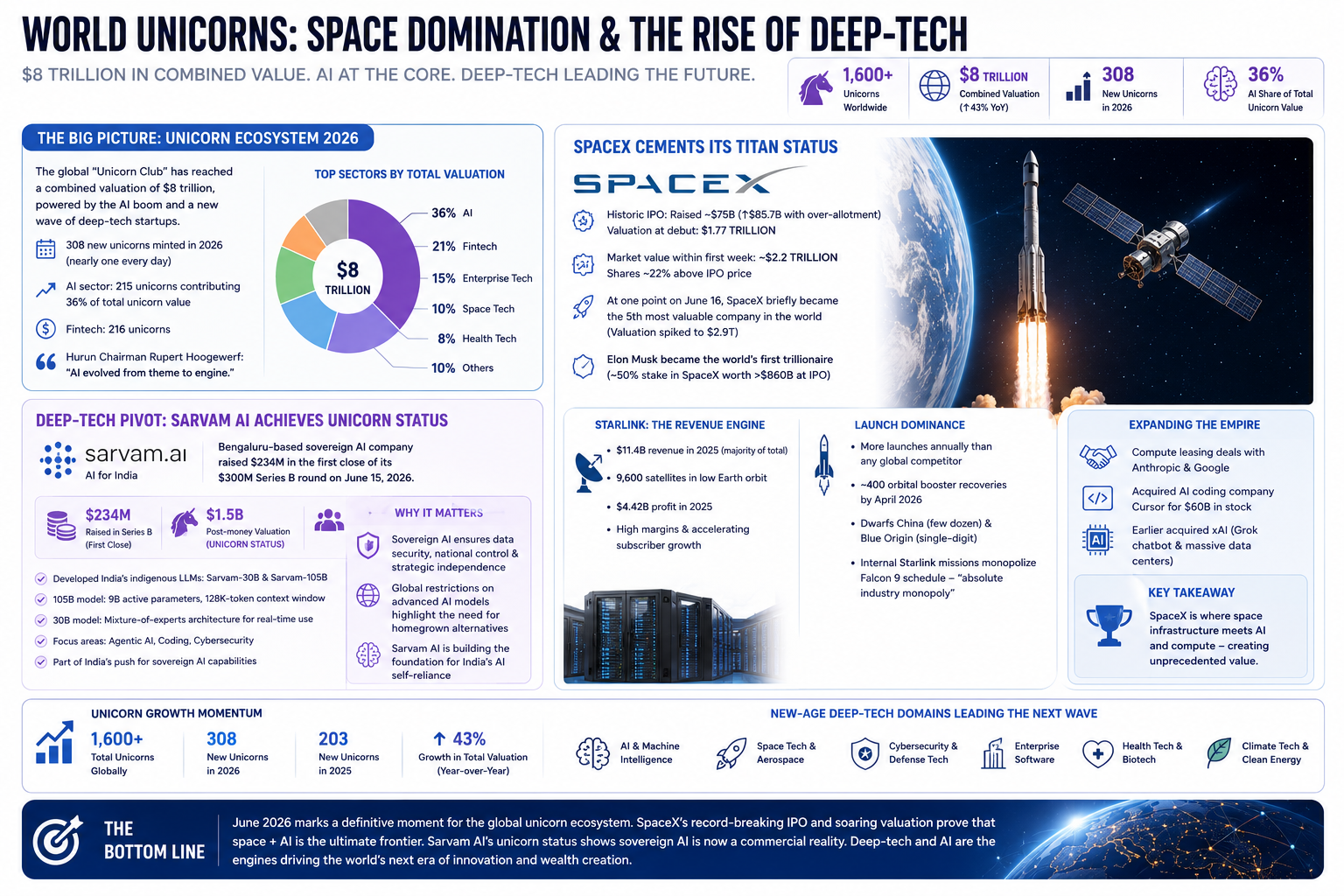
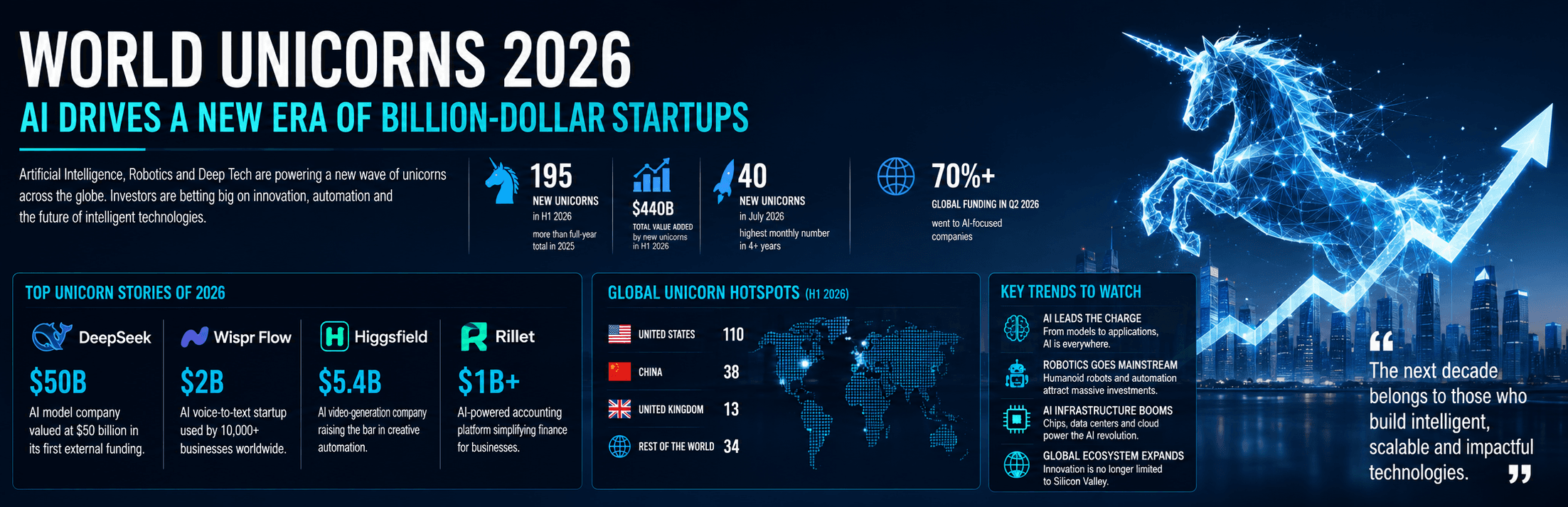
The global "Unicorn Club"—private startups valued over $1 billion—has officially hit a combined valuation of $8 trillion, driven overwhelmingly by the artificial intelligence boom and a new wave of deep-tech entrants reshaping industries from aerospace to national security. The AI sector alone now accounts for 36% of total unicorn value despite numbering just 215 companies, nearly matching fintech's 216. 308 new unicorns were minted this year—nearly one every day—up from 203 last year. Hurun Chairman Rupert Hoogewerf described 2026 as the year AI evolved "from theme to engine," with the race to build the world's most capable AI models now defining global competition.
SpaceX Cements Its Titan Status
SpaceX has cemented its status as the undisputed heavyweight titan of the private tech world, completing the largest initial public offering in history. The company priced 555.56 million shares at $135 each, raising approximately $75 billion and debuting with a valuation of $1.77 trillion—toppling all previous IPO records. Strong investor demand pushed the total raised to $85.7 billion after underwriters purchased additional shares. Within its first week of trading, SpaceX's market value surged to nearly $2.2 trillion, with shares trading around 22% above the IPO price. At one point on June 16, the company briefly passed Amazon to become the fifth-most valuable company in the world, with its valuation spiking to $2.9 trillion before settling back.
The company's dominance rests on two pillars. Starlink, its satellite internet division, generated approximately $11.4 billion in revenue in 2025—the majority of SpaceX's total—with high margins and accelerating subscriber growth. The network now comprises 9,600 satellites in low Earth orbit and generated $4.42 billion in profit in 2025. On the launch side, SpaceX conducts more launches annually than any global competitor, with roughly 400 orbital booster recoveries by April 2026, dwarfing China's combined total of a few dozen and Blue Origin's single-digit count. Internal Starlink deployment missions now monopolize the Falcon 9 flight schedule, creating what analysts describe as an "absolute industry monopoly".
The company has also added new revenue streams through compute leasing deals with Anthropic and Google, and announced the acquisition of AI coding company Cursor for $60 billion in stock. This came after SpaceX earlier acquired xAI, Elon Musk's AI startup, which has built massive data centers and created the Grok chatbot. The IPO made Musk the world's first trillionaire, with his roughly 50% stake in SpaceX valued at over $860 billion at the offering price.
Deep-Tech Pivot: Sarvam AI Achieves Unicorn Status
Traditional consumer apps are being replaced by deep-tech entries, with Sarvam AI emerging as a prime example. The Bengaluru-based sovereign AI company raised $234 million in the first close of its $300 million Series B funding round on June 15, achieving unicorn status with a post-money valuation of $1.5 billion. HCLTech emerged as the lead strategic investor, contributing $150 million, with participation from Bessemer Venture Partners, Khosla Ventures, and Peak XV Partners.
The company has been mandated to build a sovereign AI stack, rolling out two indigenous large language models developed entirely in India—Sarvam-30B and Sarvam-105B—at the India AI Impact Summit in February 2026. The 105-billion-parameter model features nine billion active parameters and a 128,000-token context window, enabling it to excel in long-form tasks, coding, and Indian language processing. The 30-billion-parameter model, built on a mixture-of-experts architecture, is designed for real-time conversational use cases.
The funding reflects a broader push by countries and companies to develop sovereign AI capabilities amid growing concerns over access to advanced models and computing infrastructure. The debate gained fresh urgency when Anthropic disabled access to its latest models, Fable 5 and Mythos 5, after the U.S. government ordered the company to suspend their use by any foreign national, citing national security concerns. With the fresh investment, Sarvam said it would fund research into next-generation AI models focused on agentic, coding, and cybersecurity applications.
The Bottom Line
June 2026 marks a definitive moment for the global unicorn ecosystem. SpaceX's historic IPO and surging valuation—now approaching $2.2 trillion—demonstrate that space infrastructure and AI are merging into a single, massively valuable proposition. Sarvam AI's unicorn status signals that sovereign AI is no longer a policy aspiration but a commercial reality, with nations racing to build homegrown alternatives to foreign cloud technology. The combined $8 trillion valuation of the world's unicorns, up 43% year-over-year, confirms that deep-tech and artificial intelligence are now the primary engines of global startup wealth creation.

Vishal Sable
B.Tech AD @ shri balaji institute of technology and management
Engineering and tech journalist. I love exploring the impact of emerging technologies on global defense, sovereignty, and everyday life. Always looking for the real story behind the headlines.