LATEST NEWS
Chips, China's DeepSeek & AI Hacker Agents: Inside This Week's Valuation Surge
October 8, 2026 4M
Back to News
News AlertWorld Unicorn
$33.5B Into AI Data Center Power Startups: Capital vs Capacity
V
Author
Vicky Galfat
Published
October 13, 2026
Reading Time
4 MIN READ
Spread the Word
US startups tackling AI data center power raised $33.5B by October, nearly double 2025. Morgan Stanley says the next test is capacity deployed.
AI data center power, Morgan Stanley data center startups, AI infrastructure funding 2026, data center power constraints, grid bottleneck AI, Mistral Series D, European AI data centers, sovereign AI compute, power and cooling startups, AI venture capital.
Capital Raised Is Not Capacity Deployed: What the $33.5 Billion AI Power Boom Really Tests
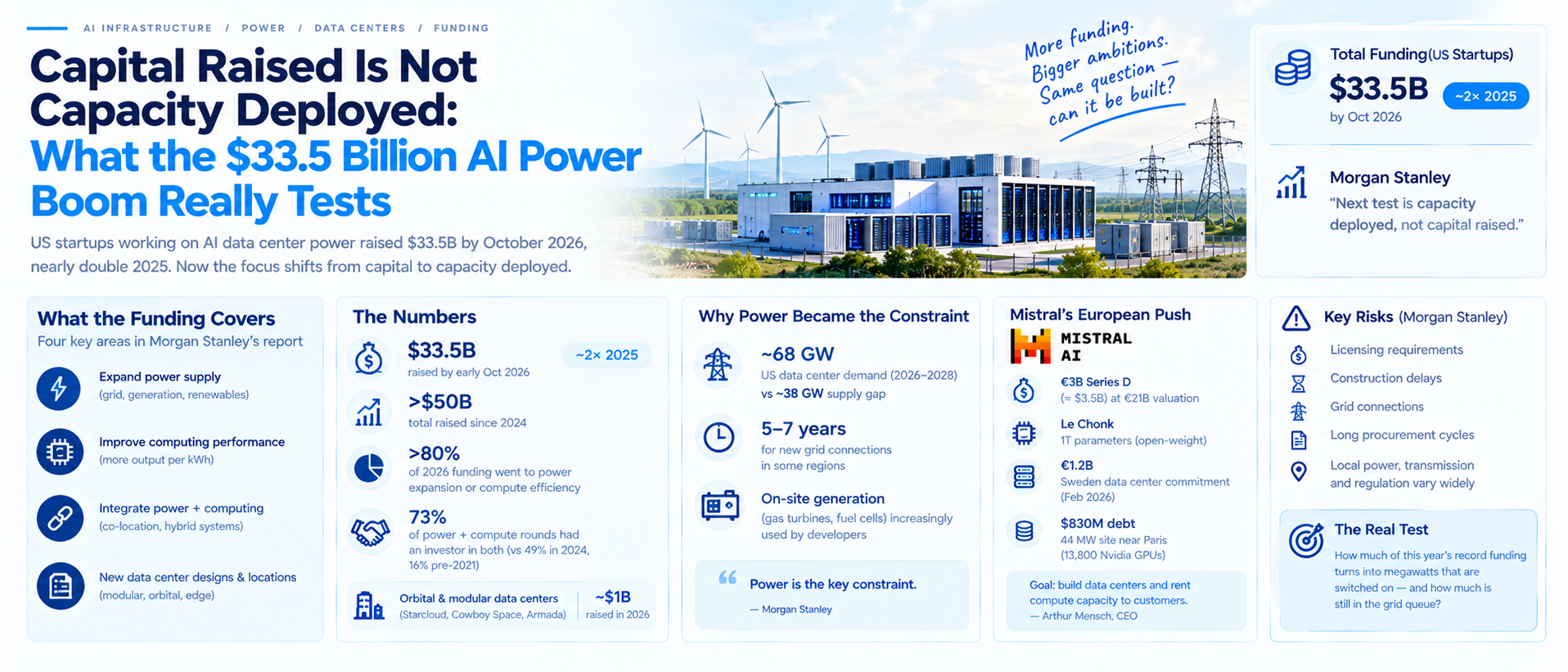
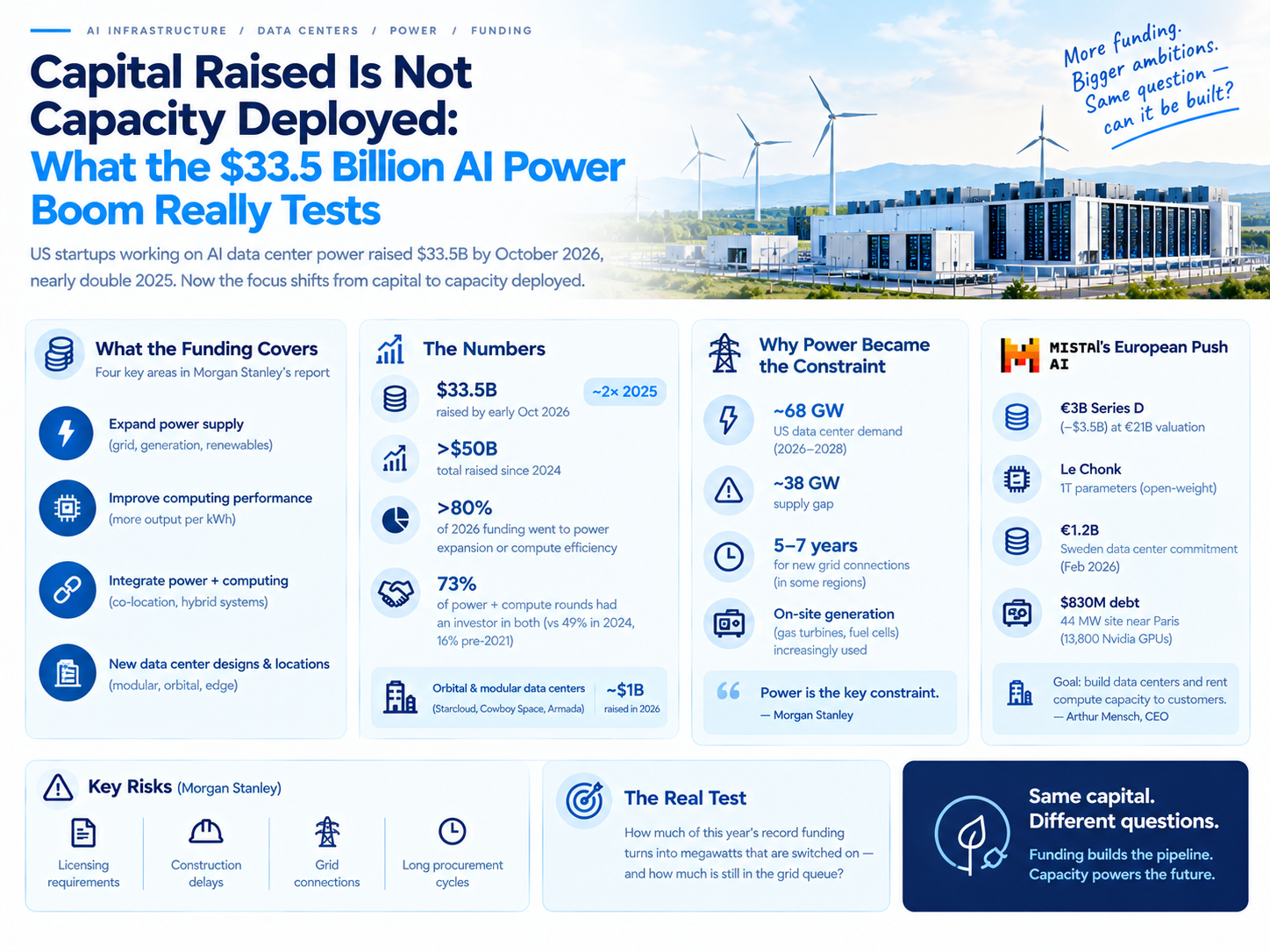
US startups working on the power and computing limits of AI data centers had raised $33.5 billion by early October 2026, nearly double the whole of 2025, according to a new Morgan Stanley report. Yet the same report makes a pointed argument: the next phase of validation should shift from capital raised to capacity deployed. In other words, the money is no longer the proof.
What the Number Covers
Morgan Stanley's universe is broader than "power startups." It spans four areas: expanding power supply, improving computing performance per unit of electricity, integrating power with computing, and new data center designs and locations. Companies in the report have raised more than $50 billion since the start of 2024, and over 80% of this year's funding went to firms expanding power availability or squeezing more computing out of each watt. Reports on the study also note that the group ranges from cloud providers deploying capacity today to ambitious nuclear and fusion projects.
One detail suggests investors now see power and compute as a single stack. In 2026, 73% of funding rounds in those two segments included an investor already backing a company in the other, up from 49% in 2024 and 16% before 2021. Orbital and modular data center companies, including Starcloud, Cowboy Space and Armada, together raised nearly $1 billion this year.
Why Power Became the Constraint
Morgan Stanley is blunt that power is the key constraint. An earlier estimate from the bank put US data center demand at roughly 68 gigawatts between 2026 and 2028, leaving a gap of about 38 gigawatts. In some parts of the country, a new grid connection can take five to seven years, which is why developers increasingly look at on-site generation such as gas turbines and fuel cells.
Mistral Shows the Same Logic in Europe
Mistral AI sits outside Morgan Stanley's US universe, but its numbers follow the same pattern. On 8 September, Mistral announced a €3 billion Series D, about $3.5 billion, at a post-money valuation above €21 billion (around $24.4 billion). Samsung led the round, up from the €11.7 billion Mistral was valued at a year earlier. Chief executive Arthur Mensch said the company would build data centers and rent computing capacity to customers, not just train models.
The physical build-out is already under way. Mistral announced a €1.2 billion data center commitment in Sweden in February, and raised $830 million in debt in March to build a 44-megawatt site near Paris with 13,800 Nvidia GPUs. Its new Le Chonk model was trained on 3,800 Nvidia Grace Blackwell GPUs in its own European data centers. One caution on the framing: sources describe the new money as funding compute, infrastructure and expansion. None describes the clusters as energy-integrated, so that claim should not be repeated without a source.
The Risks Morgan Stanley Flags
The report lists licensing requirements, construction delays, grid connections and long procurement cycles as risks. It also says the economics of a data center will increasingly depend on where it is built, because local power availability, transmission limits and regulation vary widely. Startups, it implies, must show commercial agreements, regulatory approvals, early deployments and competitive operating costs, not just a funding announcement.
Mistral is a useful test case for that standard. It has the capital, but a 44-megawatt site is small next to the multi-gigawatt demand figures driving this boom, and the company expects annual recurring revenue to exceed $1 billion by the end of 2026, a target it has set itself. If capacity deployed becomes the scoreboard, the open question is how much of this year's record funding turns into megawatts that are switched on, and how much is still waiting in a grid queue.

Vicky Galfat
University of Mumbai/BCA
Learning, building, and exploring the world of technology one project at a time.