Back to News
News AlertWorld Money
AI Architecture & Strategic Consolidation
V
Author
Vishal Sable
Published
August 9, 2026
Reading Time
7 MIN READ
Spread the Word
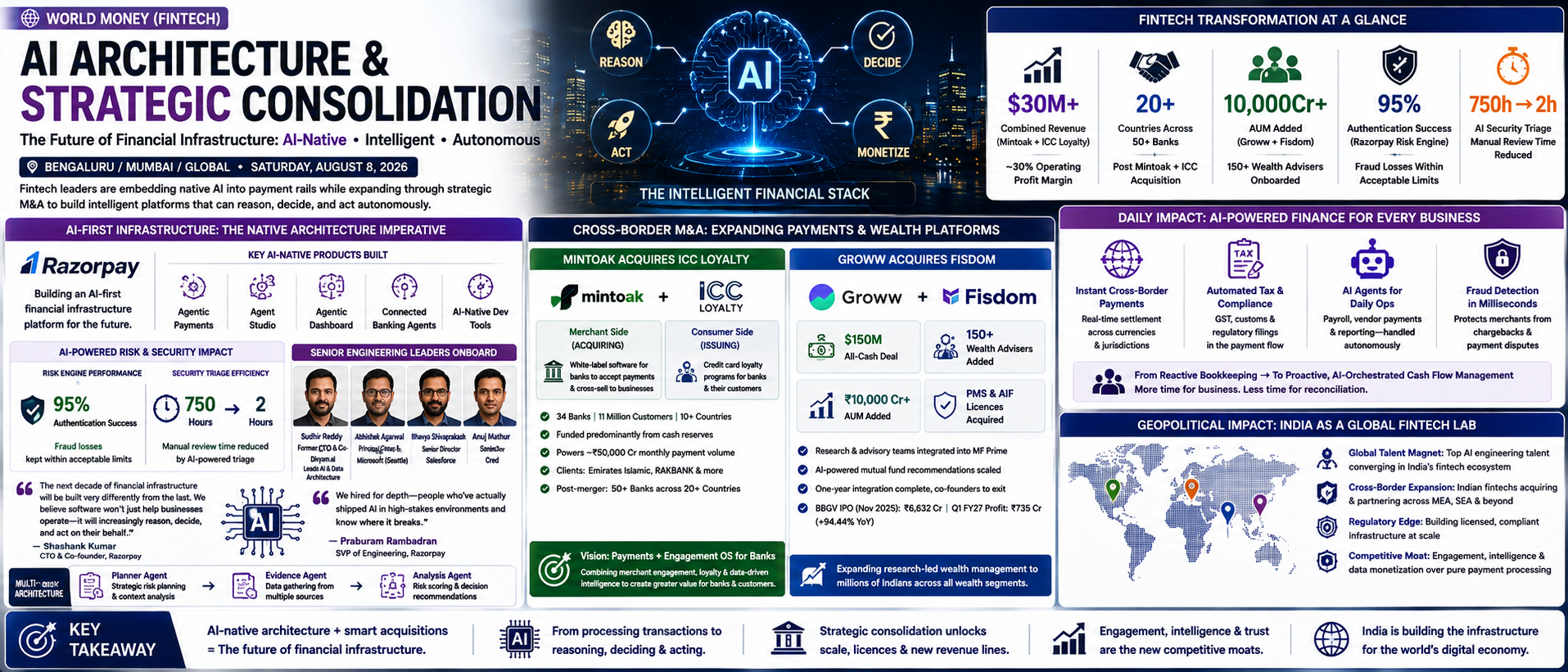
The global fintech sector is undergoing a dual transformation—architectural and structural—as major players race to embed native AI into their payment rails while simultaneously consolidating through strategic cross-border acquisitions. The message from boardrooms and engineering teams is unambiguous: the future of financial infrastructure belongs to platforms that can reason, decide, and act autonomously, and the quickest path to that future runs through both elite engineering talent and complementary business lines.
AI-FIRST INFRASTRUCTURE: The Native Architecture Imperative
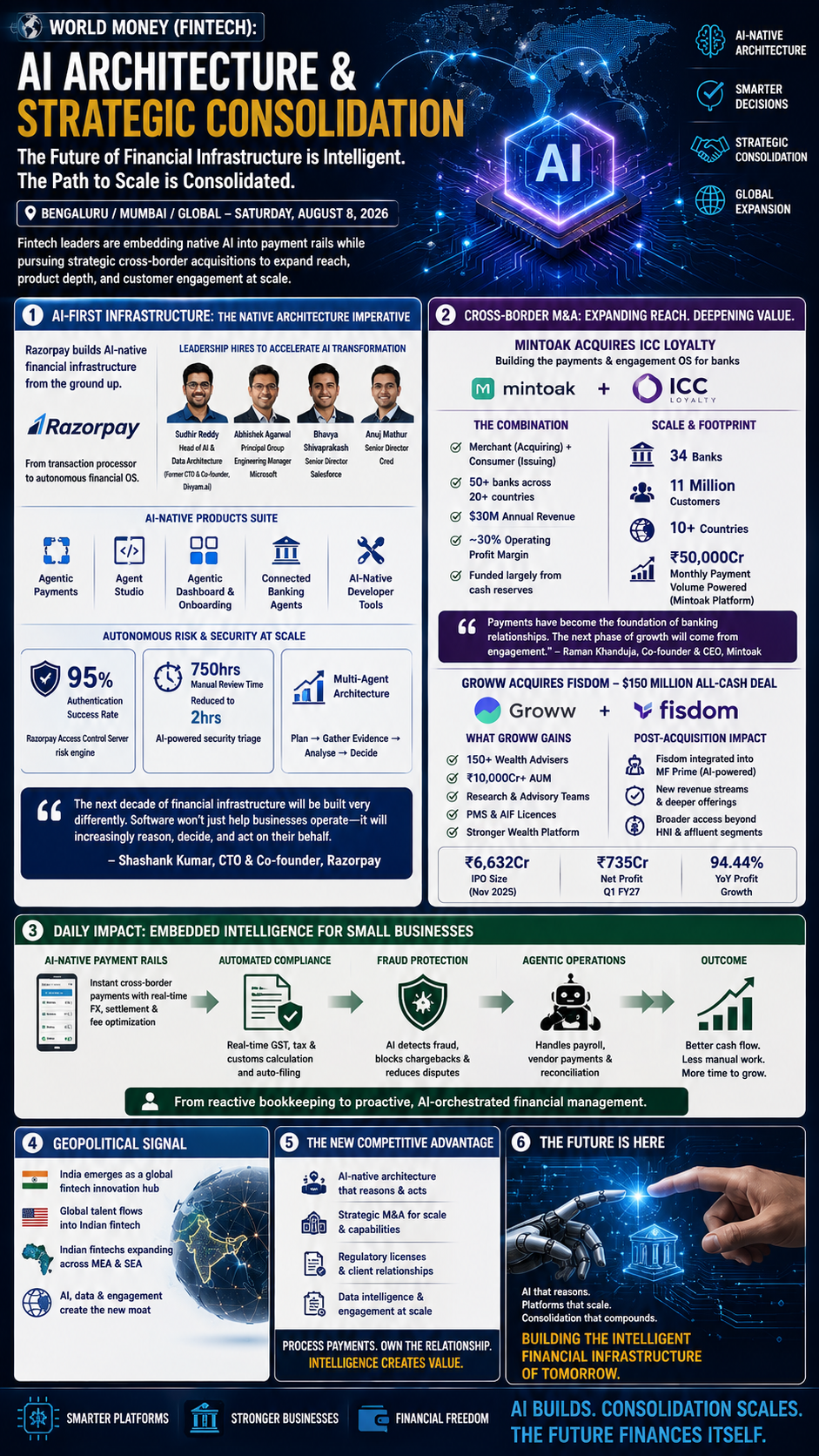
Major payment processors are fundamentally rewiring their technology stacks, moving beyond bolted-on machine learning features toward native AI architectures designed from the ground up for automated decision-making. Razorpay has emerged as the most aggressive exponent of this shift, hiring four senior engineering executives from Microsoft, Salesforce, Cred, and Divyam.ai to accelerate its transition to an AI-first financial infrastructure platform. The hires reflect a deliberate strategy where payment systems increasingly make decisions rather than simply process transactions. Sudhir Reddy, former CTO and co-founder of Divyam.ai, joins to lead AI and data architecture, bringing nearly two decades of experience building large-scale AI platforms at Flipkart, Yahoo, and Symantec. He is joined by Abhishek Agarwal, formerly a principal group engineering manager at Microsoft in Seattle; Bhavya Shivaprakash, formerly a senior director at Salesforce; and Anuj Mathur, formerly a senior director at Cred.
The engineering build-out began in September 2025 and has already produced a suite of autonomous financial products, including Agentic Payments, Agent Studio, Agentic Dashboard and Onboarding, Connected Banking Agents, and a growing portfolio of internal AI-native developer tools. These systems enable automated risk scoring through multi-agent architectures that separate planning, evidence gathering, and analysis into specialised roles. Razorpay's Access Control Server risk engine now achieves up to 95 percent authentication success while keeping fraud losses within acceptable limits, and its AI-powered security triage has reduced manual review time from 750 hours to just two hours. Razorpay CTO and co-founder Shashank Kumar framed the ambition in sweeping terms: "The next decade of financial infrastructure will be built very differently from the last. We believe software won't just help businesses operate—it will increasingly reason, decide, and act on their behalf". Senior vice president of engineering Praburam Rambadran added that the company hired for depth—"people who've actually shipped AI in high-stakes environments and know where it breaks".
CROSS-BORDER M&A: Strategic Consolidation Across Payments and Wealth
While Razorpay builds its AI architecture through talent acquisition, other fintechs are pursuing growth through strategic M&A that expands both geographic footprint and product breadth. Mintoak, the Bengaluru-based merchant payments software company, has acquired Dubai-headquartered ICC Loyalty in a largely cash-funded deal, adding consumer rewards technology to its bank platform as it expands across West Asia and Africa. The acquisition was funded predominantly from Mintoak's cash reserves with a small debt component, and it brings together two complementary sides of banking: Mintoak operates on the merchant (acquiring) side, supplying white-label software that lets lenders accept payments and cross-sell financial products to small businesses, while ICC operates on the consumer (issuing) side, powering credit card loyalty programmes for 34 banks and 11 million customers across more than 10 countries.
The combined business generates approximately $30 million in annual revenue with an operating profit margin around 30 percent. Mintoak's platform already powers close to Rs 50,000 crore of monthly payment volume for banks including HDFC Bank, Axis Bank, and SBI Payments, while ICC's clients include Emirates Islamic and RAKBANK. Following the acquisition, Mintoak now works with more than 50 banks across more than 20 countries. Co-founder and CEO Raman Khanduja described the strategic rationale in terms that echo the broader industry pivot toward engagement over pure processing: "Payments have become the foundation of banking relationships. The next phase of growth will come from engagement. By bringing together merchant engagement, customer loyalty and data-driven intelligence, we are building a payments and engagement OS that enables banks to create greater value". ICC Loyalty CEO Amit Narang added that integrating with Mintoak would enable the combined entity to leverage AI for next-generation hyper-personalisation.
In the wealth management sector, Groww has finalized its $150 million all-cash acquisition of Fisdom, one of the largest consolidation deals in India's wealthtech space. The deal, signed in May 2025 and closed in October, brought Groww more than 150 wealth advisers, over Rs 10,000 crore in assets under management, research and advisory capabilities, and licences spanning portfolio management services and alternative investment funds. Fisdom's research and advisory teams have since been folded into MF Prime, Groww's AI-powered mutual fund recommendation engine, opening up new revenue streams while extending research-led wealth management beyond affluent and high-net-worth customers. Following a planned one-year integration, Fisdom co-founders Subramanya S.V. and Anand Dalmia are now set to exit the business, with Groww's own founders taking a more hands-on role in the wealth management division. Groww's parent entity, BillionBrains Garage Ventures, launched its Rs 6,632 crore IPO in November 2025 and posted a consolidated net profit of Rs 735 crore for the first quarter of FY27, a 94.44 percent year-on-year jump.
DAILY ROUTINE IMPACT: Embedded Intelligence for Small Business
For small business owners and entrepreneurs, the convergence of AI-native architecture and strategic consolidation translates into a tangible upgrade in daily financial operations that would have seemed futuristic just three years ago. Embedded digital payment rails now clear cross-border supplier invoices instantly while simultaneously executing real-time tax compliance, eliminating the multi-day settlement windows and manual reconciliation that traditionally consumed hours of administrative work each week. A Bengaluru-based apparel exporter can pay a Vietnamese fabric supplier, calculate applicable GST and customs duties, and file the requisite returns—all within the same payment flow, without switching between banking, accounting, and tax portals. The same AI engines that score transaction risk in milliseconds now power automated fraud detection that protects small merchants from chargebacks and payment disputes, while agentic systems handle payroll, vendor payments, and compliance reporting without requiring business owners to navigate complex banking interfaces. For the millions of SMEs served by platforms like Razorpay and Mintoak, financial operations are shifting from reactive bookkeeping to proactive, AI-orchestrated cash-flow management—a transformation that frees entrepreneurs to focus on their core business rather than the plumbing of payments and reconciliation.
Geopolitically, these developments signal India's emergence as a global fintech laboratory where AI-native architecture and strategic M&A are being tested at scale, with implications that extend far beyond the subcontinent. The Razorpay hiring spree from global technology giants reflects a broader talent that is concentrating AI engineering expertise in Bengaluru's fintech ecosystem, while the Mintoak-ICC merger and Groww-Fisdom consolidation demonstrate how Indian fintechs are using their domestic scale to acquire complementary assets across the Middle East, Africa, and Southeast Asia. As payment processing becomes increasingly commoditised, the competitive moat now lies in engagement, intelligence, and monetisation of transaction data—capabilities that require both elite AI talent and the regulatory licences and client relationships that come with strategic acquisitions. The next phase of fintech growth will be built not by software that merely processes, but by AI that reasons, decides, and acts on behalf of businesses—and the race to build that infrastructure is well underway.

Vishal Sable
B.Tech AD @ shri balaji institute of technology and management
Engineering and tech journalist. I love exploring the impact of emerging technologies on global defense, sovereignty, and everyday life. Always looking for the real story behind the headlines.