Back to News
News AlertWorld Money
AI Is Coming for the Debt Collector: YuVerse's 50% Claim
T
Author
Tushar Shrivas
Published
September 24, 2026
Reading Time
6 MIN READ
Spread the Word

YuVerse says its AI can deliver 50% higher collection efficiency than human telecallers. Here's what its “last-mile AI” actually does.
YuVerse AI, Yubi AI, AI debt collection India, AI financial telecallers, last-mile AI, AI collections, AI in banking 2026, agentic AI finance, YuVerse GFF 2026
AI Is Coming for the Debt Collector: YuVerse Claims 50% Higher Collection Efficiency
YuVerse AI, Yubi AI, AI debt collection India, AI financial telecallers, last-mile AI, AI collections, AI in banking 2026, agentic AI finance, YuVerse GFF 2026
AI Is Coming for the Debt Collector: YuVerse Claims 50% Higher Collection Efficiency
For years, banks and NBFCs have relied on human telecallers to chase overdue payments, follow up on loan applications and guide customers through repetitive financial processes. Now Yubi's AI arm, YuVerse, is taking that work into the last mile of financial operations, positioning AI agents as systems that can execute workflows rather than simply answer questions. At Global Fintech Fest 2026, the company showcased this strategy through four AI products covering document-to-decisioning, conversational AI, video creation and workflow automation. The Economic Times
What “Last-Mile AI” Actually Means
What “Last-Mile AI” Actually Means
YuVerse's idea is different from the typical AI chatbot. Its definition of “last-mile AI” focuses on putting AI directly inside business processes where work gets completed — from customer conversations and document processing to credit decisions and workflow execution. The company's platform currently includes voice AI for outbound collections and support, document intelligence, credit intelligence and workflow tools designed for financial institutions.
The distinction matters because financial institutions do not simply need an AI that can understand a borrower. They need systems that can take the next operational step. YuVerse's YuAccess, for example, processes documents such as bank statements, ITR, GST and KYC records, while its credit-intelligence tools are designed to turn financial and alternative data into credit-assessment outputs. YuVerse
The 50% Number Comes With an Important Asterisk
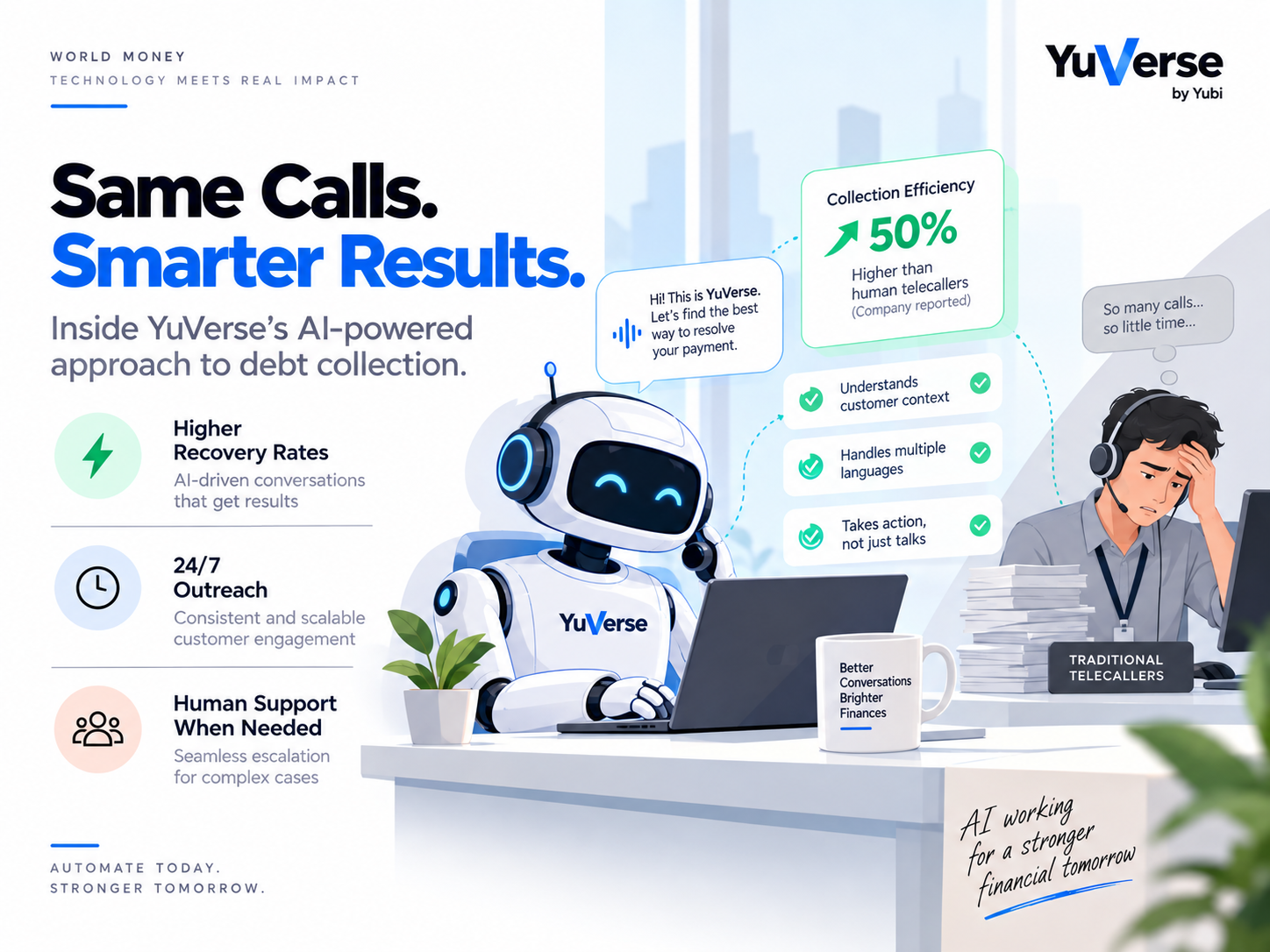
The headline number is significant, but it needs attribution. YuVerse CEO and co-founder Mathangi Sri Ramachandran said at GFF that collection efficiencies in many cases had increased by 50% over human agents. That is a company-reported performance claim, not an independently audited industry comparison, so the more accurate interpretation is that YuVerse says its AI collections deployments have outperformed human-agent efficiency in those cases.
YuVerse's own platform currently reports a 50%+ collection-efficiency uplift over human telecallers, alongside 25 million-plus voice calls per month across outbound and inbound AI agents. It also says its voice systems operate across more than 15 languages and can escalate conversations to humans when required. These figures come from YuVerse itself, so they should be viewed as company-reported operating metrics rather than independently verified market averages. YuVerse
From Collections to the Loan File
The bigger story is that YuVerse is not building AI only for debt recovery. Its document-to-decisioning technology is designed to analyse financial documents and identify information needed for underwriting and other financial decisions, while its conversational systems can operate across customer-facing channels. At GFF, the company presented this as part of a broader attempt to embed AI directly into financial workflows. The Economic Times
That shift could change where human employees spend their time. Instead of having staff manually make every reminder call, check every document or move information between systems, AI can handle repetitive stages and escalate exceptions. YuVerse's own case studies show examples of AI voice collections, automated financial-document processing and credit-assessment workflows being deployed across banks, NBFCs and fintechs.
Why This Is Bigger Than a Call-Centre Upgrade
The Bigger Picture for Financial AI
FAQ
The important development is not simply cheaper calling. It is the movement from AI that assists employees to AI that participates in the workflow itself. That is consistent with the broader direction of agentic AI discussed at GFF 2026, where the focus has shifted toward systems capable of sensing, deciding and acting within governed financial processes. KPMG
For customers, that could eventually mean fewer repetitive calls and faster resolution of routine financial tasks. A borrower who has missed a payment, for example, could interact with an AI voice system rather than waiting for a human agent to become available. But the quality of that experience will depend on how well financial institutions handle consent, escalation, transparency and sensitive customer information. India's financial-sector AI discussions are increasingly emphasizing governance and human oversight alongside automation. Express Computer
The Human Debt Collector Isn't Disappearing Yet
A 50% efficiency claim does not mean human collections teams are obsolete. Financial recovery involves disputes, hardship situations, complaints and cases where context matters more than a scripted workflow. YuVerse itself describes its voice AI as capable of escalating conversations to humans, suggesting a model where automation handles scale while people deal with exceptions and more complicated interactions.
The more interesting question is therefore not whether AI will eliminate every telecaller. It is how much of the financial workflow can be automated before a human needs to step in. If AI can handle millions of routine interactions while humans focus on exceptions, the economics of collections and lending operations could change substantially. YuVerse's “last-mile AI” strategy is essentially a bet that the biggest gains will come not from making AI smarter in the abstract, but from making it operationally useful.
The Bigger Picture for Financial AI
YuVerse's launch comes as financial institutions are moving beyond experiments with generative AI toward systems that can perform specific operational tasks. At GFF 2026, YuVerse presented four products aimed at bringing AI into document processing, conversations, video production and workflow automation. That makes the company's strategy less about building another general-purpose chatbot and more about embedding specialized AI into the machinery of financial services. The Economic Times
The 50% figure will ultimately matter less than whether those gains survive at scale, across different borrowers, languages, institutions and regulatory environments. If they do, the financial industry's AI race may not be won by the model that produces the smartest answer. It could be won by the systems that can complete the most real financial work with the fewest human interventions — while still knowing when a human needs to take over. YuVerse — Last-Mile AI strategy
FAQ
What is YuVerse?
YuVerse is Yubi's AI company focused on applying AI to financial and business workflows, including conversational AI, document intelligence, credit intelligence and workflow automation.
Did YuVerse really report 50% higher collection efficiency?
Yes. YuVerse's CEO said collection efficiency had increased by 50% over human agents in many cases, and the company's website currently reports a 50%+ collection-efficiency uplift over human telecallers. This is a company-reported figure, not an independently audited industry benchmark.
Is YuVerse replacing all debt collectors?
No. The available evidence supports automation of collections workflows and human escalation when necessary, rather than the complete elimination of human collections employees.
What other financial tasks can YuVerse automate?
Its platform covers areas including document processing, credit intelligence, conversational AI, collections, customer engagement and workflow automation.

Tushar Shrivas
B.Tech CS@ Shri Balaji Institute of Technology & Management
I write at Metaplugs — breaking down the latest in tech, economics, and business into simple, impactful stories for everyday readers. Passionate about software testing and global finance.