Back to News
News AlertWorld Money
ECB Pontes Launch: Central Bank Money Goes On-Chain
T
Author
Tushar Shrivas
Published
September 24, 2026
Reading Time
5 MIN READ
Spread the Word
The ECB has launched Pontes, connecting tokenised financial markets with central bank money. Here's why it could reshape institutional blockchain settlement.
ECB blockchain, Pontes settlement, central bank money on blockchain, tokenised assets, ECB tokenisation, stablecoin settlement, DLT financial markets
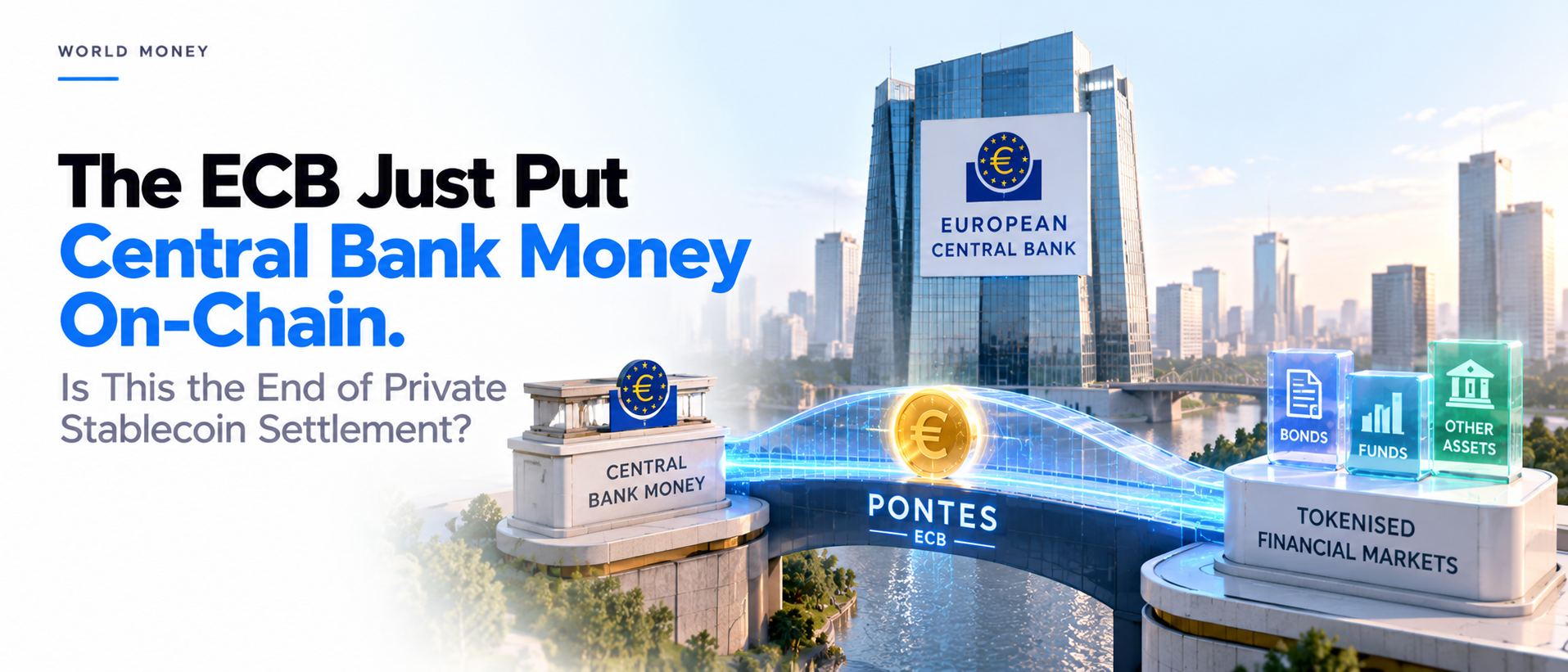
The ECB Just Put Central Bank Money On-Chain. Is This the End of Private Stablecoin Settlement?
Why Central Bank Money Matters
ECB blockchain, Pontes settlement, central bank money on blockchain, tokenised assets, ECB tokenisation, stablecoin settlement, DLT financial markets
The ECB Just Put Central Bank Money On-Chain. Is This the End of Private Stablecoin Settlement?
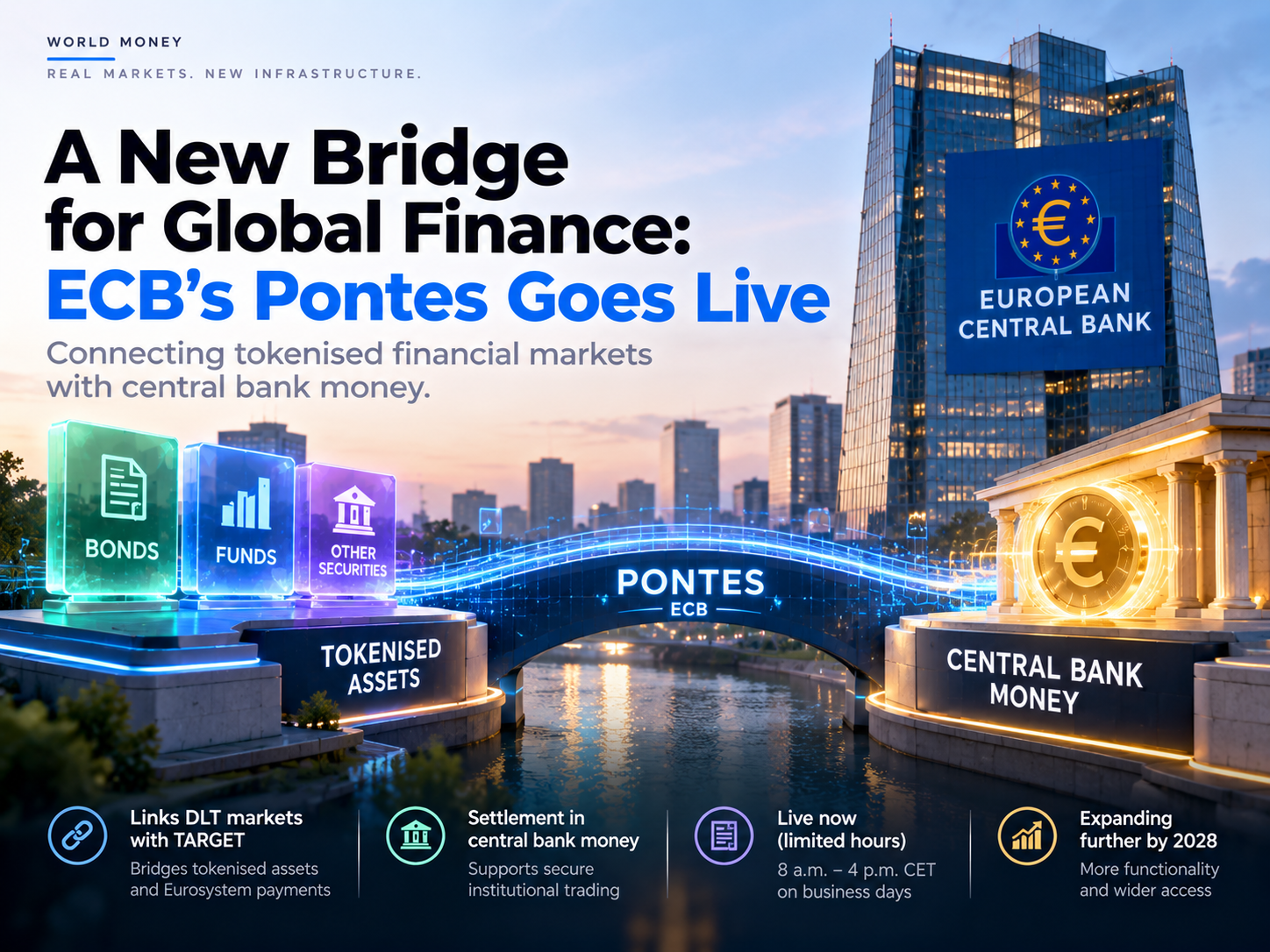
For years, tokenised financial markets faced a basic problem: what money should settle an on-chain trade? On September 21, 2026, the European Central Bank launched Pontes, a new Eurosystem service connecting distributed-ledger technology (DLT) market platforms with the existing TARGET payment infrastructure. It allows wholesale tokenised-asset transactions to settle in central bank money rather than relying solely on private digital settlement assets. European Central Bank ECB
Pontes is not a new cryptocurrency or an ECB-operated public blockchain. Instead, it acts as a bridge between DLT-based financial markets and the Eurosystem's payment infrastructure. The first participants include major financial institutions such as Deutsche Bank, Santander and Clearstream, alongside other banks and market infrastructures that completed onboarding for the launch. Euronext Reuters
Why Central Bank Money Matters
The distinction between private digital money and central bank money is important for institutional markets. When a tokenised bond or other digital security changes hands, the cash leg of the transaction still needs a settlement asset. Pontes is designed so that the cash side can settle in central bank money, while the asset remains on its respective DLT platform. That architecture can support delivery-versus-payment (DvP), where the asset and payment legs are synchronisation.
This gives institutions an alternative to settling tokenised transactions with privately issued stablecoins or other commercial forms of money. It does not, however, mean stablecoins are suddenly disappearing. The significance is that Europe's financial system now has an official infrastructure through which central bank money can interact with tokenised markets. AOL
The ECB Is Becoming a User Too
Pontes Is Live — But It Is Not 24/7 Yet
The ECB is not just building the infrastructure and watching from the sidelines. It has also announced preparations to invest a small portion of its own funds in euro-denominated tokenised securities. The initial focus will be securities issued by euro-area governments, regional governments, agencies and European supranational institutions, with purchases intended to settle through Pontes. ECB
That is significant because it gives the central bank direct practical experience with the technology it is trying to develop. The ECB says the investment programme will allow it to learn about the complete lifecycle of tokenised securities, including trade execution, settlement and portfolio management. In other words, the central bank is testing the infrastructure as a market participant, not just as a regulator. CoinDesk
Pontes Is Live — But It Is Not 24/7 Yet
There is an important limitation behind the headlines. Pontes initially operates between 8 a.m. and 4 p.m. CET on business days. The ECB plans to expand its functionality and operating hours over time, with the broader implementation targeted for 2028. So Europe's on-chain financial infrastructure has gone live, but it is still being built out.
Reuters
Reuters
The project also builds on earlier experimentation. Clearstream participated in testing ahead of the launch, including work focused on interoperability and DvP settlement in central bank money. Those tests were intended to validate connectivity and settlement processes between traditional market infrastructure and DLT-based systems. Clearstream
The Bigger Bet
FAQ
The real story behind Pontes is therefore not that the ECB has suddenly “put the euro on a blockchain.” It has created a settlement bridge between central bank money and tokenised financial markets. If tokenised bonds, funds and other securities expand, this infrastructure could allow them to operate with the same central-bank settlement anchor used by traditional wholesale markets.
That could become important for the future of institutional finance. Tokenisation promises more automation and potentially faster processing, but technology alone cannot create a functioning market. Institutions also need trusted settlement, interoperability and liquidity. Pontes does not guarantee that tokenisation will succeed; it removes one major infrastructure barrier to its expansion. The next test is whether banks, exchanges and investors actually move meaningful volumes of assets onto these systems. FinTech Weekly
FAQ
What is ECB Pontes?
Pontes is a Eurosystem settlement service connecting DLT-based financial market platforms with TARGET Services so wholesale tokenised transactions can settle in central bank money.
Is Pontes a blockchain?
No. Pontes connects existing DLT platforms with the Eurosystem's payment infrastructure. It is a settlement bridge, not a public blockchain or cryptocurrency.
Does Pontes replace stablecoins?
Not immediately. Stablecoins and other private settlement assets can continue to exist. Pontes provides institutions with another settlement option based on central bank money.
When did Pontes launch?
The ECB launched Pontes on September 21, 2026. Its functionality and operating hours are expected to expand toward 2028.

Tushar Shrivas
B.Tech CS@ Shri Balaji Institute of Technology & Management
I write at Metaplugs — breaking down the latest in tech, economics, and business into simple, impactful stories for everyday readers. Passionate about software testing and global finance.