Back to News
News AlertWorld Money
UPI Merchant Fees Are Coming. Will They Push India to e-Rupee?
T
Author
Tushar Shrivas
Published
September 19, 2026
Reading Time
6 MIN READ
Spread the Word
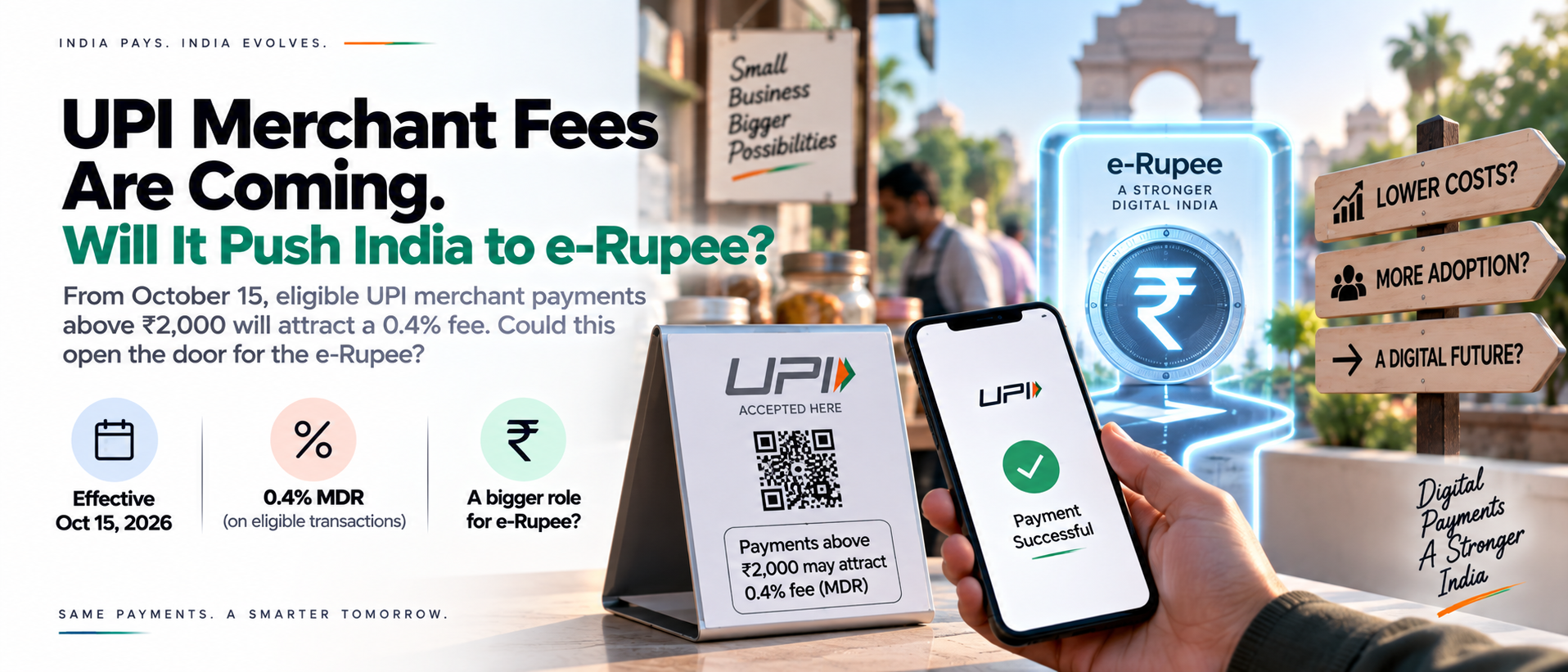
A 0.4% UPI merchant fee starts October 15. Here's why it could open a door for e-Rupee — and why adoption still hasn't followed.
UPI Merchant Discount Rate 2026, e-Rupee CBDC India, UPI 0.4% fee October 2026, digital rupee offline wallet, RBI CBDC adoption, UPI vs CBDC
India's New UPI Merchant Fee Is Coming. Could It Finally Push India Toward e-Rupee?
Starting October 15, selected UPI merchant payments above ₹2,000 will carry a new Merchant Discount Rate (MDR). Consumers themselves will not be charged, but eligible merchants will face a 0.4% fee, capped at ₹300 for transactions of ₹75,000 or more. Whether that creates an opening for the RBI's e-Rupee, though, is a separate question — and right now, there is no evidence of a meaningful shift.
NPCI confirmed in mid-September that a 0.4% MDR will apply to select UPI person-to-merchant (P2M) transactions above ₹2,000, effective October 15, 2026. The fee is capped at ₹300 for transactions of ₹75,000 or more. Consumers and peer-to-peer transfers remain free, while small merchants receiving up to ₹1 lakh per month through UPI QR payments are exempt from MDR. Certain sectors, including fuel, railways, telecom and insurance, have separate fee structures. Moneycontrol
This is a real reversal of longstanding policy. The government eliminated MDR on UPI and RuPay debit transactions in January 2020 to accelerate digital-payment adoption. The new framework brings merchant-side charges back for selected transactions from October 15, although the government has directed banks and payment providers not to pass the MDR on to consumers. Reuters
Here's Where the "Mass e-Rupee Adoption" Claim Breaks Down
It's worth being direct about this: there is no public data currently showing merchants or consumers shifting to e-Rupee because of the MDR change — mainly because the new MDR has not taken effect yet, and e-Rupee adoption remains much smaller than UPI. The two systems operate at very different scales, with UPI processing billions of transactions each month while retail CBDC usage remains comparatively limited.
What's real is the structural argument for why e-Rupee could benefit. UPI is a payment system that moves money between bank accounts through the banking and payments ecosystem, while the e-Rupee is a digital form of central-bank money issued by the RBI and held through participating wallets. That gives the CBDC a different settlement structure from UPI. However, the absence of MDR on e-Rupee should not be treated as an automatic cost advantage for every merchant, because wallet providers and participating institutions still form part of the CBDC ecosystem. Digital Rupee
What's Actually Live vs. What's Still a Roadmap Item
Some real e-Rupee progress has genuinely happened — just not as a response to this MDR announcement. MobiKwik and Cred became among the first non-bank platforms to launch e₹ wallets in January 2025, with MobiKwik working with the RBI and Yes Bank as its banking partner. The e-Rupee ecosystem has also been designed to work with existing merchant infrastructure, including UPI QR interoperability, reducing the need for merchants to install completely separate hardware.
The RBI has also been testing broader CBDC capabilities, including offline functionality and programmability, but these should be described as development and pilot areas rather than as a confirmed 2028–2032 rollout schedule. The RBI has previously highlighted offline CBDC payments as a way to improve access in areas with weak connectivity and programmability as a potential tool for targeted government payments. The exact timing and scale of wider deployment remain subject to RBI decisions and further testing.
The Honest Version of This Story
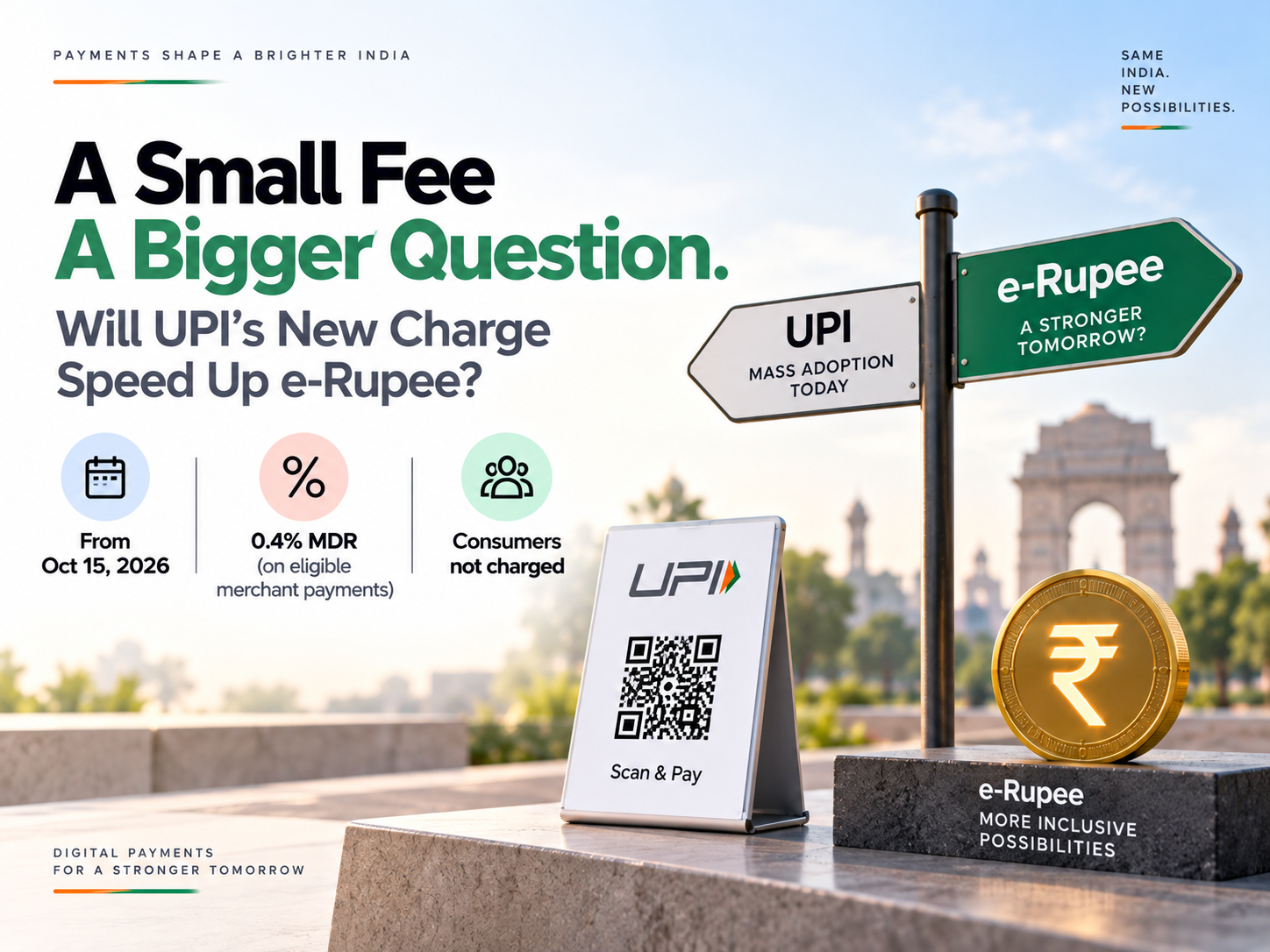
The MDR change is real, dated, and specific. The idea that it could eventually nudge some merchants toward an alternative digital payment rail is a reasonable hypothesis — particularly if merchants become more sensitive to payment-processing costs. But “could nudge” and “is currently triggering mass e-Rupee adoption” are very different claims, and only the first has a defensible basis right now.
There is already an early signal worth watching: some merchant groups and fuel retailers have said they may restrict UPI payments above ₹2,000 once the MDR takes effect because of the additional cost. That does not mean they will move to e-Rupee; cash, cards and other payment methods are also alternatives.
The thing actually worth watching over the next few months isn't a dramatic user migration — it's whether merchant awareness and usage of e-Rupee increase at all after October 15. If merchants begin looking for lower-cost digital alternatives, the CBDC will have an opportunity to prove whether its different architecture can translate into real-world adoption. Until then, the e-Rupee remains a potential beneficiary of the new UPI economics, not an established replacement.
FAQ
Is the 0.4% UPI merchant fee live now?
No. The new MDR framework takes effect October 15, 2026. Until then, the new 0.4% charge has not started.
Are consumers being charged this fee?
No. The 0.4% MDR applies to eligible merchant-side transactions. Consumers continue to use UPI without a direct transaction fee, and banks/payment providers have been instructed not to pass the MDR on to customers.
Are small merchants exempt?
Yes, under the new framework, merchants receiving up to ₹1 lakh per month through UPI QR payments qualify for the small-merchant exemption. This means an individual transaction above ₹2,000 does not automatically mean every merchant will pay MDR.
Is there evidence merchants are already switching to e-Rupee because of the fee?
No. The MDR has not started yet, so there is currently no evidence of a resulting migration to e-Rupee. Some merchant groups have discussed restricting higher-value UPI payments or returning to cash, but that is different from adopting CBDC.
Are offline rural wallets and programmable subsidies available nationwide now?
Not as a fully deployed nationwide replacement for UPI. Offline functionality and programmability are areas the RBI has explored and tested, but their wider rollout depends on further development, pilots and RBI decisions.

Tushar Shrivas
B.Tech CS@ Shri Balaji Institute of Technology & Management
I write at Metaplugs — breaking down the latest in tech, economics, and business into simple, impactful stories for everyday readers. Passionate about software testing and global finance.