Back to News
News AlertWorld Money
Bharat Connect Adds 5 Currencies: Is the Forex Kiosk Done?
T
Author
Tushar Shrivas
Published
September 17, 2026
Reading Time
6 MIN READ
Spread the Word
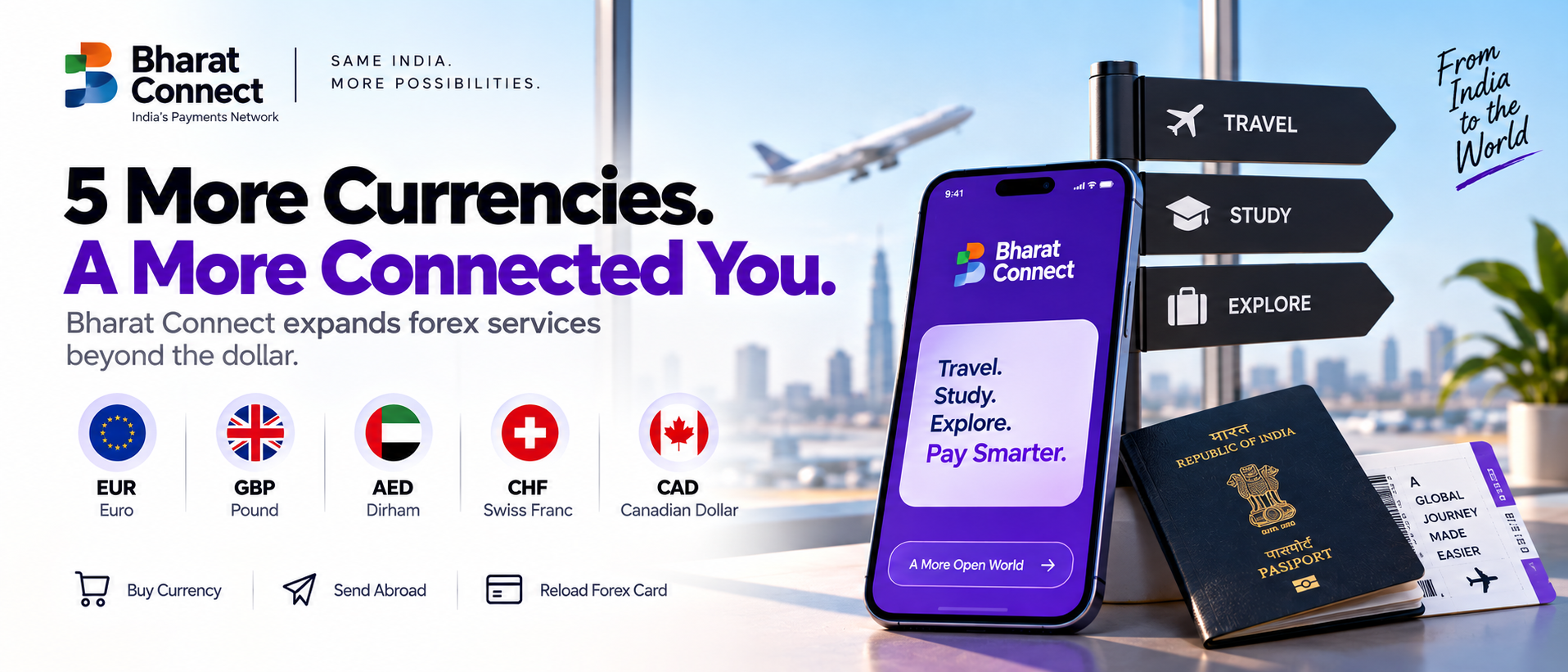
RBI soft-launched five new currencies on Bharat Connect's forex rail — euro, pound, dirham, franc, and CAD. Here's what's actually live today.
Bharat Connect multicurrency, FX-Retail NPCI, RBI forex Bharat Connect, forex card reload India, Bharat Connect currencies, NBBL FX-Retail, overseas remittance India digital
Bharat Connect Just Expanded Past the Dollar. Is the Forex Kiosk on Its Way Out?
Exchanging currency for international travel or overseas tuition has traditionally meant using a bank, forex provider or physical exchange counter. Now India's digital payments infrastructure is moving another part of that process online. On September 9, the Reserve Bank of India announced a multicurrency expansion of Bharat Connect's retail forex service, adding five currencies beyond the U.S. dollar. The important detail is that the service is still in a controlled-user-group (CUG) soft launch, rather than being universally available. Business Today
This Builds On Something That Already Existed
The new facility is an expansion of an existing Bharat Connect–FX-Retail integration. CCIL records show that Clearcorp's FX-Retail platform was integrated with NBBL's Bharat Connect in October 2025, allowing customers to onboard and book forex transactions through banking and third-party applications. The initial phase supported individual customers buying U.S. dollars digitally.
Business Standard
Business Standard
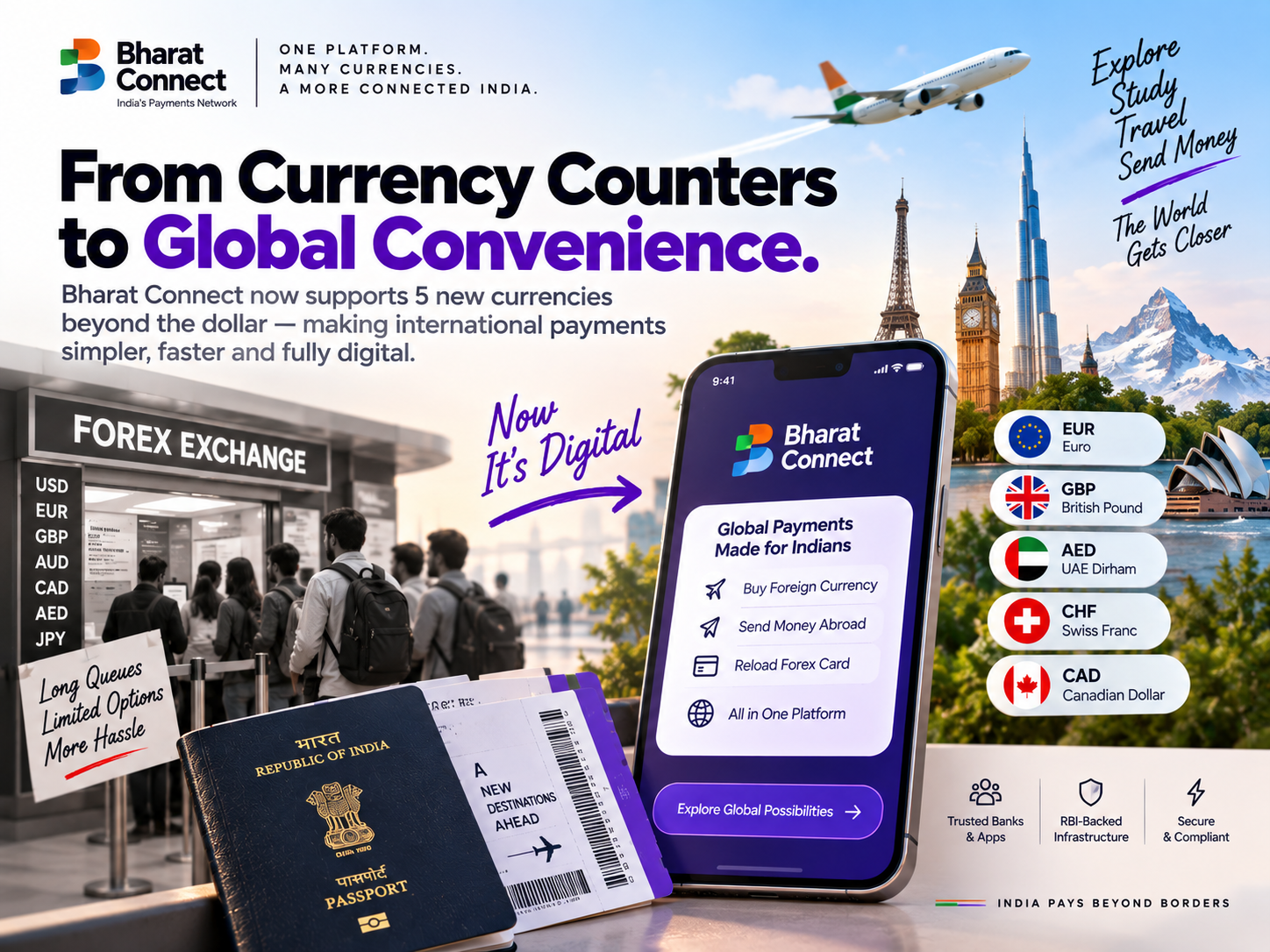
The new expansion adds the euro, British pound, Canadian dollar, Swiss franc and UAE dirham to the existing dollar offering. RBI has also indicated that additional currencies such as the Japanese yen, Australian dollar, Singapore dollar, Hong Kong dollar and New Zealand dollar are planned for the broader FX-Retail expansion. Economic Times
How the New Currencies Actually Work
The technology stack is relatively straightforward. Bharat Connect, operated by NPCI Bharat BillPay, provides the digital customer-access layer, while FX-Retail is operated by Clearcorp Dealing Systems, a wholly owned subsidiary of the Clearing Corporation of India. The platform provides access to forex pricing, while participating relationship banks handle fulfilment. Outlook Money
During the current soft-launch phase, customers can use participating Bharat Connect channels for foreign-currency purchases, overseas remittances and forex-card reloads. Participating channels and banks include MobiKwik, BHIM, bob World, PNB, Federal Bank, SBI and Axis Bank, with PNB, SBI, Axis Bank, Bank of Baroda and Federal Bank among the fulfilment banks. Greater Kashmir
There is already evidence that the underlying service has some usage. According to reporting on the RBI announcement, forex transactions through Bharat Connect crossed ₹10 crore between April and July 2026. That is still small relative to India's overall retail payments and foreign-exchange market, but it gives the multicurrency expansion an existing transaction base rather than making it a completely new experiment.
Why This Matters for Everyday Users
The potential benefit isn't that Bharat Connect magically removes the cost of foreign exchange. The more concrete change is access and convenience: instead of starting a separate forex process, eligible users can access the service through participating digital channels, with pricing connected to the FX-Retail infrastructure and fulfilment handled by their relationship bank. Axis Bank
That could matter for several ordinary use cases. A student sending money for education, a traveller loading a forex card or a customer making an eligible overseas remittance could potentially begin the transaction through a familiar digital channel instead of navigating a completely separate forex platform. The service still operates within existing KYC, purpose-code and foreign-exchange regulations, so digital access does not mean regulatory requirements disappear.
The Bigger Shift Is Infrastructure, Not Just Five Currencies
The five new currencies are the headline, but the more interesting development is the attempt to connect retail forex with India's existing digital-payment distribution network. Bharat Connect already provides a common digital interface for participating financial-service providers; linking it with FX-Retail extends that model into foreign-exchange transactions.
That doesn't mean the traditional forex counter disappears tomorrow. Cash requirements, bank relationships, compliance checks and different exchange-rate spreads will continue to matter. But if more currencies, banks and digital channels are added, the balance could gradually shift from “where do I buy foreign currency?” to “which digital channel gives me the best available rate and fulfilment?”
What Happens Next
The most important number to watch isn't the five-currency count. It's how quickly the CUG expands into wider availability. NBBL said the multicurrency service is proposed to be extended to additional Bharat Connect channels and participating banks after the CUG phase is completed and assessed. No specific date for universal availability has been announced. Business Today
For now, the forex kiosk isn't obsolete. But India's digital payments infrastructure has started connecting another traditionally separate financial service to the same ecosystem — and if the pilot scales, buying, loading and sending foreign currency could become much more of a digital banking workflow than a separate forex transaction.
FAQ
Is Bharat Connect's multicurrency forex service available to everyone right now?
No. It was soft-launched through a Controlled User Group (CUG). Wider availability is proposed after the testing phase is assessed.
Which five currencies were added?
The new currencies are the euro (EUR), British pound (GBP), Canadian dollar (CAD), Swiss franc (CHF) and UAE dirham (AED). The U.S. dollar was already supported.
Is this a completely new forex platform?
No. It expands the existing Bharat Connect–FX-Retail integration, which began with U.S.-dollar transactions in 2025.
What can users do through the service?
Participating channels support foreign-currency purchases, overseas remittances and forex-card reloads, subject to the applicable bank and regulatory requirements.
Does Bharat Connect eliminate forex fees or exchange-rate spreads?
No such blanket claim has been announced. The platform provides digital access to the forex process; applicable rates, bank charges and other transaction conditions still depend on the service and participating bank.
Is the forex kiosk finished?
Not yet. The multicurrency service is still in a limited CUG phase. Its significance is that India is testing whether retail forex can increasingly be delivered through existing digital-payment infrastructure rather than separate channels.

Tushar Shrivas
B.Tech CS@ Shri Balaji Institute of Technology & Management
I write at Metaplugs — breaking down the latest in tech, economics, and business into simple, impactful stories for everyday readers. Passionate about software testing and global finance.