Back to News
News AlertWorld Money
Amazon Now Hits $1B: Is Quick Commerce Beating E-Commerce?
T
Author
Tushar Shrivas
Published
September 15, 2026
Reading Time
5 MIN READ
Spread the Word
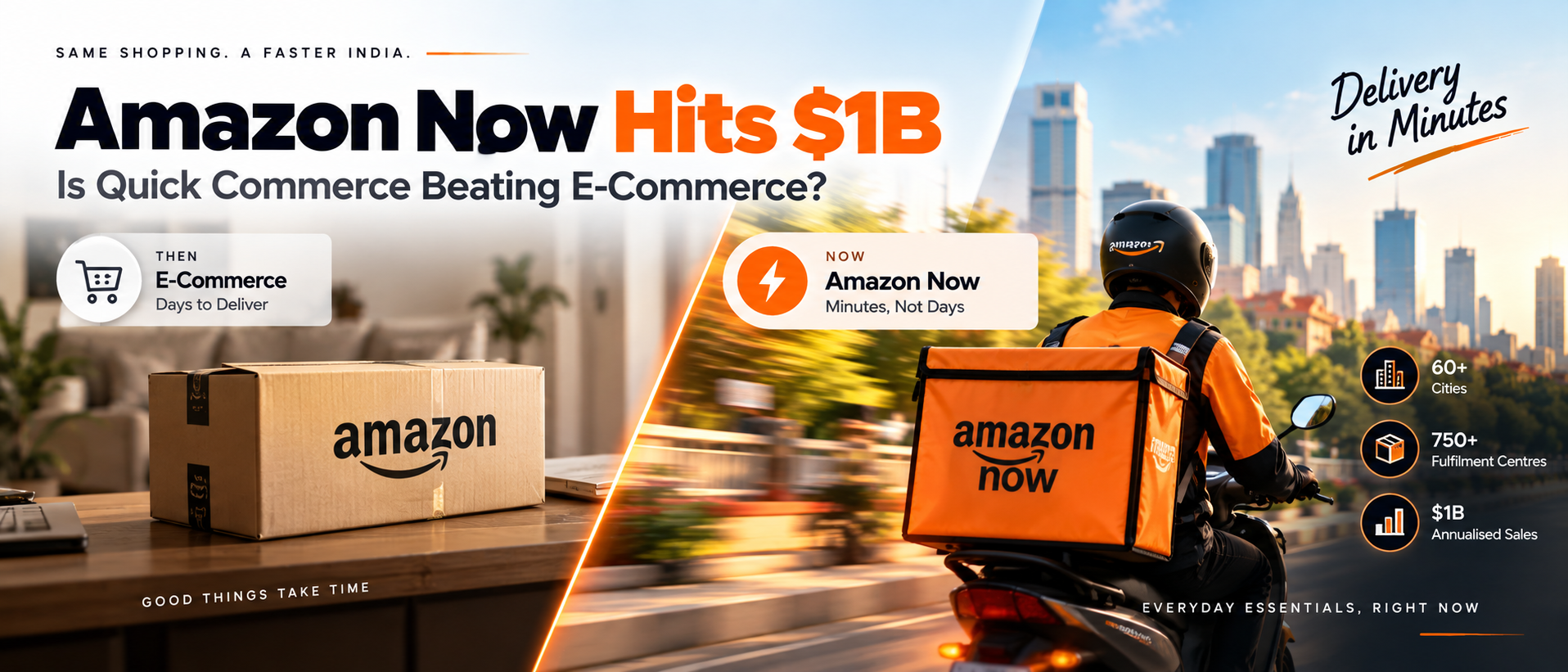
Amazon Now crossed $1B in annualised sales in just three months and 60+ Indian cities. Here's what the numbers actually show — and what they don't.
Amazon Now India, quick commerce vs e-commerce, Blinkit Zepto Swiggy Instamart, India quick commerce market size, Amazon Now cities, dark stores India
Amazon Now Crosses $1 Billion in India as Quick Commerce Muscles Into E-Commerce's Turf
We used to think two-day delivery was the finish line for online shopping. In India, Amazon's newest bet says the real race is measured in minutes, not days — and the early numbers back that up.
Amazon said on September 15 that its ultra-fast delivery service, Amazon Now, has reached $1 billion in annualised gross sales in India, based on its performance over the past three-month period — meaning if the current pace holds for a full year, that's the run-rate it would generate. Orders have doubled every quarter since launch, making it the fastest-growing e-commerce business unit in Amazon India's history. Business Standard
The expansion behind that number is aggressive by any standard: Amazon Now has grown to more than 60 Indian cities and towns in under 10 weeks — a fourfold increase — reaching well beyond metros into towns like Padubidri, Gurdaspur, Jalandhar, Vellore, Dharwad, and Berhampur ahead of the festive season. Deccan Herald
The Infrastructure Behind the Speed
That reach is built on a genuinely large physical network: over 750 micro-fulfilment and urban fulfilment centres positioned close to the neighbourhoods they serve, allowing inventory to sit nearer to customers before an order is placed. Entrepreneur India
People familiar with the business told Business Standard that Amazon Now's average order value sits around ₹540 (roughly $6.50), with the service handling about 700,000 orders a day — giving it an estimated 10% market share by order volume and 14% by value in India's quick-commerce category.
This Isn't Amazon Inventing the Shift — It's Amazon Catching Up
It's worth being precise here: Amazon didn't create India's quick-commerce boom. Blinkit, Zepto, Swiggy Instamart, and Flipkart Minutes were already fighting for this market before Amazon Now scaled up, and Amazon's entry intensifies an existing fight rather than starting a new one. Samir Kumar, Amazon India's country manager, said the company is "on track to expand to 100 cities by Diwali," part of a plan first announced in June 2026 to eventually reach more than 300 cities nationwide. Outlook Business
That distinction matters for how big this trend really is. India's broader e-commerce sector — of which quick commerce is a fast-growing slice — is projected to nearly triple to $345 billion by 2030, up from $125 billion in 2024. Quick commerce is a major driver of that growth, but the underlying data describes an expanding market, not one channel wholesale replacing another.
What's Actually Changing for Consumers
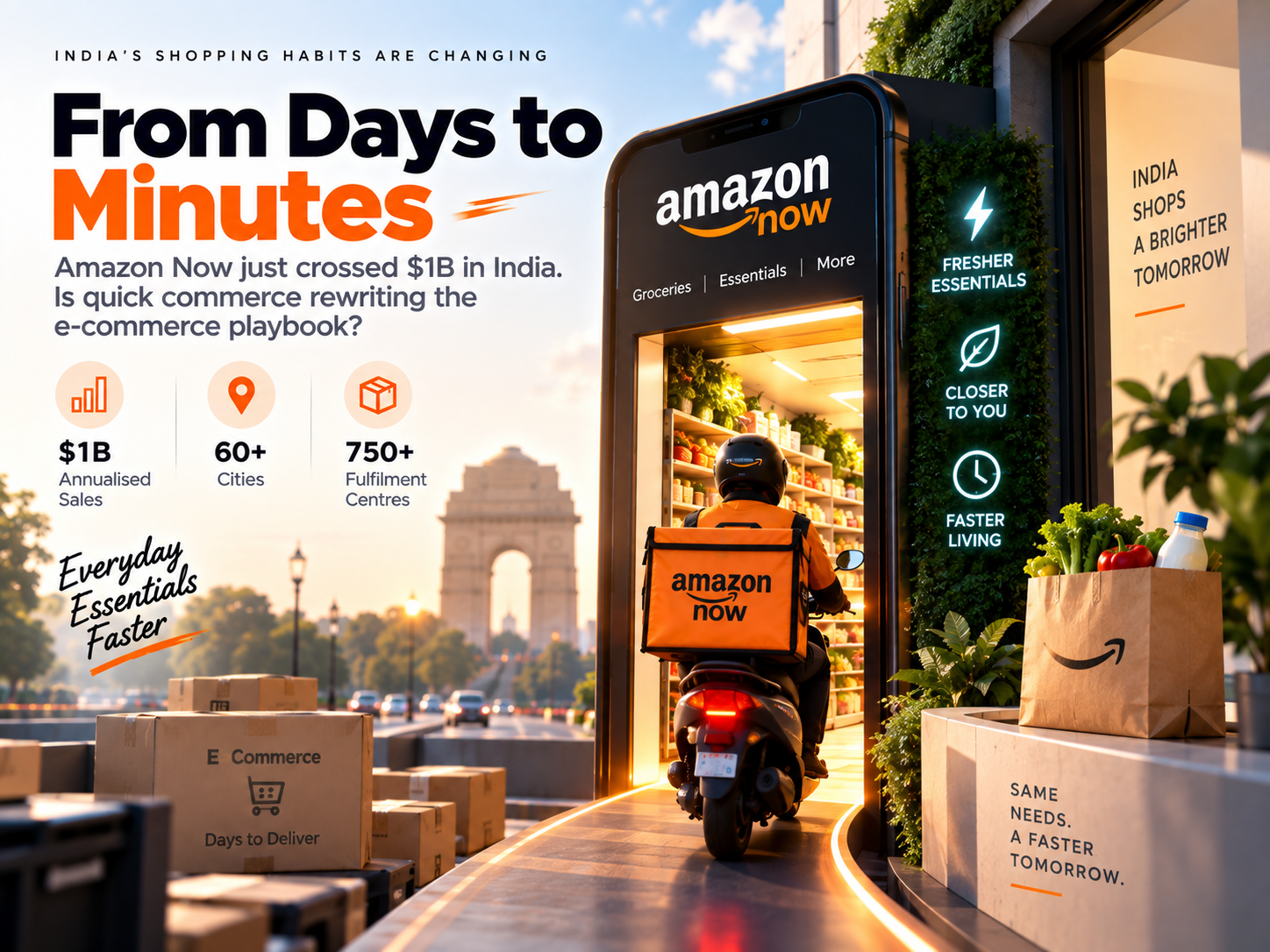
Amazon itself describes the service as "delivery-in-minutes" — the company hasn't published a specific, guaranteed delivery-time SLA like "15 minutes," so it's worth not overstating the precision of that number. What is measurable is the infrastructure shift: Amazon's micro-fulfilment centres are positioned closer to the neighbourhoods they serve, putting inventory nearer to customers before an order is placed. That setup can support more frequent, smaller, immediate-need purchases rather than only larger, planned shopping trips.
The Open Questions
The $1 billion milestone confirms Amazon Now's growth rate, but plenty about the model remains unresolved. What isn't yet clear from public data is how this pace of expansion will affect commercial rents in the neighbourhoods these fulfilment centres cluster into, delivery-worker conditions and pay, municipal traffic and zoning pressure, and — perhaps most importantly for investors — the actual contribution margin per order once discounting and rider incentives are accounted for.
Reaching 100 cities by Diwali without a visible drop in delivery-speed claims — while rivals defend their strongest markets rather than matching Amazon city-by-city — is the thing to actually watch next, more than the headline billion-dollar number itself.
FAQ
Is this a global Amazon milestone or India-specific?
India-specific. Amazon Now is Amazon's ultra-fast delivery service in India, and the $1 billion annualised gross sales figure applies only to the Indian market.
Does "$1 billion in annualised gross sales" mean Amazon Now already made $1 billion?
No. It means Amazon Now's sales pace over the last three months, if it continued for a full year, would produce $1 billion — it's a run-rate projection, not a trailing 12-month revenue figure.
Does Amazon guarantee 15-minute delivery?
Amazon describes the service as "delivery-in-minutes" but hasn't published a specific guaranteed delivery-time SLA, so a precise number like "15 minutes" isn't something the company has confirmed.
Is quick commerce actually replacing traditional e-commerce in India?
Not based on current data. India's overall e-commerce market is projected to nearly triple by 2030, with quick commerce as a fast-growing segment within that larger market — the data shows an expanding pie, not one channel replacing another.

Tushar Shrivas
B.Tech CS@ Shri Balaji Institute of Technology & Management
I write at Metaplugs — breaking down the latest in tech, economics, and business into simple, impactful stories for everyday readers. Passionate about software testing and global finance.