Back to News
News AlertWorld Money
The Checkout Button Is Dying — And an Indian Fintech Just Proved It, One Flight Booking at a Time
S
Author
Saumya Dawande
Published
September 18, 2026
Reading Time
4 MIN READ
Spread the Word
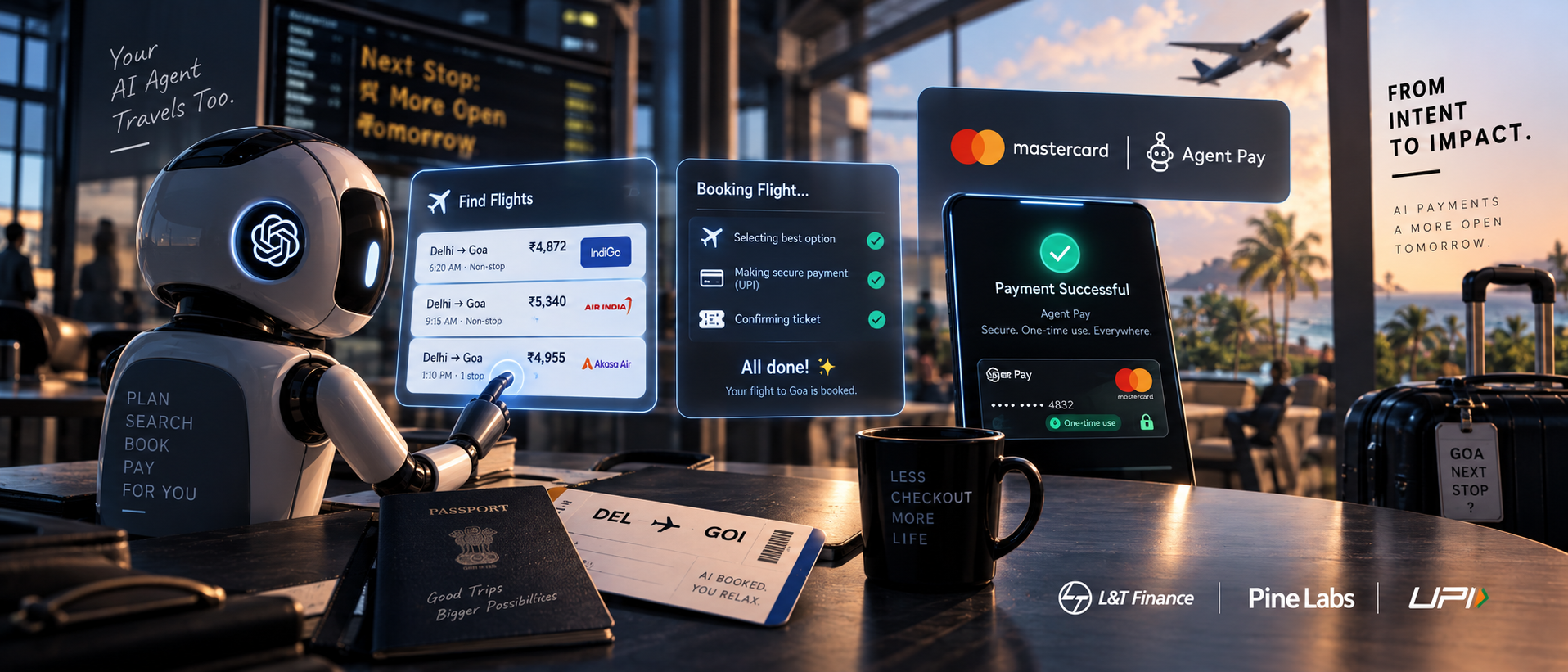
Mastercard just launched agent-ready payment credentials today. Days earlier, an Indian NBFC quietly let AI agents book flights on UPI — no human checkout required
Today, September 17, Mastercard and blockchain infrastructure firm Alchemy announced Mastercard Agent Pay, a system that gives AI agents their own identity, wallet, and one-time-use Mastercard credentials to buy things anywhere Mastercard is accepted — no human typing a card number required. Alchemy's own framing was blunt: "The checkout button is dying." Mastercard says roughly 132 million consumers already use AI in some part of their shopping process. PYMNTS ,
That's the global headline. But the more concrete proof that this isn't just a press release came nine days earlier, out of Mumbai. At Global Fintech Fest 2026, L&T Finance and Pine Labs announced they're integrating an "Agentic Storefront" into L&T Finance's PLANET app — and the very first thing it's built to do is book flight tickets autonomously. A user's AI agent searches, compares, and completes the purchase on their behalf, with the payment settled through Pine Labs' own protocol running over UPI. It's close to a direct real-world version of the "book me a flight to Goa under budget" example that gets used to explain agentic commerce — except this one is a live product from an Indian NBFC, not a hypothetical. Finextra , Hybiz
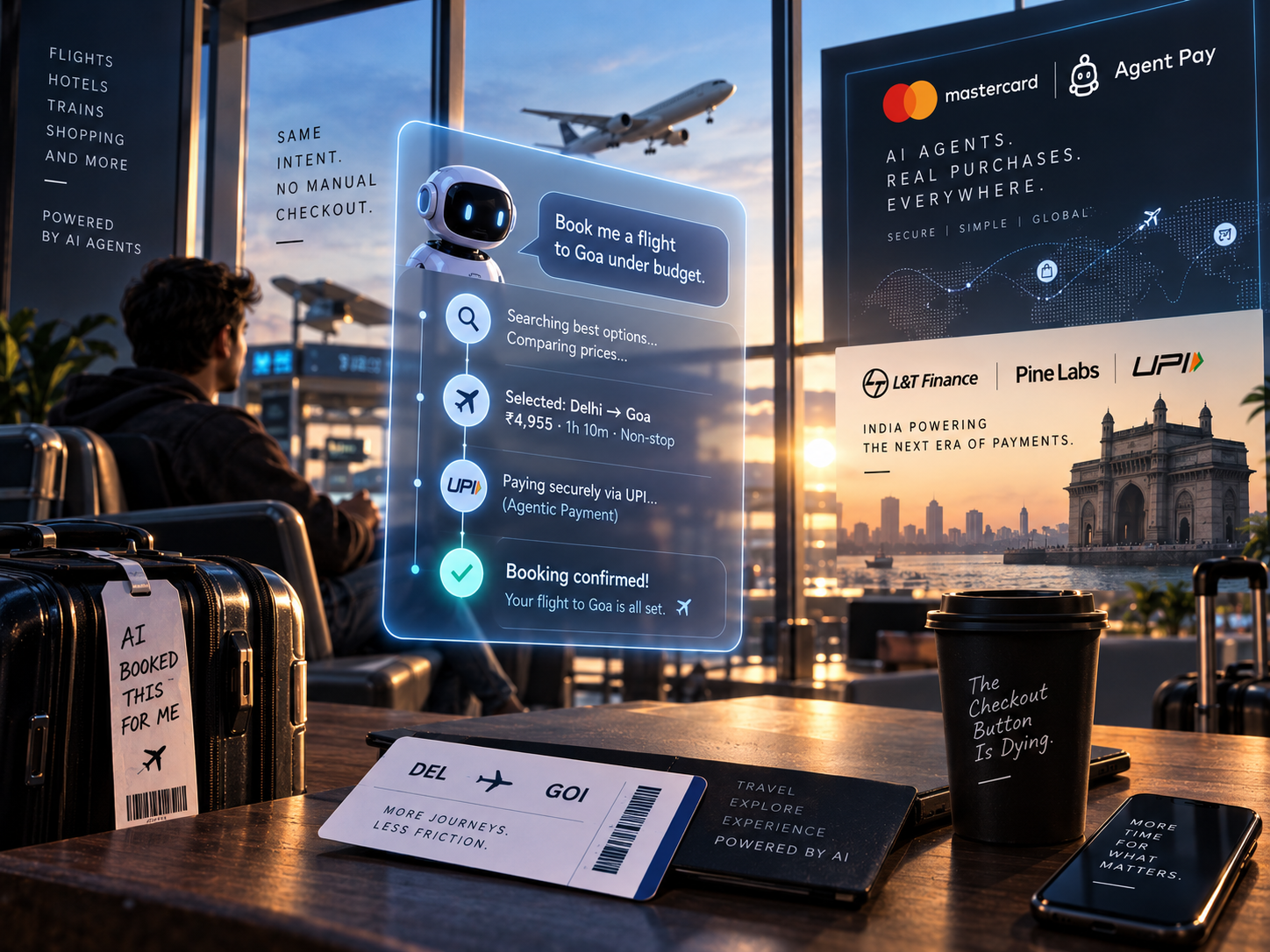
Both launches point at the same underlying shift: payments used to be the last step a human did by hand — typing a card number, hitting confirm — and every major rail is now racing to remove that step. Visa has Intelligent Commerce, Mastercard has Agent Pay, and OpenAI's Instant Checkout inside ChatGPT already lets users complete a purchase without leaving the chat, charging merchants a 4% fee on agent-led transactions. Two weeks before Mastercard's announcement, India signaled it wants a seat at the front of this race too: the National Payments Corporation of India was expected to unveil a Unified Agent Protocol at the same Global Fintech Fest, aimed at letting AI agents make small UPI payments autonomously under preset rules — which would make India one of the first countries with dedicated national infrastructure for agent-led payments rather than leaving it to individual banks and fintechs to build their own. IMF , IndianWeb2
The money behind this isn't speculative, either. Boston Consulting Group's most-cited projection puts AI agent-led shopping at over a quarter of all e-commerce spending within the next several years — a number payment networks are clearly treating as a land grab, which is why Visa, Mastercard, and Google are each pushing their own competing protocol rather than waiting to see which one wins. eMarketer
The catch is exactly the one security researchers keep raising: an agent empowered to transact on your behalf is also an agent that can be tricked into transacting on someone else's behalf, through something as simple as a manipulated web page or a poisoned instruction hidden in a product listing. Mastercard's answer, at least on paper, is architectural rather than just a policy promise — Agent Pay's one-time-use credentials mean a compromised agent session can't be replayed or reused for a second unauthorized charge, and identity is tied to the agent itself, not a reusable stored card number. Whether that actually holds up against real fraud attempts, rather than the demo, is the part regulators and banks are watching most closely. PYMNTS
For now, the honest state of things is a live pilot, not a takeover: L&T Finance's own announcement calls flight bookings "just the beginning," with other merchant categories still to come, and India's own agent-payment infrastructure is only weeks old. The open question isn't whether AI agents will eventually handle routine purchases — that pipeline is already being built out by NPCI, Mastercard, and Visa simultaneously. It's whether "one-time-use credentials" and "governed frameworks" are enough friction to keep a system built for convenience from becoming the easiest new target fraud has seen in years.

Saumya Dawande
B.Tech AIML @ oriental institute of science technology bhopal
Engineering and tech journalist. I love exploring the impact of emerging technologies on global defense, sovereignty, and everyday life. Always looking for the real story behind the headlines.