Back to News
News AlertWorld AI Tech
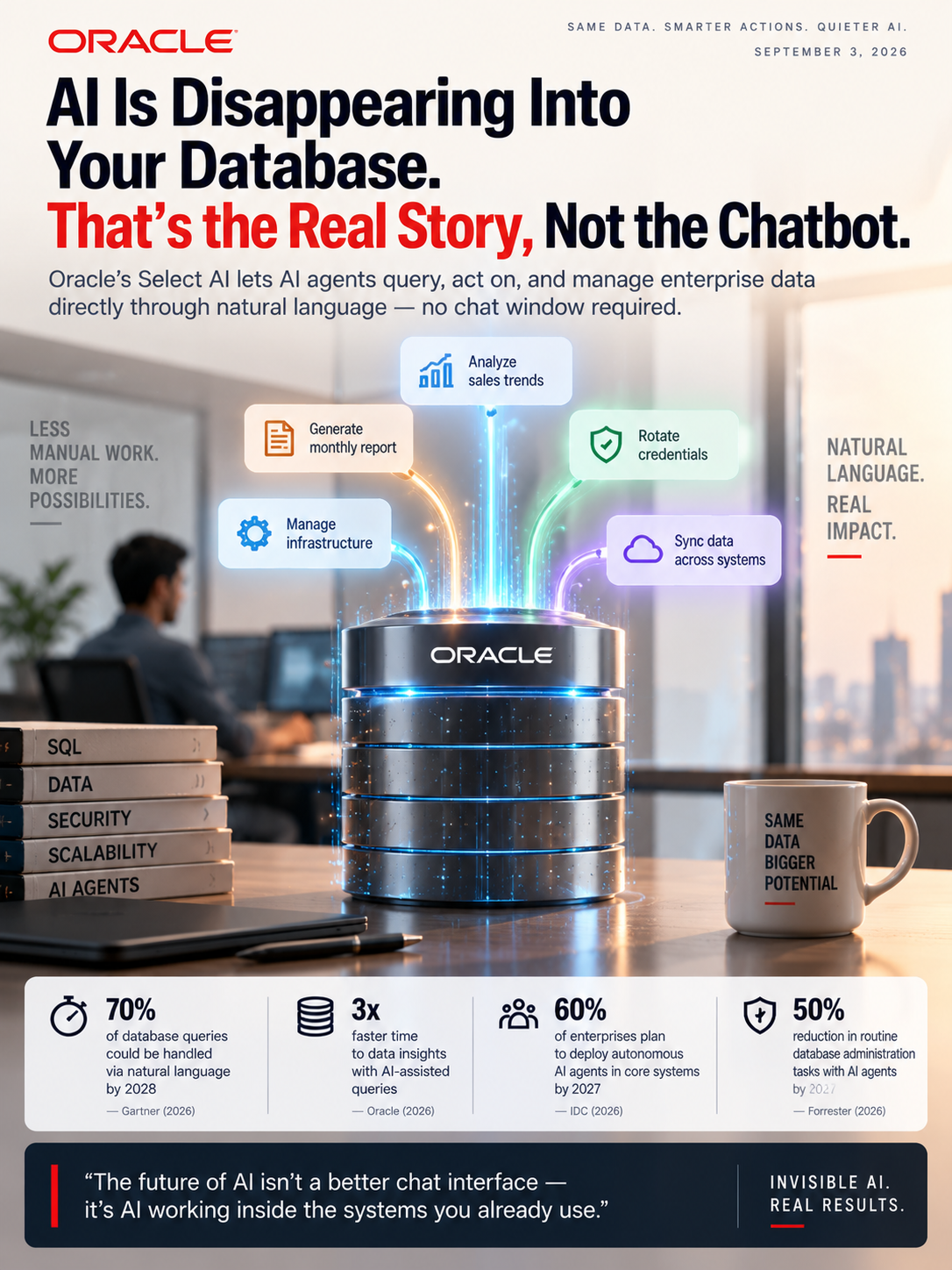
AI Is Disappearing Into Your Database. That's the Real Story, Not the Chatbot.
V
Author
Vishal Sable
Published
September 7, 2026
Reading Time
5 MIN READ
Spread the Word
Oracle's Select AI now lets AI agents query, act on, and manage enterprise databases directly through natural language — no chat window required. Here's what "invisible AI" actually looks like.
agentic AI database, Oracle Select AI, natural language to SQL, invisible AI infrastructure, enterprise AI agents 2026
The chat window was never the destination
For the past three years, the default way most people have experienced AI is a text box: type a question, get an answer. That was always a transitional interface, not the end state. The real shift happening in enterprise AI right now isn't a better chatbot — it's AI disappearing entirely into the systems people already use, doing the work before anyone thinks to ask.
Oracle's own database platform is one of the clearest, most concrete examples of what that actually looks like in production today.
What's actually running inside the database now
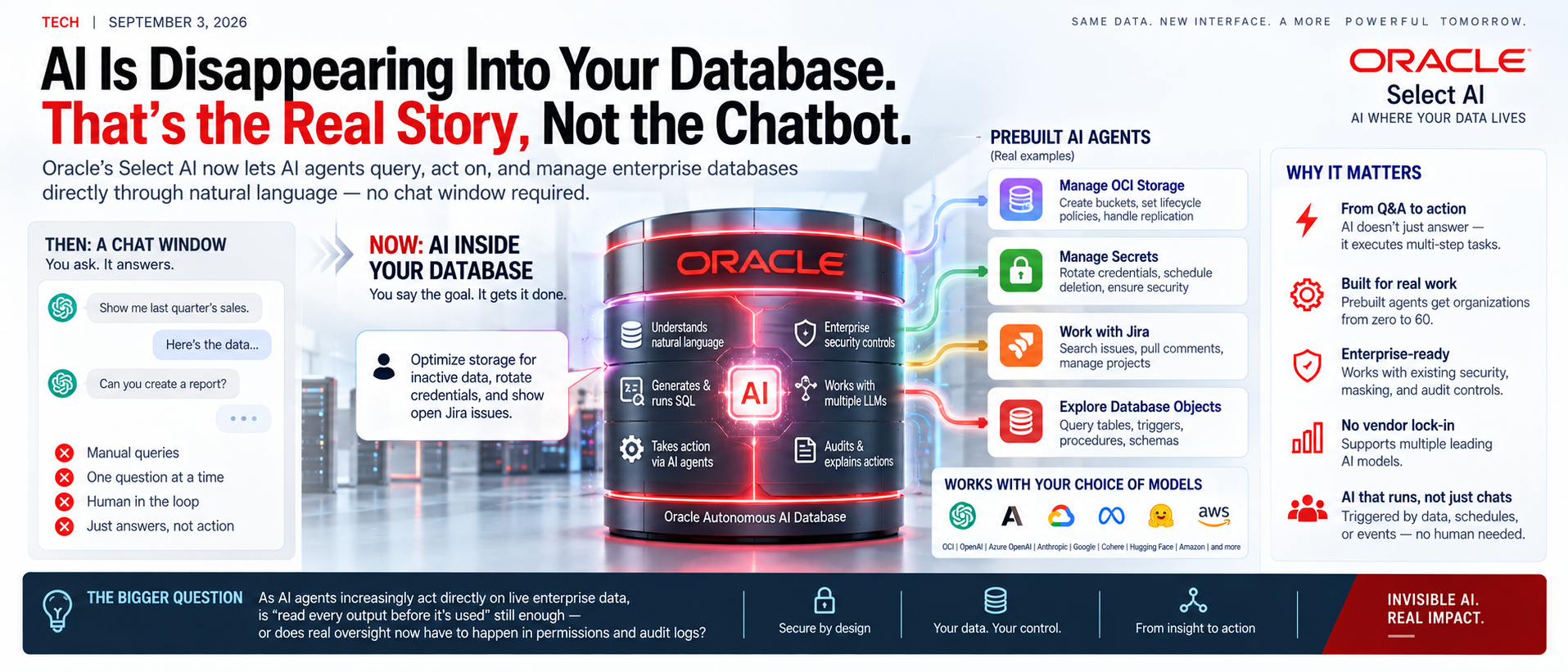
Oracle's Select AI, built into Oracle Autonomous AI Database, lets users query enterprise data in plain English instead of writing SQL — the system generates, runs, and explains the query itself, using a component called the DBMS_CLOUD_AI package as the connective layer. That alone is the "invisible interface" trend in miniature: the SQL never disappears, it just stops being something a human has to write.
The more significant piece is what Oracle added on top of it: Select AI Agents, a framework for building, managing, and running autonomous AI agents directly inside the database. Oracle now ships pre-built agents that go well beyond query generation — one manages OCI Object Storage buckets, lifecycle policies, and data replication through natural language commands; another handles secure, conversational management of secrets, including credential rotation and scheduled deletion; another connects to Jira to search issues, pull comments and worklogs, and manage projects, all without a person opening a ticketing dashboard. Developers can explore and manage actual database objects — tables, triggers, procedures, schemas — through plain conversational queries instead of navigating an admin console.
Oracle also opened Select AI to a wide range of model providers — OCI's own Generative AI service, OpenAI, Azure OpenAI, Anthropic, Google, Cohere, Hugging Face, Amazon, and private model deployments — meaning enterprises can plug in whichever model fits their security posture rather than being locked to one vendor's AI.
Why this counts as a genuine shift, not a feature update
The distinction that matters here is the one between AI you talk to and AI that's already running. A chat interface requires someone to initiate a request and wait for a response. An agent embedded in the database layer can be triggered by data itself — a threshold crossed, a record updated, a scheduled condition met — and complete a multi-step task (query, decide, act, log) without a human in the loop for each step. That's the actual meaning of "agentic workflow" as distinct from "chatbot with a longer memory": the unit of interaction stops being a single question-and-answer pair and becomes an entire task, executed autonomously against live enterprise data.
This matters more as more of these agents get pre-built and standardized rather than custom-coded per company. Oracle explicitly frames its prebuilt agent suite as taking organizations "from zero to 60" — the barrier to deploying an autonomous agent against your own database has dropped from a bespoke engineering project to installing a pre-packaged tool.
Why it matters
For businesses, the practical shift is less about any single flashy capability and more about where oversight needs to move. When AI lived in a chat window, a human reviewed every output before acting on it by default — the chat itself was the checkpoint. When AI lives inside the database, executing multi-step logic against live systems on its own schedule, the checkpoint has to be designed in deliberately: audit trails, permission scoping, and monitoring become the actual safety layer, not a human reading each response before it's used. Oracle's own materials lean on this point — pairing Select AI with existing database security features like data masking, Virtual Private Database controls, and audit trails, because the AI is now operating with the same access a human administrator would have.
As AI agents increasingly act directly on live enterprise data instead of just answering questions about it, is "read every output before it's used" still a meaningful safety practice — or does real oversight now have to happen in permissions and audit logs instead of in the chat window?
---

Vishal Sable
B.Tech AD @ shri balaji institute of technology and management
Engineering and tech journalist. I love exploring the impact of emerging technologies on global defense, sovereignty, and everyday life. Always looking for the real story behind the headlines.