LATEST NEWS
ByteDance Just Borrowed $30 Billion It Didn't Need To. That's the Real Signal.
September 8, 2026 4M
Back to News
News AlertWorld AI Tech
AI Just Supercharged the Race for Room-Temperature Superconductors
V
Author
Vishal Sable
Published
July 7, 2026
Reading Time
3 MIN READ
Spread the Word
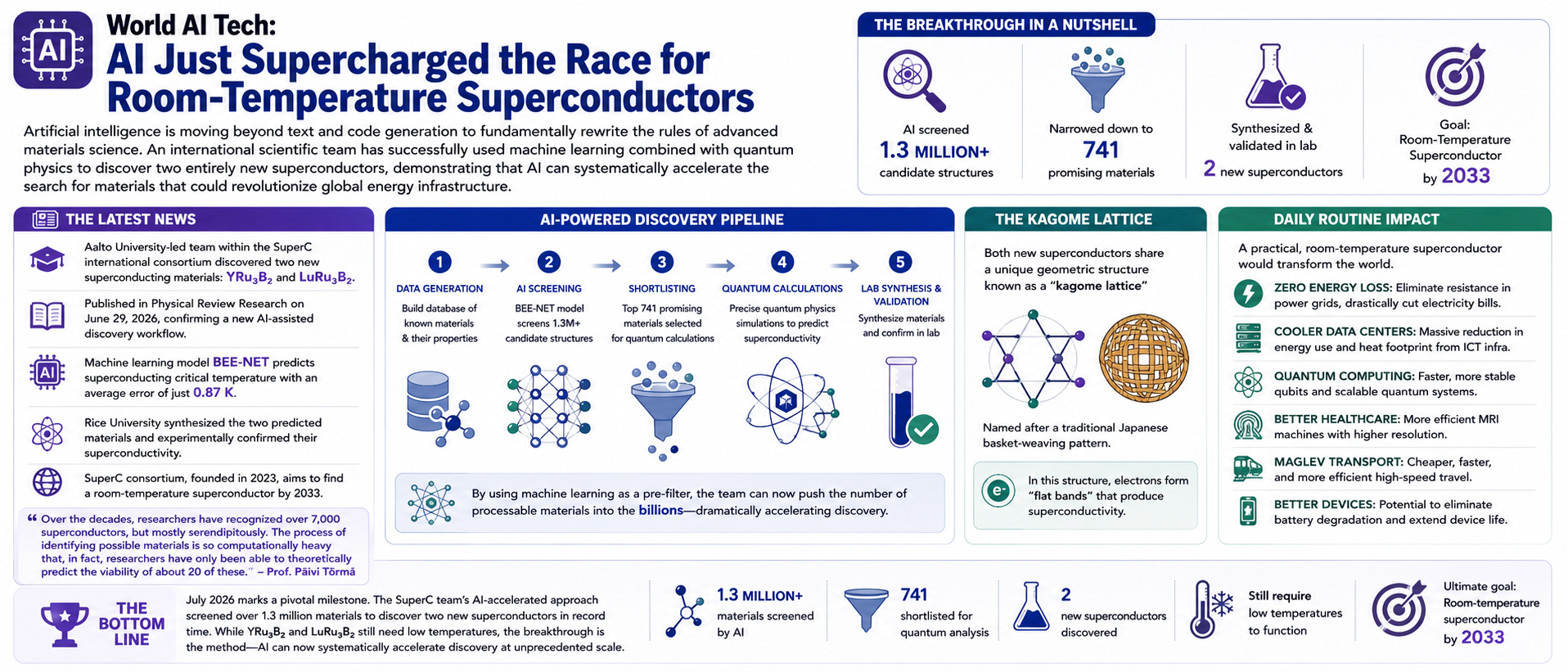
Artificial intelligence is moving beyond text and code generation to fundamentally rewrite the rules of advanced materials science. An international scientific team has successfully used machine learning combined with quantum physics to discover two entirely new superconductors, demonstrating that AI can systematically accelerate the search for materials that could revolutionize global energy infrastructure .
The Latest News
The Aalto University-led research team, working within the SuperC international consortium, discovered two new superconducting materials: YRu₃B₂ and LuRu₃B₂ . Their findings were published in the journal Physical Review Research on June 29, 2026, confirming a new AI-assisted discovery workflow .
The method centered on a machine learning model called BEE-NET, which predicts a material's superconducting critical temperature with an average error of just 0.87 K . The AI screened over 1.3 million candidate structures, rapidly narrowing them down to just 741 promising materials for precise quantum physics calculations . Rice University researchers then synthesized the two predicted materials and experimentally confirmed their superconductivity, completing a full pipeline from AI prediction to lab validation .
Both new superconductors share a unique geometric structure known as a "kagome lattice" —named after a traditional Japanese basket-weaving pattern . Within this structure, electrons form "flat bands" that produce superconductivity . This discovery builds on recent research showing that kagome lattices harbor rich quantum properties, making them a key direction for next-generation superconductor research.
The breakthrough represents a major step for the SuperC consortium, founded in 2023 with the ambitious goal of finding a room-temperature superconductor by 2033 . Professor Päivi Törmä, who leads the consortium, emphasized the significance: "Over the decades, researchers have recognized over 7,000 superconductors, but mostly serendipitously. The process of identifying possible materials is so computationally heavy that, in fact, researchers have only been able to theoretically predict the viability of about 20 of these" . By using machine learning as a pre-filter, the team can now push the number of processable materials into the billions .
Daily Routine Impact
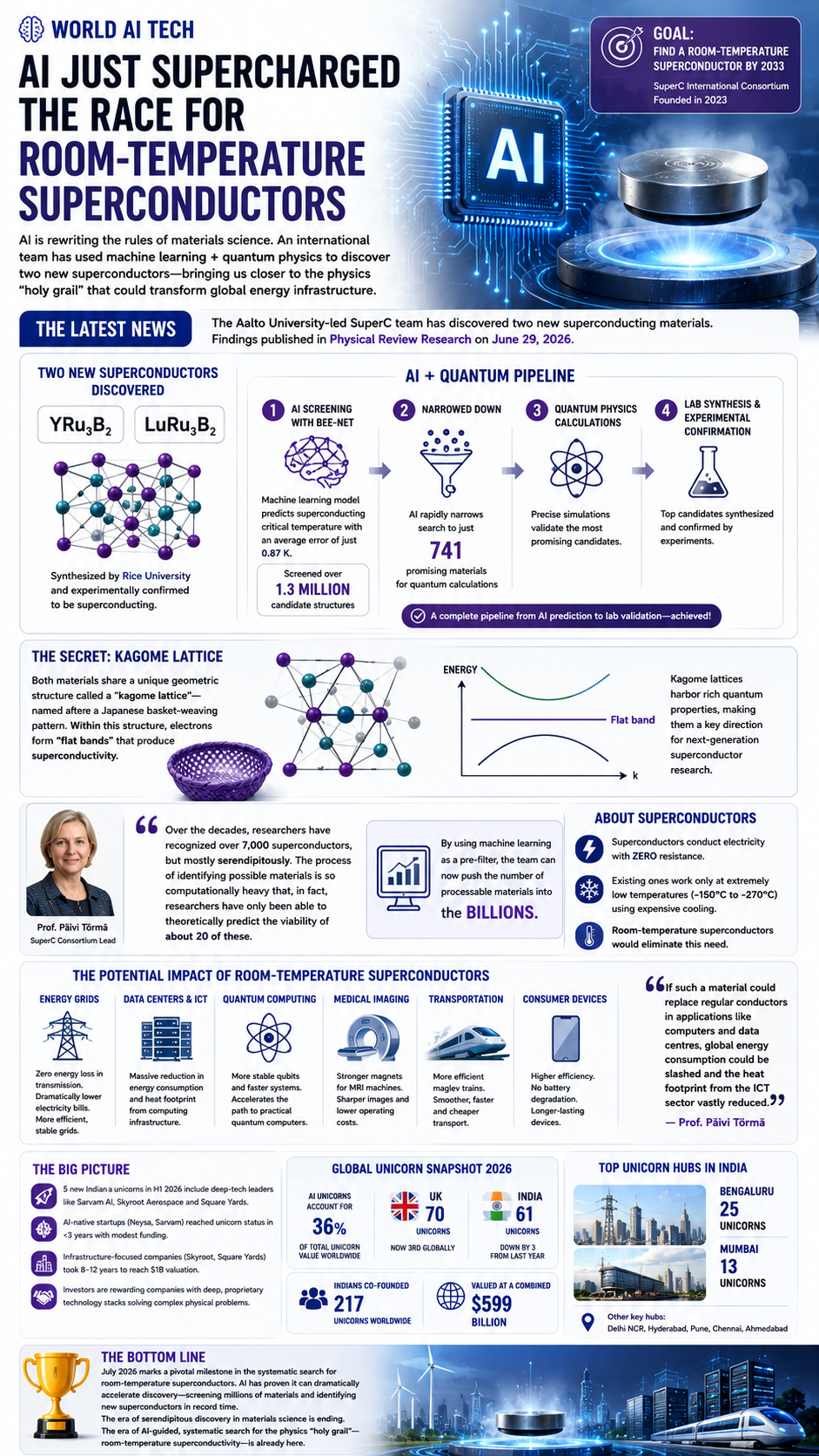
Finding a practical, room-temperature superconductor would fundamentally transform energy consumption . Superconductors conduct electricity with zero resistance, but currently only work at extremely low temperatures (between -150°C and -270°C), requiring expensive and energy-intensive cooling systems . If room-temperature materials can be found and scaled, they would eliminate energy loss in electrical grids, drastically reduce electricity bills, and slash the massive heat footprint from data centers and ICT infrastructure .
The implications extend far beyond energy grids. Room-temperature superconductors would accelerate quantum computing, improve MRI imaging, enable more efficient maglev trains, and potentially eliminate battery degradation in consumer devices . As Törmä explained: "If such a material could replace regular conductors in applications like computers and data centres, global energy consumption could be slashed and the heat footprint from the ICT sector vastly reduced" .
The Bottom Line
July 2026 marks a pivotal milestone in the systematic search for room-temperature superconductors. The SuperC team's AI-accelerated approach demonstrates a scalable path forward—from screening over 1.3 million materials to identifying two new superconductors in record time. While YRu₃B₂ and LuRu₃B₂ still require low temperatures to function, the significance lies in the method: AI has proven it can dramatically accelerate discovery, potentially pushing the number of processable candidates into the billions . The era of serendipitous discovery in materials science is ending. The era of AI-guided, systematic search for the physics "holy grail"—room-temperature superconductivity—is already here.

Vishal Sable
B.Tech AD @ shri balaji institute of technology and management
Engineering and tech journalist. I love exploring the impact of emerging technologies on global defense, sovereignty, and everyday life. Always looking for the real story behind the headlines.