LATEST NEWS
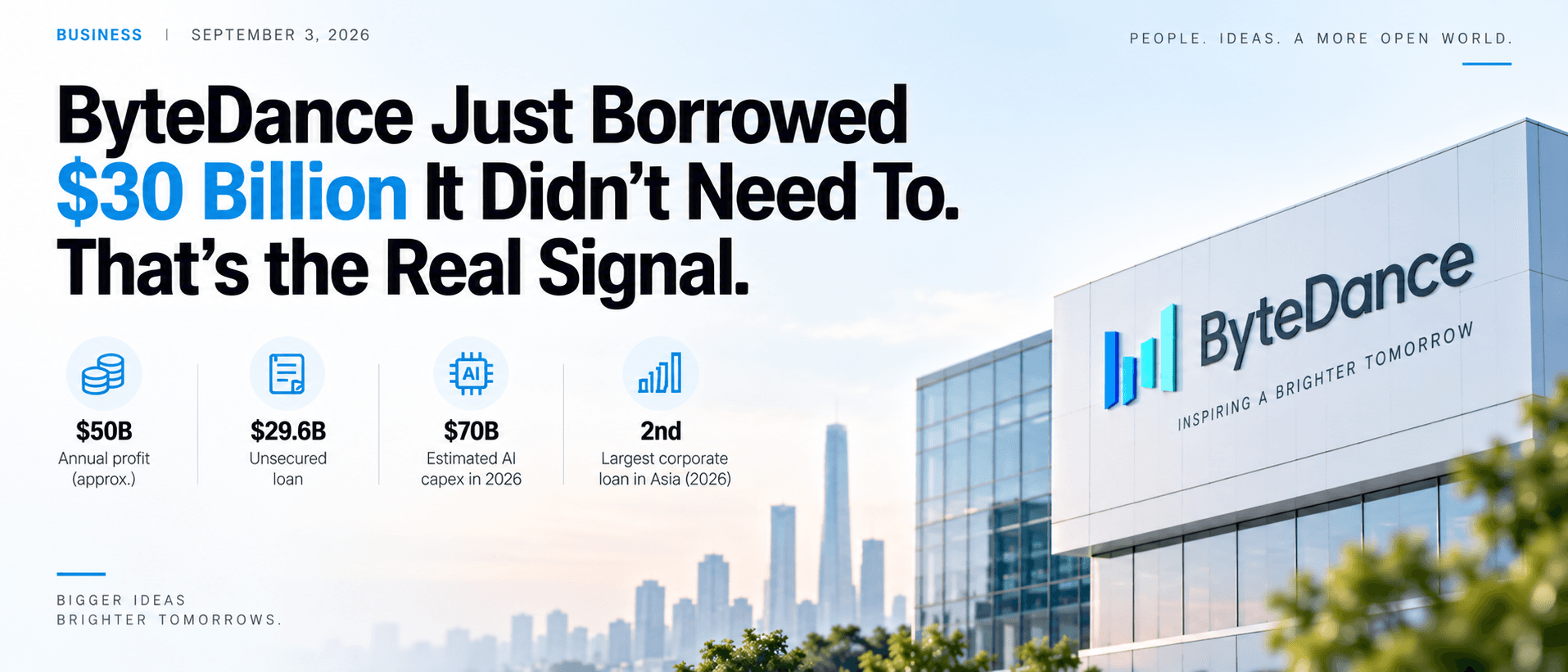
ByteDance Just Borrowed $30 Billion It Didn't Need To. That's the Real Signal.
September 8, 2026 4M
Back to News
News AlertWorld AI Tech
OpenAI Drops "GPT-Live" Multi-Model Voice Engine
V
Author
Vishal Sable
Published
July 11, 2026
Reading Time
4 MIN READ
Spread the Word
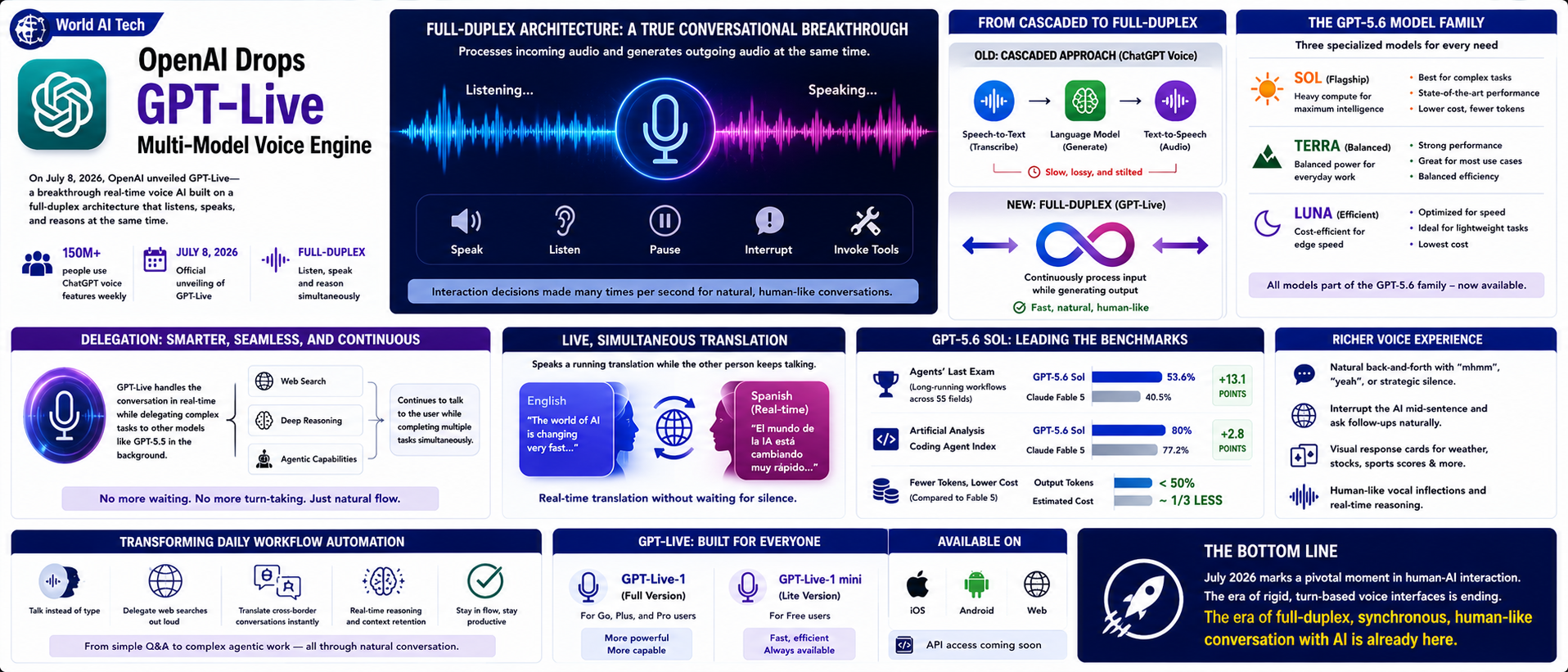
Artificial intelligence has moved past basic text responses, introducing full-duplex systems that listen, speak, and reason at the exact same time. On July 8, OpenAI officially unveiled GPT-Live, a breakthrough generation of real-time voice AI built on a full-duplex architecture that fundamentally changes how humans interact with machines .
The core technical innovation behind GPT-Live is its full-duplex architecture, meaning the model can process incoming audio and generate outgoing audio simultaneously, rather than waiting for one side of the conversation to finish before starting the next . This addresses a long-standing limitation of earlier voice systems. The original ChatGPT Voice used a cascaded approach, chaining three separate models together—speech-to-text to transcribe, a language model to generate a response, and text-to-speech to convert it back to audio—which meant information could be lost across models and responses were slow and stilted . Even Advanced Voice Mode, which processed speech within a single model, still operated on discrete turns, requiring the model to wait for silence before responding, leading to unnatural interruptions during thoughtful pauses or when background noise was present .
GPT-Live changes this by continuously processing input while generating output, allowing the model to make interaction decisions many times per second—whether to speak, continue listening, pause, interrupt, or invoke a tool . This enables the model to engage in more natural back-and-forth, maintain a better sense of time, and even perform live, simultaneous translation . In demonstrations, the model could speak a running translation while a person continued talking, rather than waiting for them to stop .
The second major architectural shift is delegation. Rather than trying to handle every query itself, GPT-Live decouples its continuous interaction layer from deeper work. When a question requires web search, heavier reasoning, or more agentic capabilities, GPT-Live delegates the task to another model like GPT-5.5 in the background, while continuing to talk to the user . This allows the voice model to maintain conversational flow even as it handles multiple tasks simultaneously .
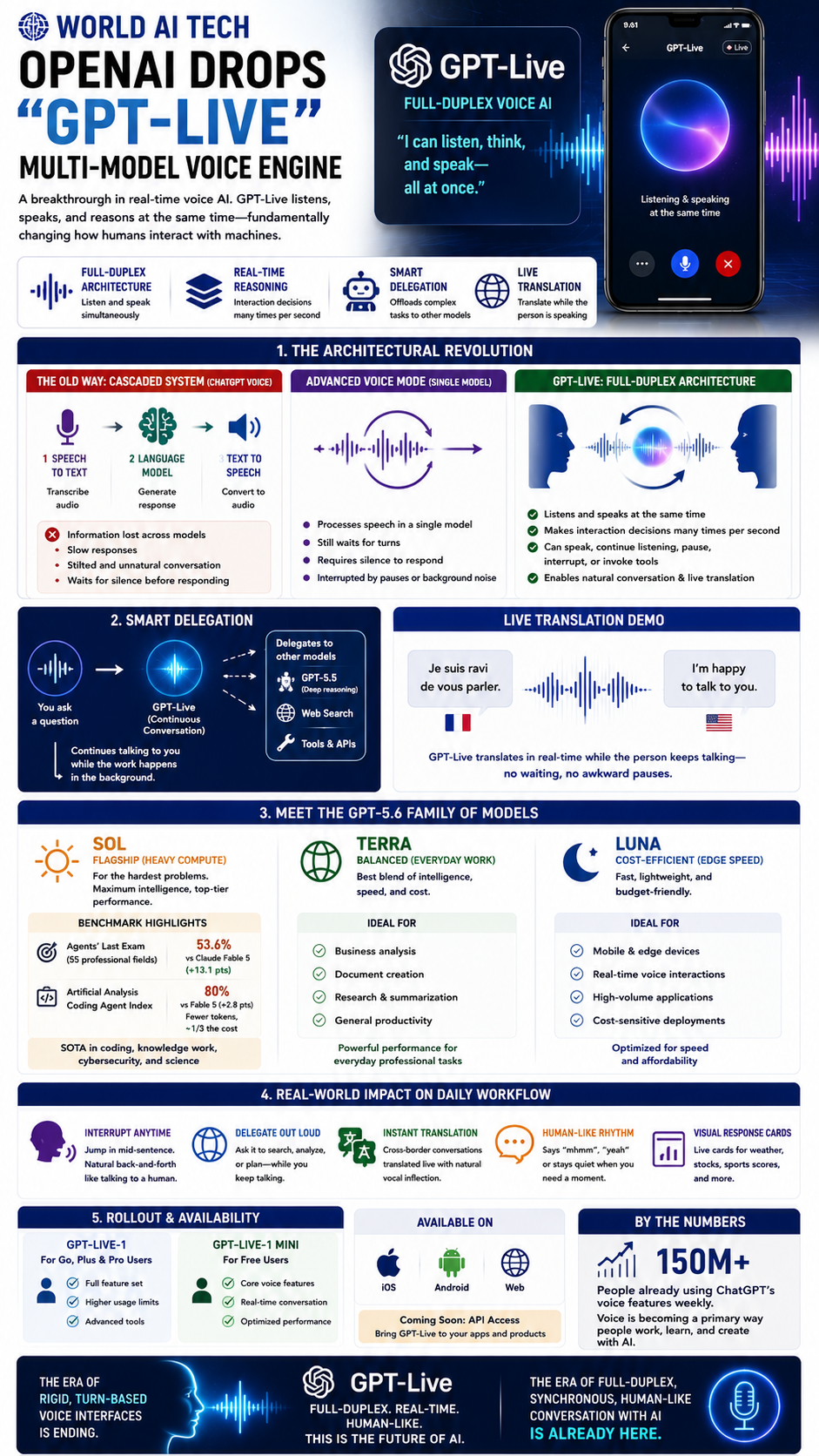
Alongside this voice leap, OpenAI publicly rolled out its GPT-5.6 family of specialized models—codenamed Sol (flagship for heavy compute), Terra (balanced for everyday work), and Luna (cost-efficient for edge speed) . GPT-5.6 Sol sets a new standard for intelligence and efficiency, achieving state-of-the-art results across coding, knowledge work, cybersecurity, and science while using fewer tokens at lower estimated cost . On Agents' Last Exam, a test of long-running professional workflows across 55 fields, Sol scored 53.6%, eclipsing Claude Fable 5 by 13.1 points . On the Artificial Analysis Coding Agent Index, Sol reached 80%, surpassing Fable 5 by 2.8 points while using less than half the output tokens and costing about one-third less .
GPT-Live changes daily workflow automation entirely. Instead of typing out prompts, users can interrupt the AI mid-sentence, delegate web searches out loud, and have the assistant translate cross-border conversations instantly with human-like vocal inflections and real-time reasoning . The model can drop in small acknowledgements like "mhmm" or "yeah" while a user is still talking, mimicking the rhythm of genuine back-and-forth conversation, or stay quiet when you need a moment to think . OpenAI has also introduced visual response cards for topics like weather, stocks, and sports scores during voice conversations, making the experience richer than audio alone .
OpenAI is rolling out two versions—GPT-Live-1 for Go, Plus, and Pro users, and GPT-Live-1 mini for Free users—across iOS, Android, and the web . The company also plans to bring these models to the API soon . With more than 150 million people already using ChatGPT's voice features weekly, OpenAI appears to be betting that voice will move from a peripheral feature to a primary way people interact with AI, including for longer, more complex agentic work . July 2026 marks a pivotal moment in human-AI interaction. The era of rigid, turn-based voice interfaces is ending. The era of full-duplex, synchronous, human-like conversation with AI is already here.

Vishal Sable
B.Tech AD @ shri balaji institute of technology and management
Engineering and tech journalist. I love exploring the impact of emerging technologies on global defense, sovereignty, and everyday life. Always looking for the real story behind the headlines.