Back to News
News AlertWorld AI Tech
India Has Twice the World's Share of "Frontier" AI Workers. That's Exactly Why the $31.6 Trillion Compute Bill Is Coming Due.
V
Author
Vishal Sable
Published
September 3, 2026
Reading Time
5 MIN READ
Spread the Word
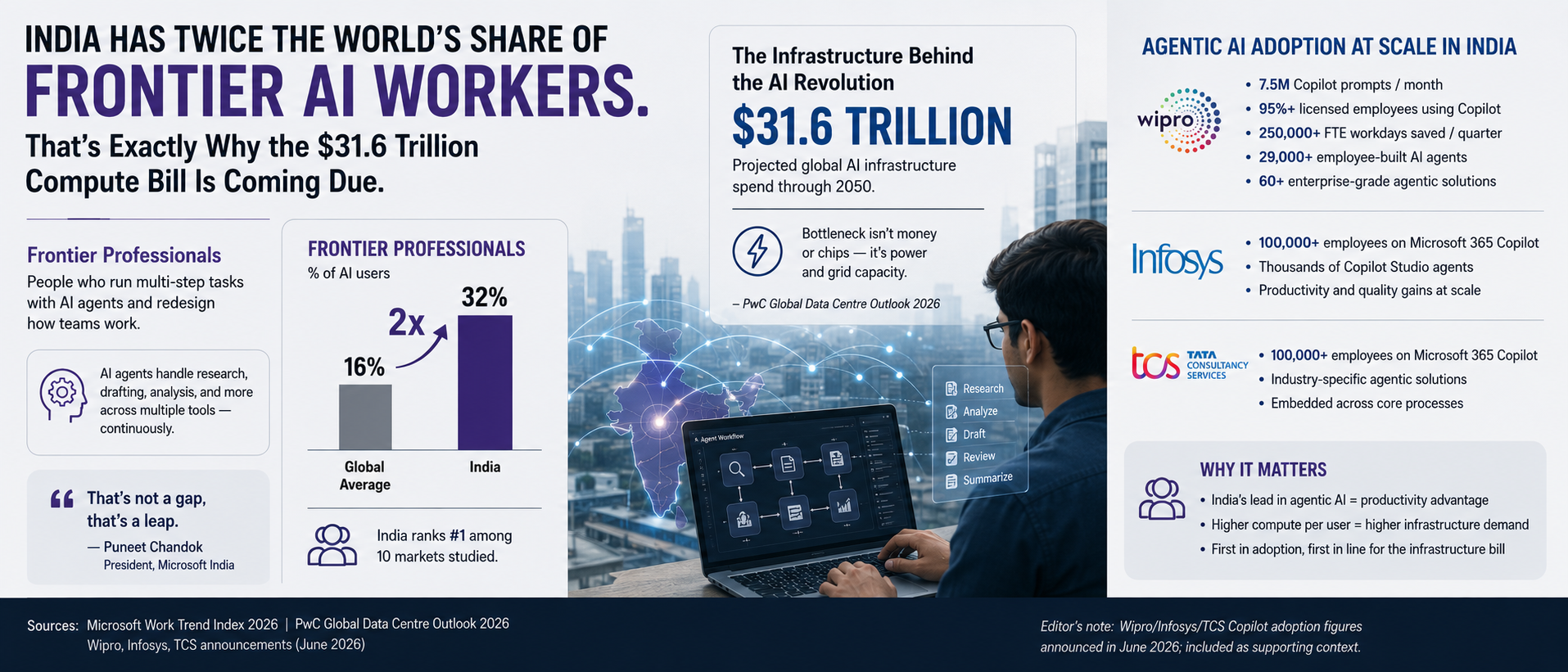
India leads the world with 32% of AI users running multi-step agent workflows, double the global average. That shift in how AI gets used is a hidden driver behind PwC's $31.6T infrastructure forecast.
Frontier Professionals India, Microsoft Work Trend Index 2026, agentic AI workforce India, AI infrastructure spend 2050, Wipro Copilot adoption
Frontier Professionals India, Microsoft Work Trend Index 2026, agentic AI workforce India, AI infrastructure spend 2050, Wipro Copilot adoption
The number that explains the other number
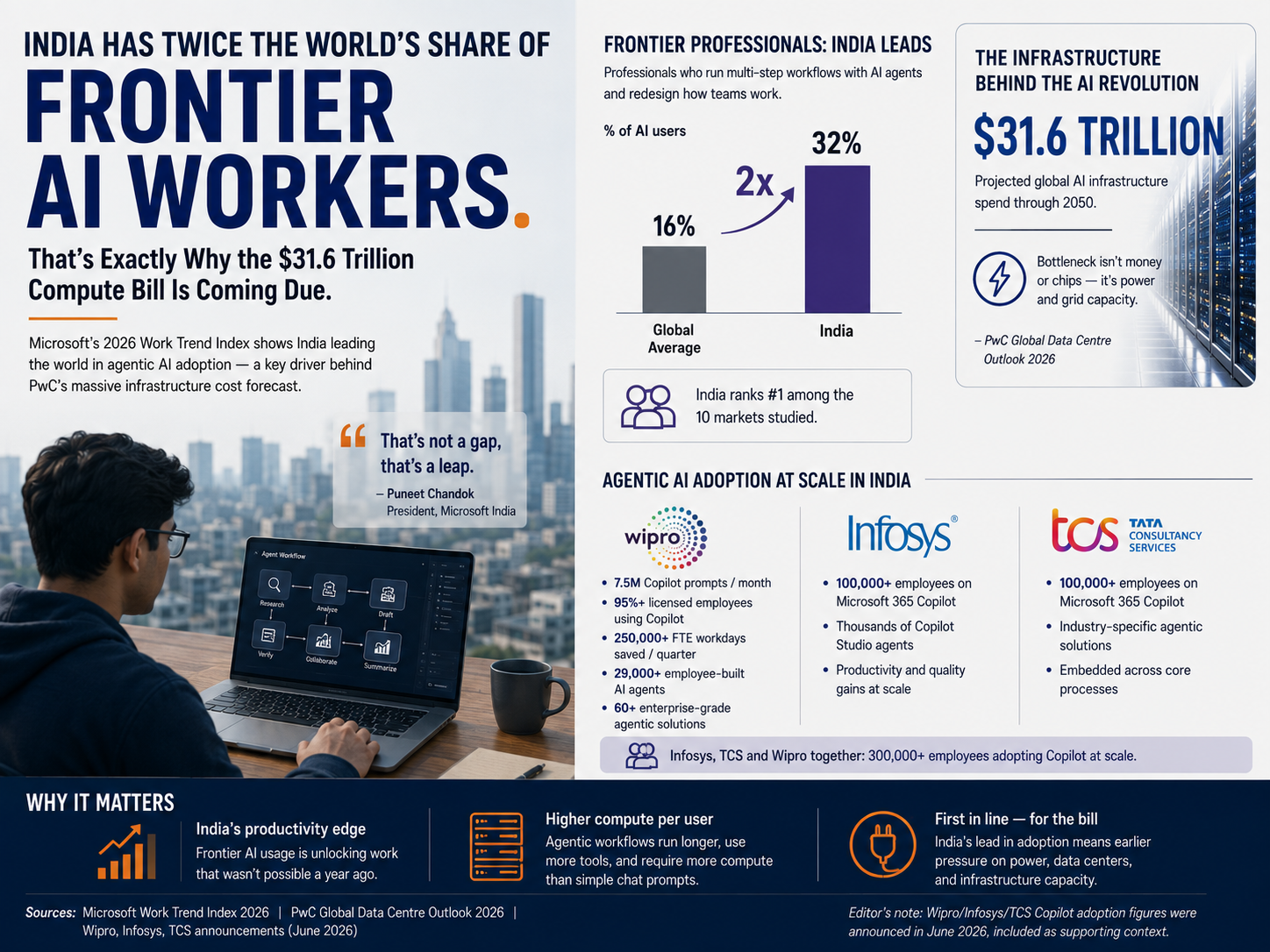
Microsoft's 2026 Work Trend Index dropped a genuinely striking stat this week: 32% of India's AI-using professionals now qualify as "Frontier Professionals" — people who hand entire multi-step tasks to AI agents and redesign how their teams work around them — exactly double the 16% global average. Of the ten markets Microsoft studied, India came out on top.
That statistic matters beyond workplace trend-watching. It's a live, on-the-ground example of the exact shift that's quietly driving one of the biggest numbers in tech right now: PwC's projection that the world will spend $31.6 trillion on AI infrastructure through 2050. One report measures how people are using AI. The other measures what that usage costs to run. Put together, they explain each other.
What "Frontier Professional" actually means
Microsoft's own definition is specific: a Frontier Professional isn't just someone who uses AI often — it's someone who runs multi-step workflows through agents, builds systems where agents collaborate with each other, and helps set the shared standards their whole team works by. That's a fundamentally different kind of AI usage than typing a one-off question into a chat box. A single chat prompt is a brief request-and-response. An agent handling a multi-step task might run continuously in the background for minutes or hours — researching across multiple sources, drafting, checking its own work, calling other tools — consuming far more compute per task than a simple prompt ever did.
Puneet Chandok, Microsoft India's president, put India's position bluntly: "That's not a gap, that's a leap." His explanation for why India is ahead points to raw capacity — 27 million developers on GitHub and the world's largest IT services workforce — combined with what he called sheer appetite for building new skills. The report also found Indian AI users are unusually deliberate about the human side of this shift: 78% say AI is letting them do work that wasn't possible a year ago (versus 58% globally), rising to 85% among Frontier Professionals specifically — while the same group remains notably attentive to quality control and judgment, not just speed.
The number behind the number: what this looks like at scale
This isn't an abstract trend. India's largest IT companies are already living it. Wipro alone reports 7.5 million Copilot prompts generated every month, with 95%+ of licensed employees actively using it and more than 250,000 full-time-equivalent workdays saved every quarter. Employees have built over 29,000 of their own AI agents internally, on top of 60-plus enterprise-grade agentic solutions already deployed across the business. Infosys and TCS have scaled similarly, with all three companies now running Copilot across more than 300,000 combined employees.
That's the texture behind Microsoft's 32% statistic: not hypothetical future adoption, but hundreds of thousands of real employees already running agent workflows daily, at a scale few other countries currently match.
Why this connects directly to the $31.6 trillion figure
PwC's Global Data Centre Outlook, released the same week, forecasts global AI infrastructure spending climbing from roughly $800 billion annually today toward $1.8 trillion a year by 2050 — and identifies the actual bottleneck as power and grid capacity, not capital or chip supply. What PwC's report doesn't fully spell out is why demand keeps climbing so fast even as efficiency improves: it's because the nature of AI usage itself is shifting toward exactly the pattern India is leading in. A single chat prompt might run in seconds. A background agent completing a multi-step research, drafting, and review task can run for far longer, calling multiple tools and models along the way. As the share of "Frontier Professional"-style usage grows — in India and everywhere else — the average AI workload per user gets heavier, not lighter, even if each individual model gets more efficient.
That's the quiet mechanism connecting these two reports: India's leap to 32% Frontier Professional usage isn't just a workplace productivity story. It's a preview of the demand curve every country will eventually climb, and a concrete example of exactly the kind of usage growth PwC is pricing into a $31.6 trillion, multi-decade infrastructure bet.
Why it matters
For India, this cuts two ways. Leading the world in agentic AI adoption is a genuine competitive advantage for its IT services sector and its case for global AI investment. But it also means India's own power grid and data center capacity will face exactly the pressure PwC describes — sooner, and more acutely, than in markets adopting agentic workflows more slowly. Being the frontier comes with being first in line for the infrastructure bill.
If agent-based work is inherently more compute-hungry than simple chat prompts, does India's lead in Frontier Professional adoption put it first in line for AI's productivity gains — or first in line for its power and infrastructure strain?
---
*Sources: [ANI News] - (https://aninews.in/news/business/with-32-ai-users-redesigning-work-with-agents-india-among-leading-8220frontier8221-workforces-microsoft-report20260903155625/),
[Business Today] - (https://www.businesstoday.in/jobs/story/who-is-the-frontier-professional-meet-the-new-ai-worker-and-why-india-is-leading-the-way-553259-2026-09-03),
[Microsoft News Asia] - (https://news.microsoft.com/source/asia/2026/06/03/infosys-tcs-and-wipro-scale-microsoft-365-copilot-to-over-300000-employees/),
[PwC Global Data Centre Outlook] - (https://www.pwc.com/gx/en/news-room/press-releases/2026/global-investment-in-ai-infrastructure.html).*
[Business Today] - (https://www.businesstoday.in/jobs/story/who-is-the-frontier-professional-meet-the-new-ai-worker-and-why-india-is-leading-the-way-553259-2026-09-03),
[Microsoft News Asia] - (https://news.microsoft.com/source/asia/2026/06/03/infosys-tcs-and-wipro-scale-microsoft-365-copilot-to-over-300000-employees/),
[PwC Global Data Centre Outlook] - (https://www.pwc.com/gx/en/news-room/press-releases/2026/global-investment-in-ai-infrastructure.html).*
Editor's note: The Wipro/Infosys/TCS Copilot adoption figures were first announced in June 2026, not this week — included here as supporting context for the scale behind India's Frontier Professional statistic, not as new news.

Vishal Sable
B.Tech AD @ shri balaji institute of technology and management
Engineering and tech journalist. I love exploring the impact of emerging technologies on global defense, sovereignty, and everyday life. Always looking for the real story behind the headlines.