Back to News
News AlertWorld AI Tech
Three Rival AI Companies Went Down at the Same Time. The Real Story Is What Broke Because of It.
V
Author
Vishal Sable
Published
September 3, 2026
Reading Time
4 MIN READ
Spread the Word
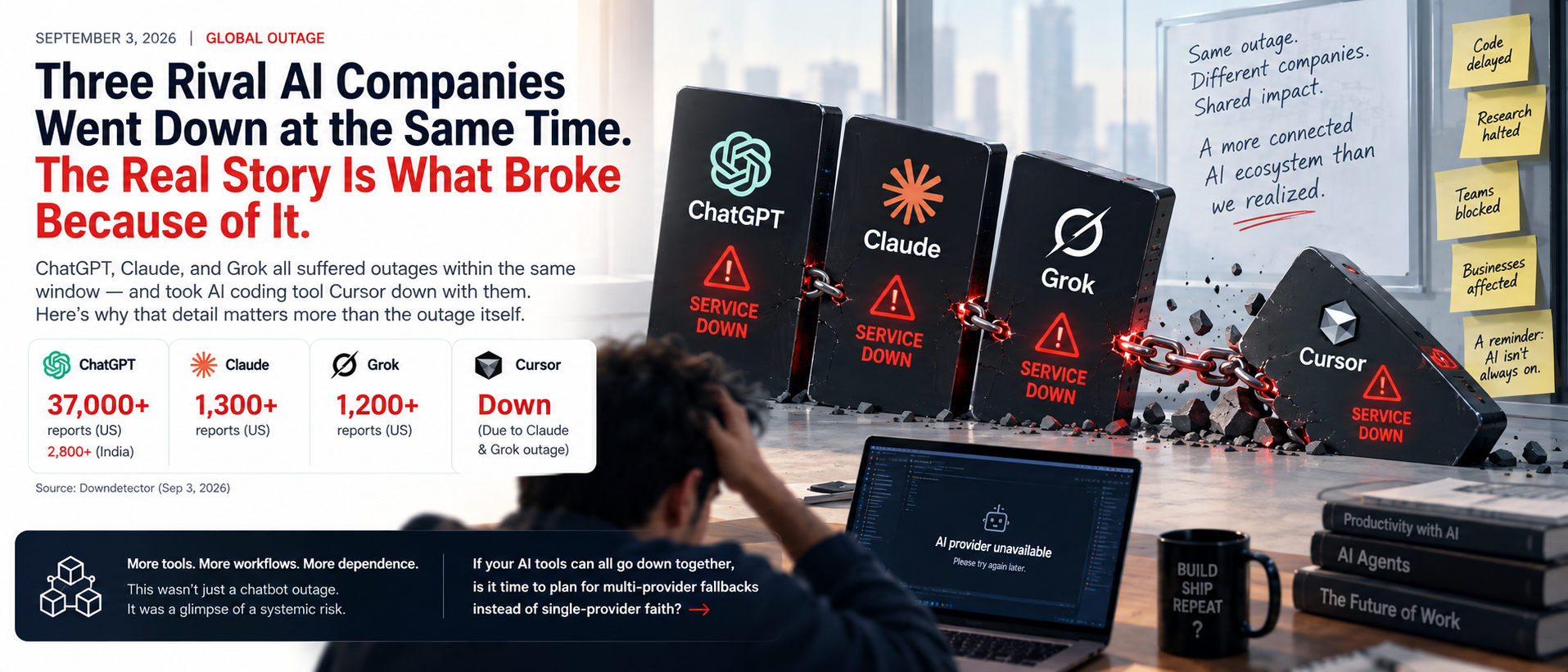
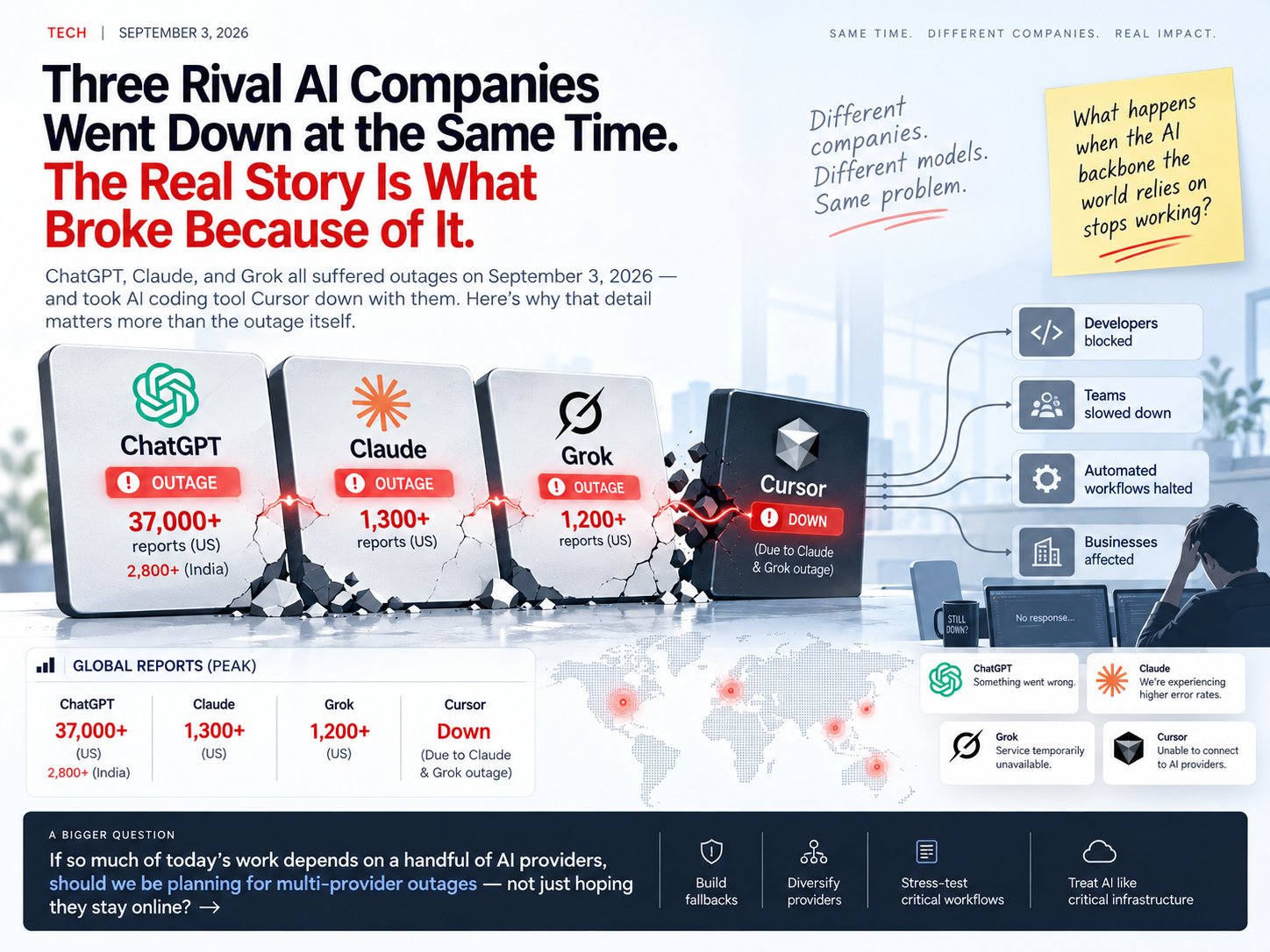
ChatGPT, Claude, and Grok all suffered outages within the same window on Sept 3, 2026 — and took AI coding tool Cursor down with them. Here's why that detail matters more than the outage itself.
ChatGPT Claude Grok outage, AI outage September 2026, Downdetector AI outage, Cursor outage, AI infrastructure dependency
ChatGPT Claude Grok outage, AI outage September 2026, Downdetector AI outage, Cursor outage, AI infrastructure dependency
Three competitors, one bad morning
On the morning of September 3, 2026, ChatGPT, Claude, and Grok — three AI chatbots built by three separate, competing companies, on three separate technology stacks — all went down within roughly the same window. Individually, an AI outage is barely news anymore. All three failing at once is not something that's supposed to happen by coincidence.
What actually happened
Reports started flooding Downdetector around 9-10:30am ET. At the peak, OpenAI's ChatGPT logged more than 37,000 outage reports in the US alone (2,800 in India), Claude peaked around 1,300-1,400 reports , and Grok hit roughly 1,200-1,400. Google's Gemini also saw a smaller spike in complaints, though Google never issued a formal outage confirmation.
OpenAI's status page flagged "elevated errors across ChatGPT and Codex" and later said a fix had been applied. Anthropic's dashboard initially listed several Claude models affected — including Mythos/Fable 5.1, Opus 5, and Opus 4.8 — before narrowing the issue down to Opus 4.8 and Opus 5 specifically, with other models recovering to baseline. Grok's status system logged a model-level outage across its apps. By around 12:30pm ET, all three services were reporting a return to normal.
The detail most coverage buried: Cursor went down too
Here's the part that actually matters more than the outage itself. Cursor, the AI coding assistant used by software engineers to write and debug code with AI agents, confirmed its own outage — caused directly by the Grok and Claude disruptions. Cursor doesn't run its own foundation models; it's built as a layer on top of models from OpenAI, Anthropic, and others. When two of its underlying providers broke at once, Cursor broke with them.
That's not a coincidence worth shrugging off. It's a live demonstration of exactly how much of today's software tooling — not just chatbots people type questions into, but agentic coding tools sitting inside real engineering workflows — now depends on a small handful of frontier AI providers staying online simultaneously.
Why this is a bigger deal than past AI outages
AI chatbots have gone down before — ChatGPT, Claude, and Perplexity had a multi-hour joint outage back in mid-2024, and ChatGPT alone has had outages stretching past ten hours in the past. What's different now isn't the outage pattern — it's what's built on top of it. As one industry write-up on Thursday's incident put it, a chatbot outage used to mean people simply couldn't ask questions or generate text for a few hours. Today, these same systems sit inside software development pipelines, customer support desks, research workflows, content production, and internal business operations — many of them running unattended, in the background, as agents rather than as something a person is actively watching.
AI chatbots have gone down before — ChatGPT, Claude, and Perplexity had a multi-hour joint outage back in mid-2024, and ChatGPT alone has had outages stretching past ten hours in the past. What's different now isn't the outage pattern — it's what's built on top of it. As one industry write-up on Thursday's incident put it, a chatbot outage used to mean people simply couldn't ask questions or generate text for a few hours. Today, these same systems sit inside software development pipelines, customer support desks, research workflows, content production, and internal business operations — many of them running unattended, in the background, as agents rather than as something a person is actively watching.
That shift is exactly the trend covered in Microsoft's 2026 Work Trend Index, which found a growing share of professionals — led by India at 32% — now delegate multi-step work directly to AI agents rather than typing one-off prompts. The more that agentic pattern spreads, the more a simultaneous outage across multiple providers stops being an inconvenience and starts being an operational risk for real, live business processes.
Why it matters
For any team or company that has built agentic workflows on top of one or more of these providers — the exact "Frontier Professional" pattern spreading fastest in India — Thursday's outage is a preview of a real dependency risk, not just a bad morning for chatbot users. If an outage on any single provider can cascade into tools like Cursor going down too, the more relevant question for businesses isn't "which AI model is best" — it's "what happens to my workflow when my AI provider, whichever one it is, has a bad day."
If AI agents are increasingly running unattended inside real business workflows, should companies building on top of frontier AI be planning for multi-provider outages the same way they already plan for cloud provider outages — with fallbacks, not just faith that today's provider stays up?
Sources: Hindustan Times, Downdetector, Inshorts coverage (Sep 4, 2026).

Vishal Sable
B.Tech AD @ shri balaji institute of technology and management
Engineering and tech journalist. I love exploring the impact of emerging technologies on global defense, sovereignty, and everyday life. Always looking for the real story behind the headlines.