Back to News
News AlertWorld AI Tech
ByteDance Just Borrowed $30 Billion It Didn't Need To. That's the Real Signal.
V
Author
Vishal Sable
Published
September 8, 2026
Reading Time
4 MIN READ
Spread the Word
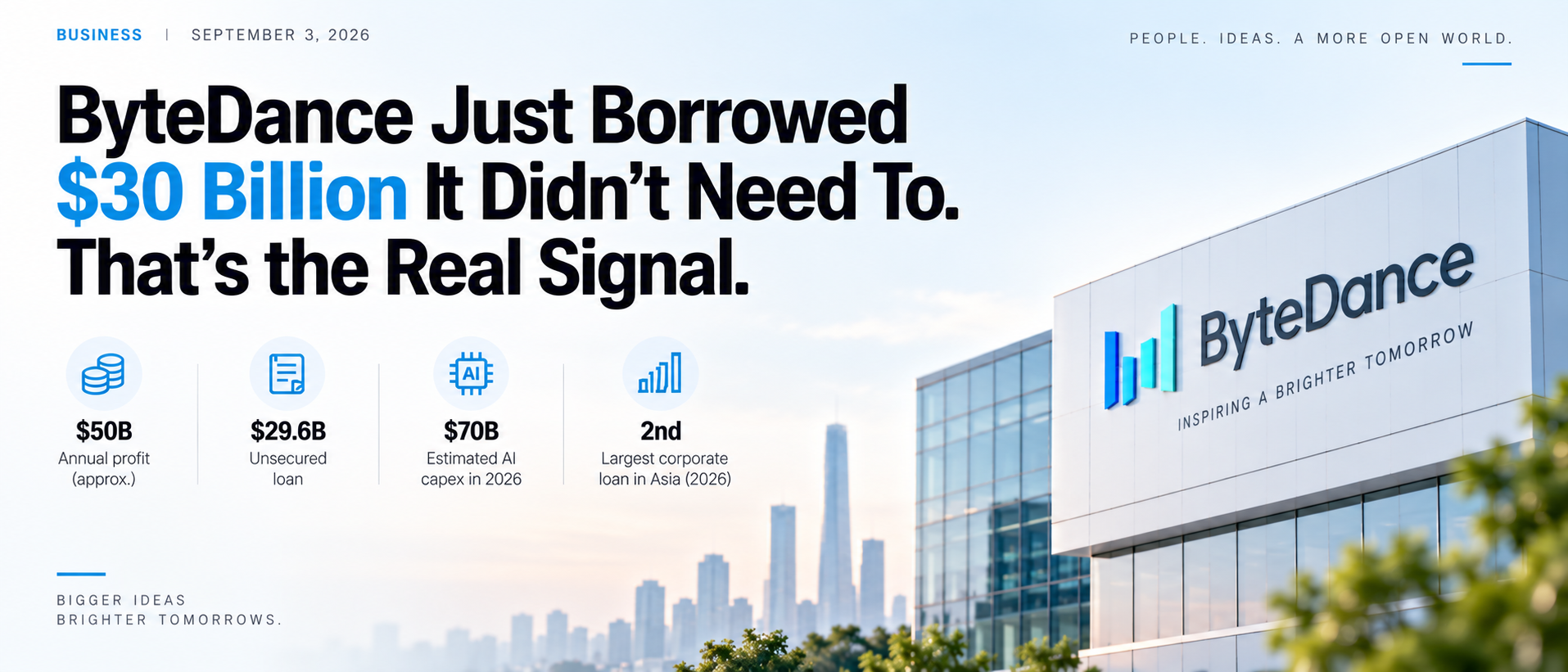
ByteDance secured a $29.6B unsecured loan to fund AI infrastructure — the second-largest in Asia this year. Why a cash-rich company is borrowing billions anyway.
ByteDance $30 billion loan, AI infrastructure financing 2026, ByteDance AI capex, data center power constraints, hyperscaler debt AI buildout
ByteDance $30 billion loan, AI infrastructure financing 2026, ByteDance AI capex, data center power constraints, hyperscaler debt AI buildout
A company with $50 billion in annual profit just took out a mega-loan
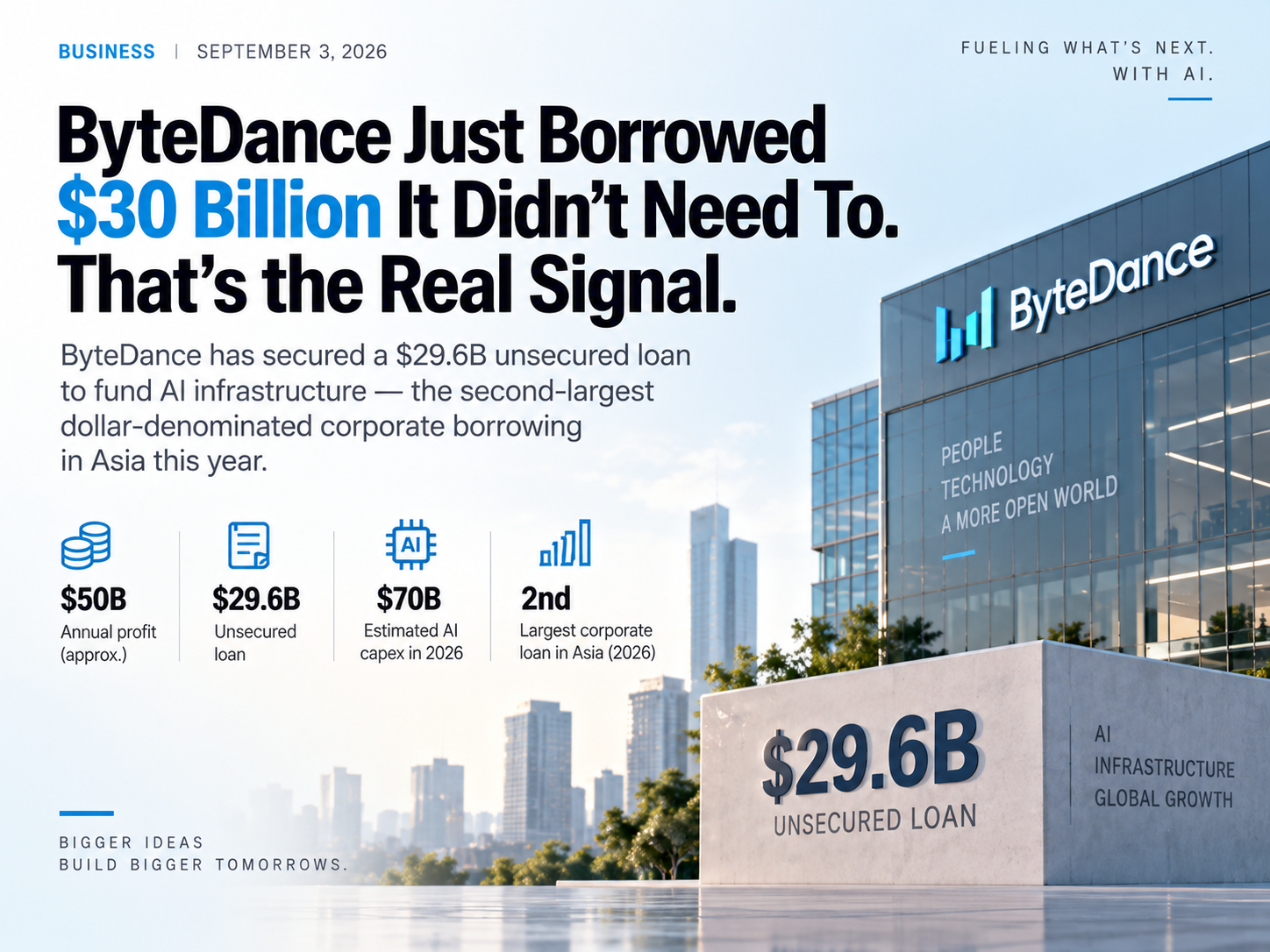
ByteDance doesn't need to borrow money. The TikTok and Douyin parent company generates roughly $50 billion a year in profit — and it just closed a $29.6 billion syndicated loan anyway, the second-largest dollar-denominated corporate borrowing in Asia this year, behind only SoftBank's $40 billion facility tied to its OpenAI investment. That combination — a cash-rich company voluntarily taking on tens of billions in new debt — is the actual story, more than the number itself.
What the loan actually looks like
ByteDance originally sought $20 billion. Demand from nearly 30 banks pushed orders past $30 billion, letting the company upsize the facility to $29.6 billion. What's unusual is the structure: it's **unsecured** — no shares, property, or other collateral pledged — which one source close to the deal described bluntly: "the banks practically are counting purely on ByteDance's name." Chinese banks took up more than 60% of the allocation, with the rest split across US, European, and Singaporean lenders, coordinated by Citigroup and JPMorgan. Pricing came in at 68 basis points over SOFR — notably tighter than the 85 basis points ByteDance paid on its last offshore loan in 2024, signaling lenders see this as lower risk than two years ago, not higher.
The stated purpose is "general corporate purposes." The understood purpose, across every outlet covering the deal, is AI infrastructure — specifically data centers being built outside mainland China, with a particular focus on Southeast Asia.
Why a profitable company borrows instead of just spending cash
ByteDance is reportedly planning **up to $70 billion in AI capital expenditure this year alone**, with projections reaching **$100 billion in 2027** — a spending pace that puts it in the same league as Amazon, Google, and Microsoft, which are collectively expected to spend around $725 billion combined on AI infrastructure in 2026. At that scale, even a company generating $50 billion in annual profit benefits from spreading the bill across debt rather than draining cash reserves needed for operations elsewhere — especially with borrowing costs currently favorable and lender appetite for AI-infrastructure-linked debt clearly strong, given the 1.5x oversubscription on this deal alone.
There's a geographic signal buried in the "Southeast Asia" detail too. Building data centers outside mainland China gives ByteDance a path around **US export restrictions on advanced AI chips**, which have made domestic Chinese AI infrastructure considerably harder to scale using the most capable hardware. Offshore data centers, financed by an offshore loan drawing on international banks, sidestep at least some of that constraint.
Why it matters
For the broader AI infrastructure race, ByteDance's loan is a specific data point in a much bigger pattern: companies at every tier — from SoftBank borrowing $40 billion against its OpenAI stake to ByteDance borrowing $30 billion against its own name — are increasingly financing AI buildouts through debt rather than pure capital reserves, even when they have the cash to avoid it. That signals real confidence that AI infrastructure spending will pay for itself — but it also means a growing share of the AI boom's foundation is now leveraged, not just invested, which raises the stakes if the return on that infrastructure spending takes longer to materialize than lenders are currently pricing in.
If some of the world's most profitable tech companies are choosing debt over cash to fund AI infrastructure, is that a sign of supreme confidence in AI's near-term payoff — or a sign that even they don't want their own balance sheets fully exposed if the bet takes longer than expected to pay off?
---
Sources : Yahoo Finance/Bloomberg
[Decrypt]
(https://decrypt.co/377489/tiktok-bytedance-loan-ai)
[TechStartups]
(https://techstartups.com/2026/09/04/bytedance-secures-29-6-billion-mega-loan-to-fund-ai-and-data-center-expansion-outside-china/)
[Cointribune]
(https://www.cointribune.com/en/tiktok-owner-bytedance-lands-a-near-30-billion-loan-to-power-its-ai-buildout).
[Decrypt]
(https://decrypt.co/377489/tiktok-bytedance-loan-ai)
[TechStartups]
(https://techstartups.com/2026/09/04/bytedance-secures-29-6-billion-mega-loan-to-fund-ai-and-data-center-expansion-outside-china/)
[Cointribune]
(https://www.cointribune.com/en/tiktok-owner-bytedance-lands-a-near-30-billion-loan-to-power-its-ai-buildout).

Vishal Sable
B.Tech AD @ shri balaji institute of technology and management
Engineering and tech journalist. I love exploring the impact of emerging technologies on global defense, sovereignty, and everyday life. Always looking for the real story behind the headlines.