Back to News
News AlertWorld AI Tech
AI Needs $31.6 Trillion in Data Centers. This Week, Palm-Sized PCs Started Doing the Job Without Them.
V
Author
Vishal Sable
Published
September 2, 2026
Reading Time
5 MIN READ
Spread the Word
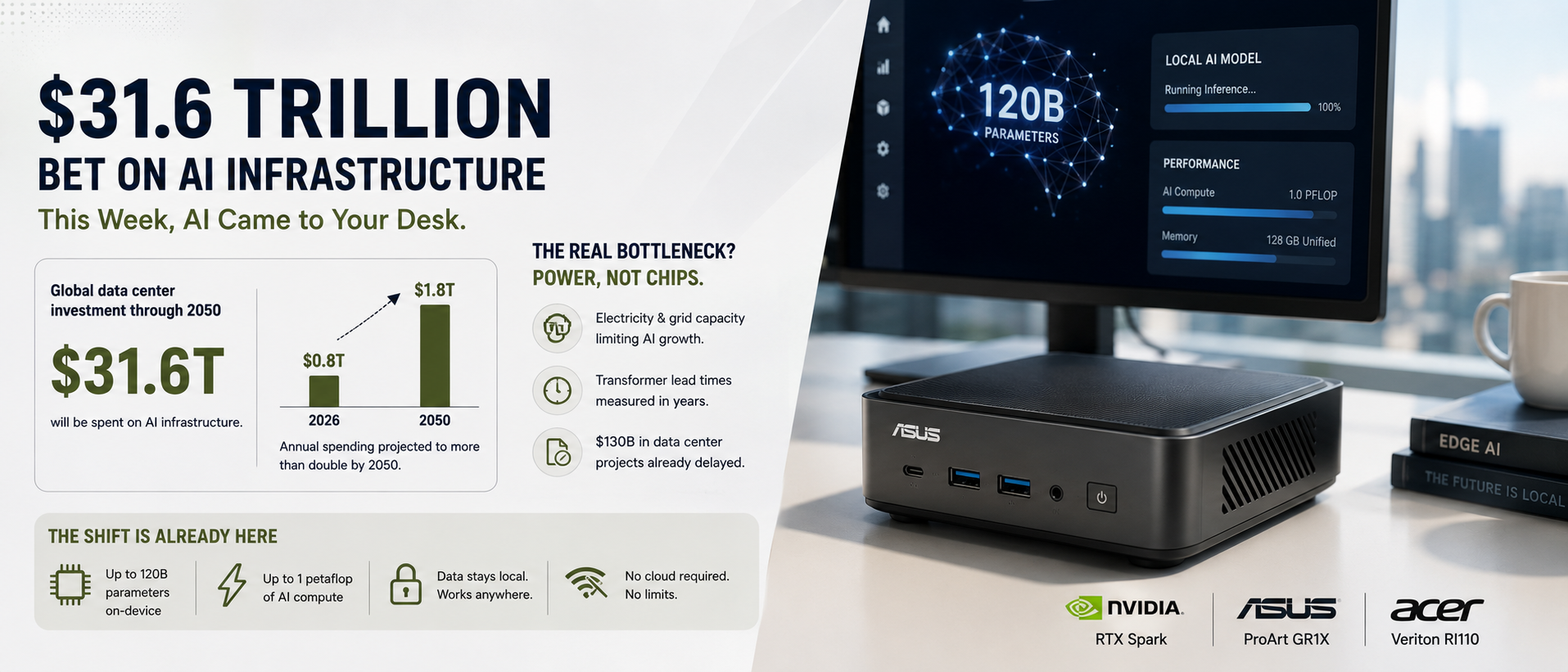
PwC says AI infrastructure will cost $31.6T through 2050 and power, not chips, is the bottleneck. Days later, palm-sized PCs launched running 120B-parameter models locally.
AI infrastructure spending 2050, PwC data center report, local AI PC 120 billion parameters, NVIDIA RTX Spark, edge AI computing 2026
AI infrastructure spending 2050, PwC data center report, local AI PC 120 billion parameters, NVIDIA RTX Spark, edge AI computing 2026
The bottleneck just changed — and so did the workaround
Two numbers from the same week tell two sides of the same story. PwC says building out the world's AI infrastructure will cost $31.6 trillion through 2050 - and that the thing actually limiting that buildout isn't money or chips anymore, it's electricity. Days later, at IFA 2026 in Berlin, hardware makers started shipping palm-sized computers that run massive AI models without touching a data center's power grid at all.
One story is about a bottleneck the size of a national economy. The other is a handful of companies quietly building around it.
The real finding buried in PwC's number
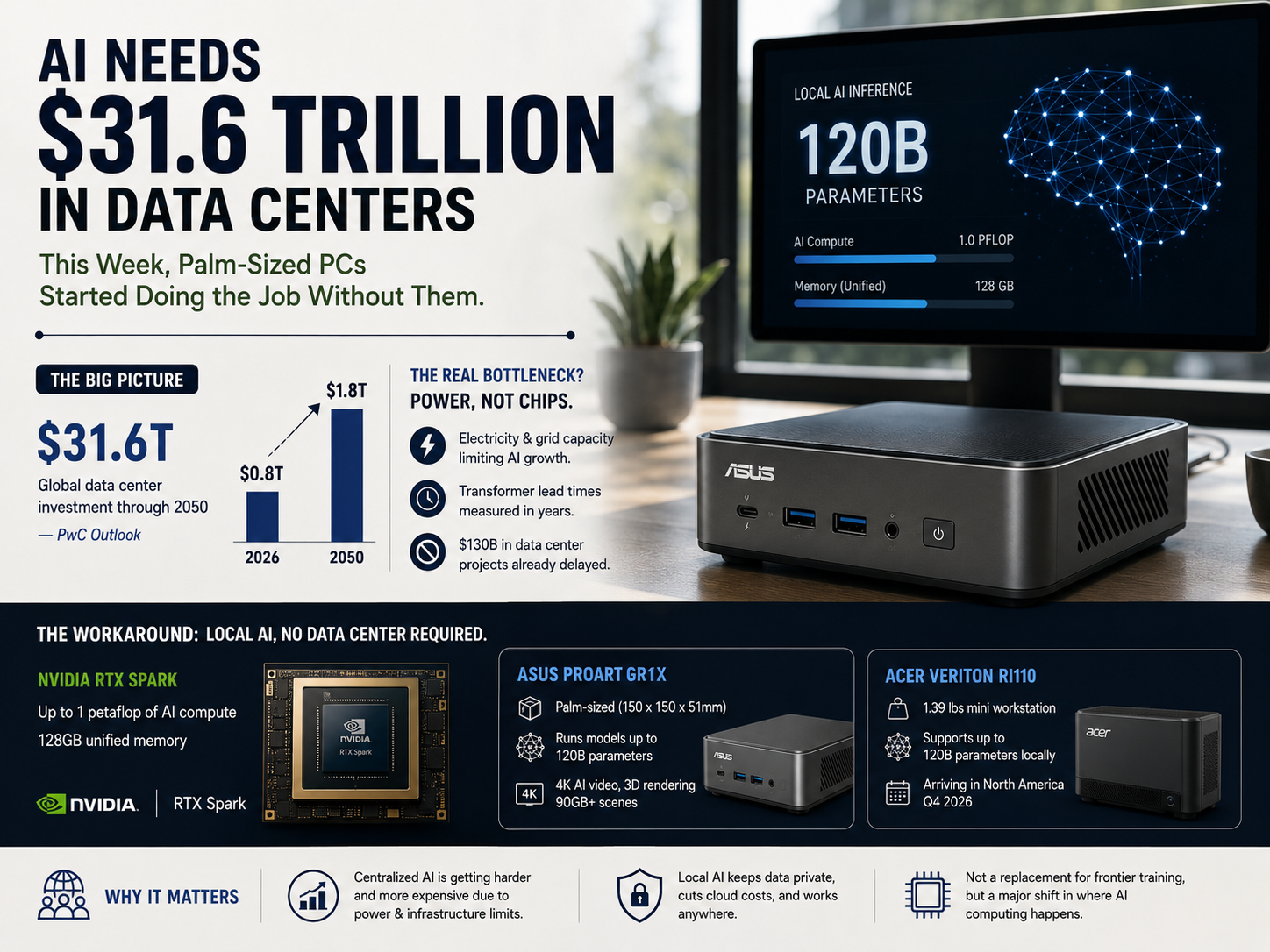
The headline figure — $31.6 trillion in cumulative global data center spending through 2050, based on modeling PwC commissioned from Oxford Economics across 46 countries — is eye-catching on its own. Annual spending is projected to climb from roughly $800 billion this year to $1.8 trillion by 2050 , a scale PwC explicitly says dwarfs what railways, electrification, or the original internet buildout cost, with a plausible range stretching to $50 trillion if AI adoption accelerates faster than expected.
But the more consequential finding isn't the size of the number — it's what PwC says is actually constraining it. The report is explicit: the industry has plenty of capital. What it doesn't have enough of is reliable, affordable electricity at scale , along with grid connections, transformers, and planning approvals that all move slower than money does. PwC points to concrete evidence already playing out — grid connection queues stretching out in Texas and Denmark, transformer lead times measured in years, and at least 75 data center projects stalled by local opposition in this year's first quarter alone, representing roughly $130 billion in delayed investment.
There's a second structural shift buried in the report that matters just as much: unlike past infrastructure booms that front-loaded spending and then tapered off, AI infrastructure investment is expected to keep accelerating , because chips and equipment need replacing every four to six years. Equipment already makes up 70% of data center capex today; PwC expects that to hit 93% by 2050 — meaning a "data center" increasingly looks less like a durable building and more like a business that has to keep re-buying its core asset every few years, forever.
The counter-move: shrinking the data center into a desktop
While PwC's report was landing, hardware makers at IFA 2026 were showing the other half of this story — literally in the same week. NVIDIA's new RTX Spark superchip — pairing a 20-core Grace CPU with a Blackwell GPU carrying up to 6,144 CUDA cores — delivers up to one petaflop of AI compute and 128GB of unified memory in devices small enough to fit in a palm.
ASUS built its new ProArt GR1X mini PC around it: a 150 x 150 x 51mm box capable of running local language models with up to 120 billion parameters , rendering 3D scenes larger than 90GB, and generating 4K AI video — entirely on-device. Acer showed a similar concept design alongside its already-shipping Veriton RI110 AI Mini Workstation, a 1.39-pound box that also supports up to 120-billion-parameter models locally, arriving in North America in Q4 2026.
The pitch from both companies is nearly identical, and it maps directly onto PwC's bottleneck: local AI compute turns unpredictable, pay-per-token cloud costs into fixed hardware you already own, keeps sensitive files and prompts off remote servers entirely, and keeps working even when there's no connection to the cloud at all — the exact three pressure points a strained, expensive, grid-constrained centralized AI infrastructure creates.
Why the two stories are actually one story
PwC's report and IFA's local AI hardware aren't a coincidence of timing so much as two visible ends of the same pressure. As the cost and physical difficulty of building centralized AI infrastructure climbs — measured now in trillions of dollars and years-long grid queues — some share of AI workloads is being pushed toward the one place that doesn't need a new power substation: the device already sitting on someone's desk. That's not a full substitute for frontier-scale training or massive concurrent cloud workloads, which both companies are careful to say still belong in the data center. But for a real slice of everyday inference work — running an agent, editing a document, generating an image, drafting a note — the palm-sized box increasingly doesn't need permission from the grid at all.
Why it matters
For businesses and governments watching the $31.6 trillion number and wondering who actually captures that spending, PwC's own modeling suggests the answer increasingly depends on power availability, not ambition — the US is projected to capture 48% of it largely because of its position in the advanced-chip ecosystem, not because other markets want AI infrastructure less. Local AI hardware doesn't solve that scarcity. But it does mean that for individuals and companies who can't wait on grid queues or don't want their data touching a shared cloud, real AI compute is becoming something you buy once and own, rather than something you have to be near a data center to access.
If a $31.6 trillion buildout is being throttled by power grids that take years to expand, will local AI hardware end up as a stopgap for the workloads centralized infrastructure can't get to fast enough — or the start of a genuine shift in where AI computing actually happens?
---
Sources : [PwC Global Data Centre Outlook] - (https://www.pwc.com/gx/en/news-room/press-releases/2026/global-investment-in-ai-infrastructure.html),
[PwC capex analysis] - (https://www.pwc.com/gx/en/ghost/where-31-6-trillion-of-capex-flows-in-the-era-defining-ai-build.html),
[Yahoo Finance] - (https://uk.finance.yahoo.com/news/data-center-spending-reach-31-040000619.html),
[ASUS Pressroom] - (https://press.asus.com/news/press-releases/asus-proart-p16-p14-gr1x-rtx-spark-ifa-2026/),
[Yanko Design] - (https://www.yankodesign.com/2026/09/02/acer-shrank-server-level-ai-into-two-mini-desktops-at-ifa-2026/).
[PwC capex analysis] - (https://www.pwc.com/gx/en/ghost/where-31-6-trillion-of-capex-flows-in-the-era-defining-ai-build.html),
[Yahoo Finance] - (https://uk.finance.yahoo.com/news/data-center-spending-reach-31-040000619.html),
[ASUS Pressroom] - (https://press.asus.com/news/press-releases/asus-proart-p16-p14-gr1x-rtx-spark-ifa-2026/),
[Yanko Design] - (https://www.yankodesign.com/2026/09/02/acer-shrank-server-level-ai-into-two-mini-desktops-at-ifa-2026/).

Vishal Sable
B.Tech AD @ shri balaji institute of technology and management
Engineering and tech journalist. I love exploring the impact of emerging technologies on global defense, sovereignty, and everyday life. Always looking for the real story behind the headlines.