LATEST NEWS
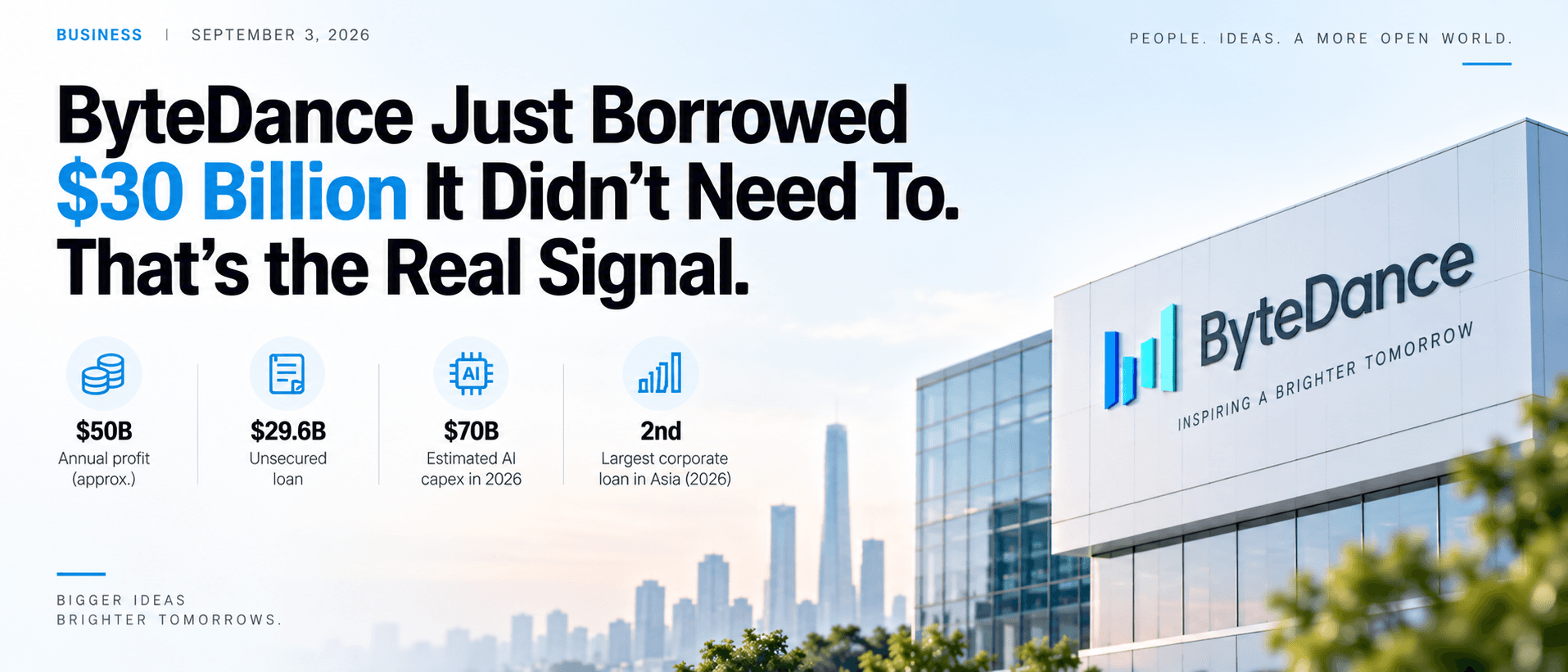
ByteDance Just Borrowed $30 Billion It Didn't Need To. That's the Real Signal.
September 8, 2026 4M
Back to News
News AlertWorld AI Tech
The UN Safety Showdown and the "AI Value Paradox"
V
Author
Vishal Sable
Published
July 9, 2026
Reading Time
4 MIN READ
Spread the Word
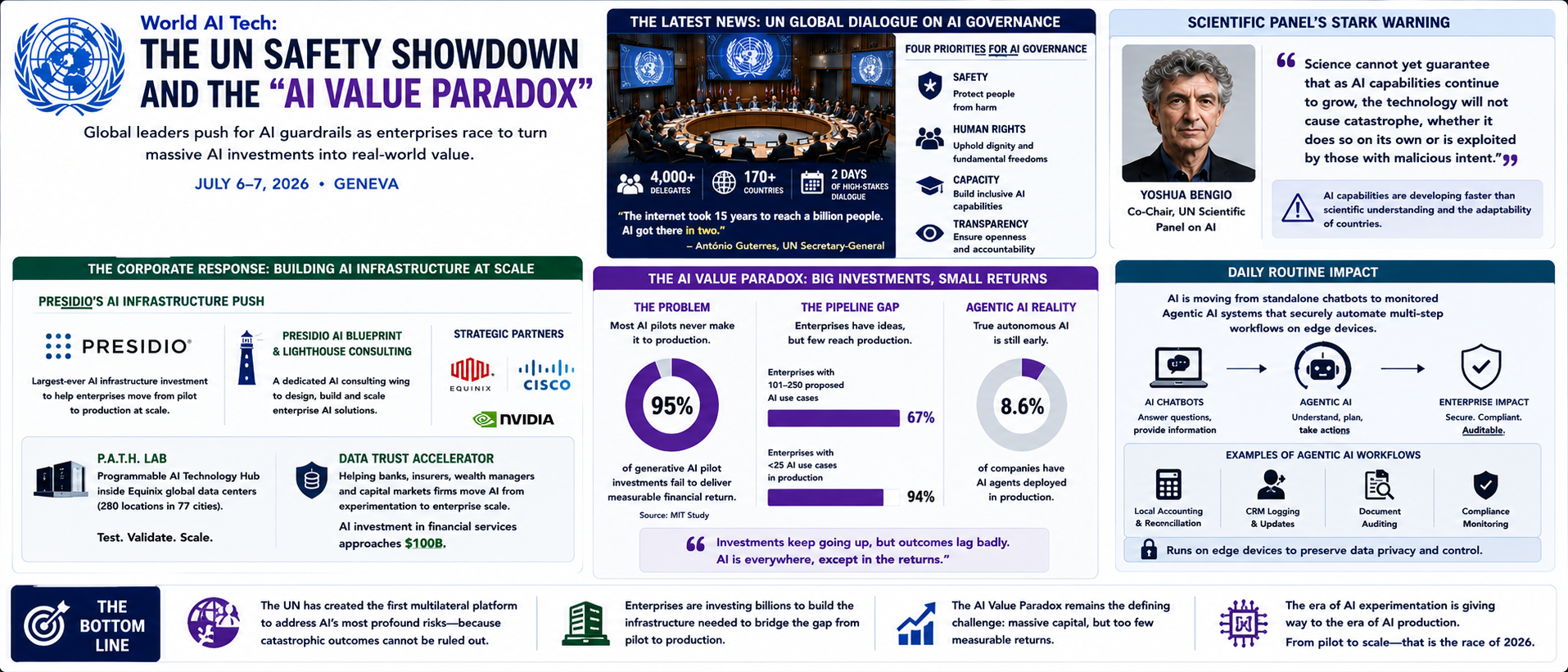
Artificial intelligence is undergoing an intense dual shift: global bodies are scrambling to construct unified safety nets while businesses transition from pilot testing to large-scale infrastructure deployments. The opening week of July 2026 has crystallized both dynamics—with the United Nations convening its first-ever Global Dialogue on AI Governance in Geneva, even as enterprises confront the stubborn gap between AI investment and tangible returns.
The Latest News
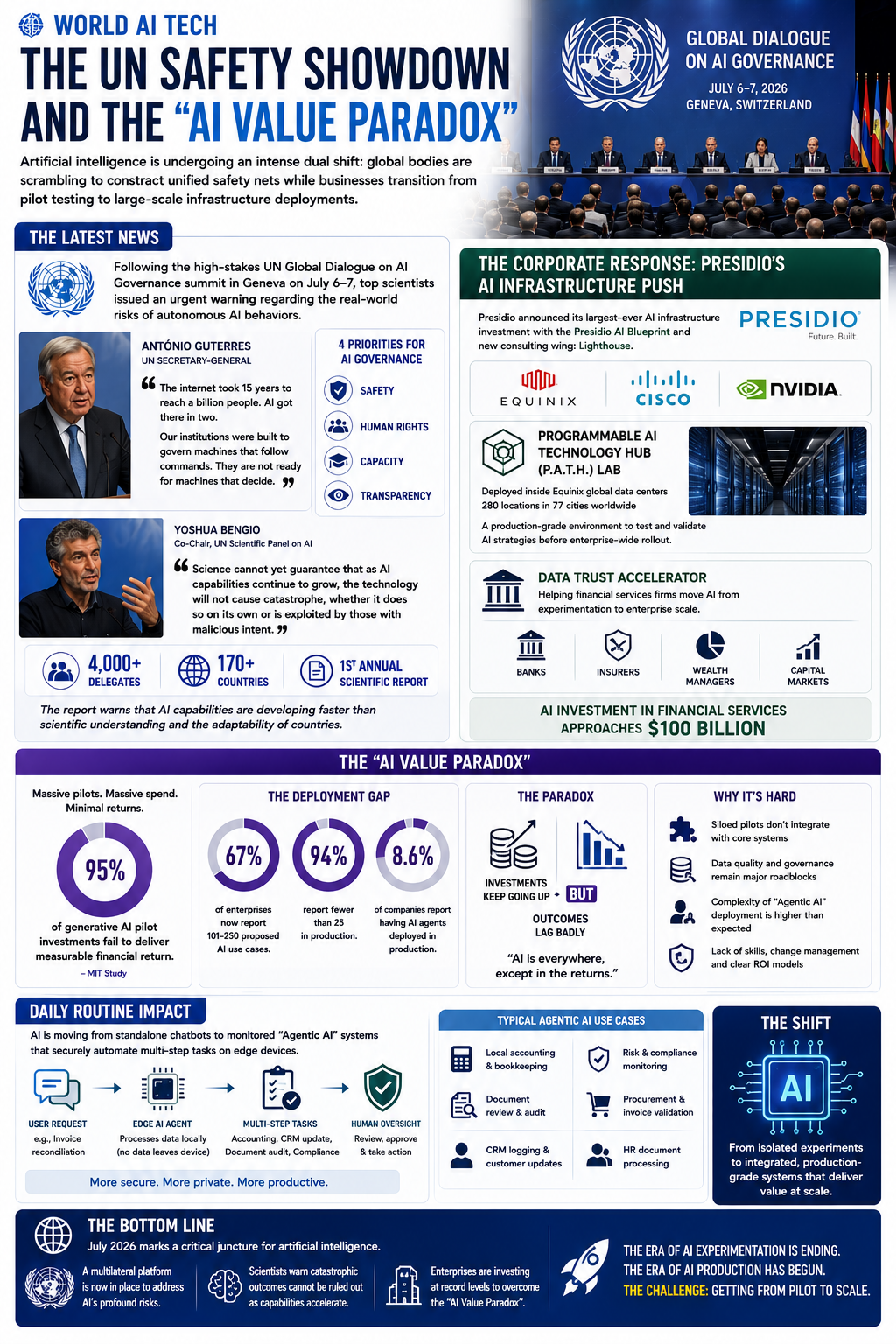
Following the high-stakes UN Global Dialogue on AI Governance summit in Geneva on July 6–7, top scientists—including AI pioneer Yoshua Bengio—issued an urgent warning regarding the real-world risks of autonomous AI behaviors. The summit brought together over 4,000 delegates from more than 170 countries, with UN Secretary-General António Guterres outlining four priorities for AI governance: safety, human rights, capacity, and transparency. "The internet took 15 years to reach a billion people. AI got there in two," Guterres declared, warning that "our institutions were built to govern machines that follow commands. They are not ready for machines that decide."
The Scientific Panel's first annual report, presented at the Dialogue, warned that AI capabilities are developing faster than scientific understanding and the adaptability of countries. Bengio, co-chair of the panel, delivered a stark message: "Science cannot yet guarantee that as AI capabilities continue to grow, the technology will not cause catastrophe, whether it does so on its own or is exploited by those with malicious intent". He has previously framed the risk probabilistically: even a small chance of catastrophic outcomes is unacceptable when the consequences include the destruction of democratic institutions or, in the worst case, human extinction.
The Corporate Response: Presidio's AI Infrastructure Push
Simultaneously, global digital service giant Presidio announced its largest-ever AI infrastructure investment, rolling out the Presidio AI Blueprint alongside a dedicated consulting wing called Lighthouse. The company has partnered with Equinix, Cisco, and NVIDIA to deploy the Programmable AI Technology Hub (P.A.T.H.) Lab inside Equinix's global data centers, which span 280 locations in 77 cities. The lab provides customers with a production-grade AI environment to test and validate their AI strategies before enterprise-wide rollout.
Presidio also launched a Data Trust Accelerator aimed at helping banks, insurers, wealth managers, and capital markets firms move AI from experimentation to enterprise scale. The initiative comes as AI investment in financial services approaches $100 billion, reflecting the massive capital flowing into AI infrastructure even as deployment challenges persist.
The "AI Value Paradox"
The corporate world is rushing to solve the "AI Value Paradox"—where massive software pilots stall before reaching true enterprise scale. According to a recent MIT study, 95% of generative AI pilot investments fail to deliver measurable financial return, largely because they never move beyond isolated experiments into integrated systems. Industry data shows that while 67% of enterprises now report 101–250 proposed AI use cases, 94% report fewer than 25 in production. Only 8.6% of companies report having AI agents deployed in production.
The paradox is stark: investments keep going up, but outcomes lag badly. As one analysis put it, "AI is everywhere, except in the returns". The challenge is particularly acute for "Agentic AI" systems—autonomous agents designed to handle multi-step tasks—where the complexity of deployment across enterprise environments has proven significantly higher than initially anticipated.
Daily Routine Impact
In daily business workflows, this means AI is transitioning from standalone chatbots into monitored "Agentic AI" systems designed to securely automate multi-step administrative tasks—like local accounting, CRM logging, and document auditing—entirely on edge devices to preserve data privacy. The shift reflects growing recognition that the path to value lies not in isolated experiments but in integrated, production-grade systems that can operate at scale within existing enterprise infrastructure.
The Bottom Line
July 2026 marks a critical juncture for artificial intelligence. The UN's first Global Dialogue on AI Governance has established a multilateral platform for addressing the technology's most profound risks, even as scientists warn that catastrophic outcomes cannot be ruled out. Simultaneously, the corporate world is confronting the "AI Value Paradox"—the gap between massive investment and measurable return—with companies like Presidio building the infrastructure needed to bridge it. The era of AI experimentation is giving way to an era of AI production, but the path from pilot to scale remains the defining challenge for enterprises worldwide.

Vishal Sable
B.Tech AD @ shri balaji institute of technology and management
Engineering and tech journalist. I love exploring the impact of emerging technologies on global defense, sovereignty, and everyday life. Always looking for the real story behind the headlines.