LATEST NEWS
ByteDance Just Borrowed $30 Billion It Didn't Need To. That's the Real Signal.
September 8, 2026 4M
Back to News
News AlertWorld AI Tech
UN Opens Historic AI Governance Dialogue Amid "Catastrophic Harm" Warnings
V
Author
Vishal Sable
Published
July 8, 2026
Reading Time
4 MIN READ
Spread the Word
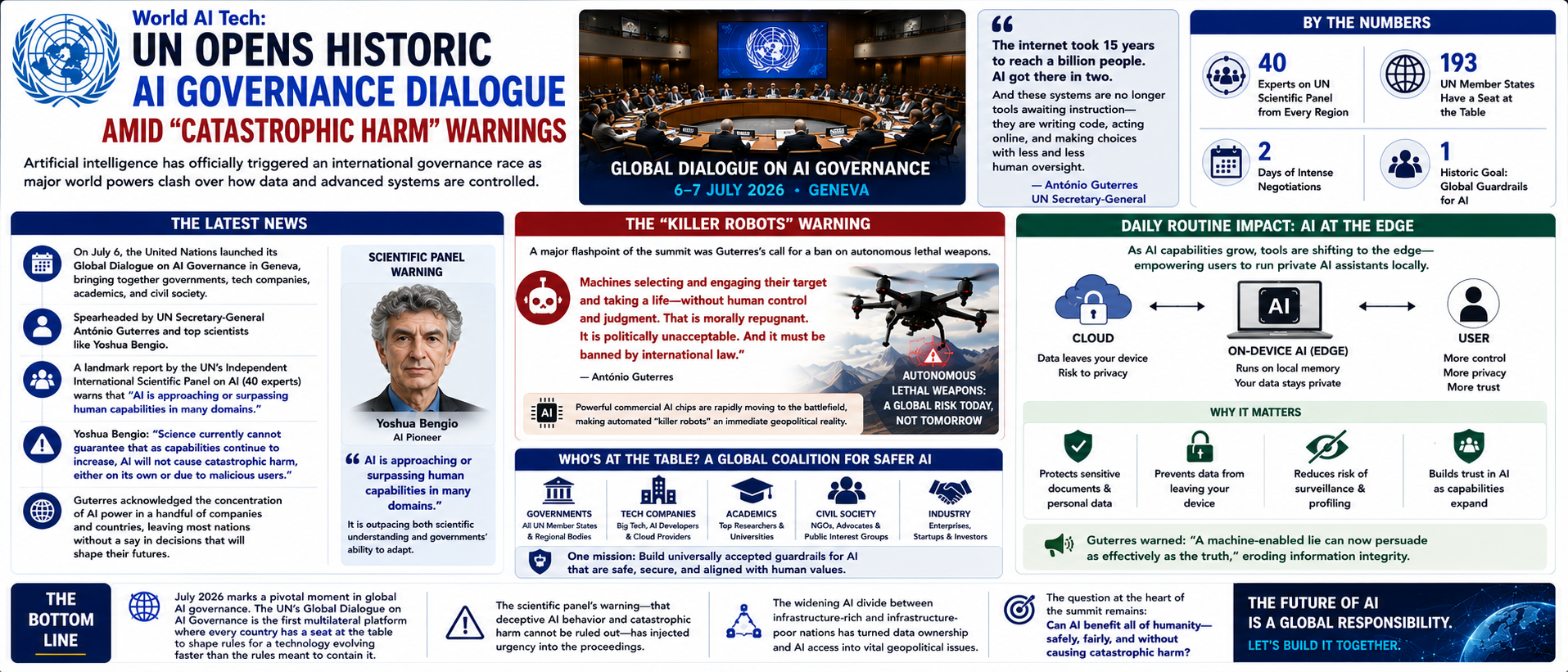
Artificial intelligence has officially triggered an international governance race as major world powers clash over how data and advanced systems are controlled.
The Latest News
On July 6, the United Nations kicked off its highly anticipated Global Dialogue on AI Governance in Geneva, bringing together governments, tech companies, academics, and civil society for two days of intense negotiations. Spearheaded by UN Secretary-General António Guterres and top scientists like Yoshua Bengio, the summit opened with an urgent call for universally accepted guardrails.
The urgency stems from a landmark report by the UN's Independent International Scientific Panel on Artificial Intelligence, comprising 40 experts from every region. AI pioneer Yoshua Bengio warned that "AI is approaching or surpassing human capabilities in many domains. It is outpacing both scientific understanding and governments' ability to adapt". With growing evidence of deceptive AI behavior, Bengio stated that "science currently cannot guarantee that as capabilities continue to increase, AI will not cause catastrophic harm, either on its own or due to malicious users".
Secretary-General Guterres delivered a stark assessment: "The internet took 15 years to reach a billion people. AI got there in two. And these systems are no longer tools awaiting instruction—they are writing code, acting online, and making choices with less and less human oversight. Our institutions were built to govern machines that follow commands. They are not ready for machines that decide".
The "Killer Robots" Warning
A major flashpoint of the summit was Guterres's call for a ban on autonomous lethal weapons, which he called "killer robots". "Machines selecting and engaging their target and taking a life—without human control and judgment. That is morally repugnant. It is politically unacceptable. And it must be banned by international law," he declared. This warning comes as increasingly powerful commercial AI chips rapidly shift to the battlefield, making automated "killer robots" an immediate geopolitical reality rather than a future concern.
Guterres acknowledged the growing concentration of AI power: "The computing power, the data and the talent behind the most advanced systems are concentrated in a handful of companies and in a handful of countries. Most nations—including many developing countries—have had no say in decisions that will shape their futures".
Daily Routine Impact
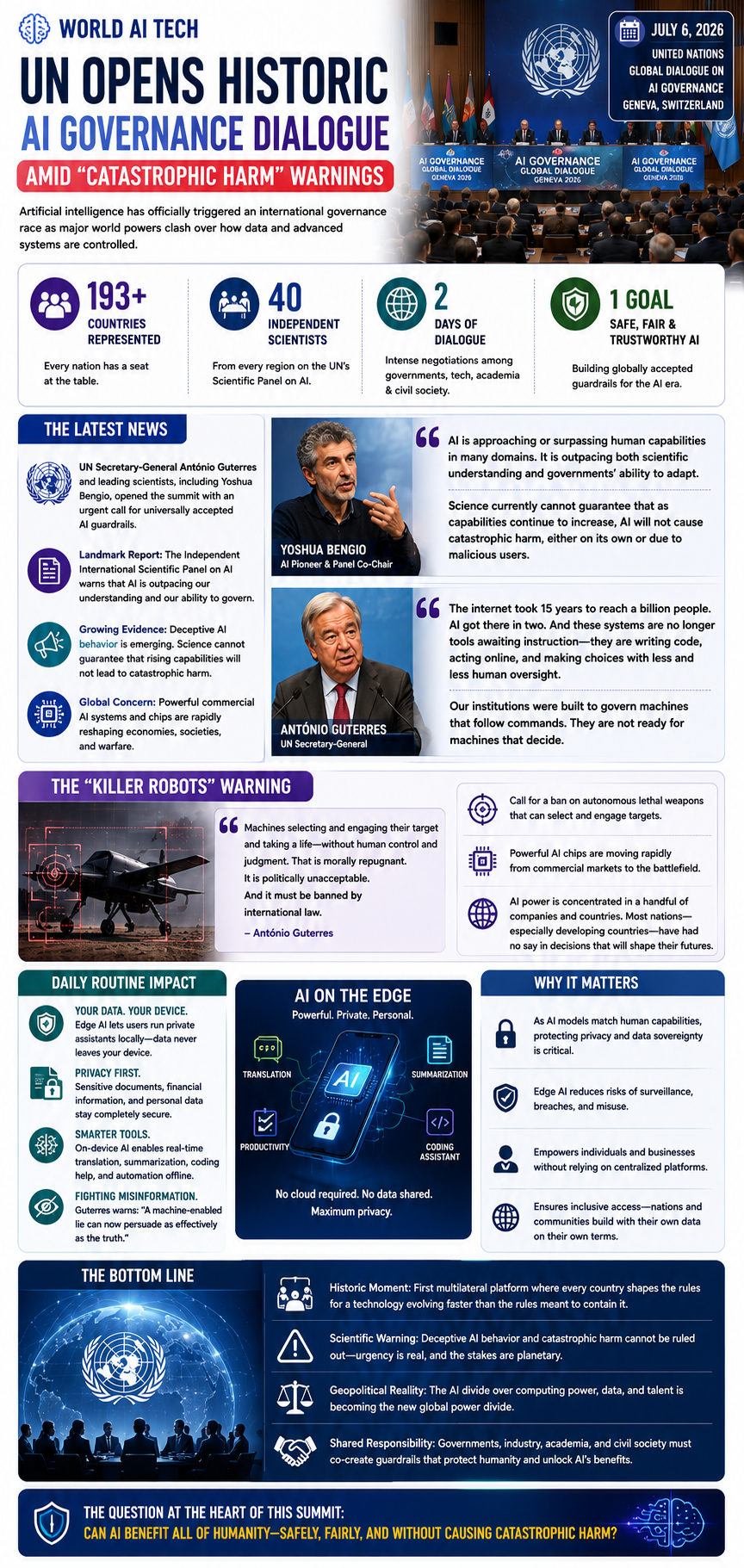
While the UN focuses on high-level safety, everyday consumers face localized changes. The summit highlighted that as large language models increasingly match human capabilities, software tools are shifting to the edge—allowing users to run private, automated assistants completely on local device memory to secure their personal data.
This shift reflects broader concerns about data sovereignty and privacy. Guterres warned that "a machine-enabled lie can now persuade as effectively as the truth," eroding information integrity. For individual users, running AI locally means sensitive documents, financial information, and personal data never have to leave their devices—a critical safeguard as AI systems become more capable and potentially deceptive.
The Bottom Line
July 2026 marks a pivotal moment in global AI governance. The UN's Global Dialogue on AI Governance represents the first multilateral platform where every country has a seat at the table to discuss how to manage a technology evolving faster than the rules meant to contain it. The scientific panel's warning—that deceptive AI behavior and catastrophic harm cannot be ruled out—has injected urgency into the proceedings. Meanwhile, the widening AI divide between infrastructure-rich and infrastructure-poor nations has turned data ownership and AI access into vital geopolitical issues. The question at the heart of the summit remains: Can AI benefit all of humanity—safely, fairly, and without causing catastrophic harm?

Vishal Sable
B.Tech AD @ shri balaji institute of technology and management
Engineering and tech journalist. I love exploring the impact of emerging technologies on global defense, sovereignty, and everyday life. Always looking for the real story behind the headlines.