Back to News
News AlertWorld of Startup’s
AI Took 64% of Q3 2026 Venture Funding, But Mega-Rounds Are Spreading
V
Author
Vicky Galfat
Published
October 8, 2026
Reading Time
4 MIN READ
Spread the Word
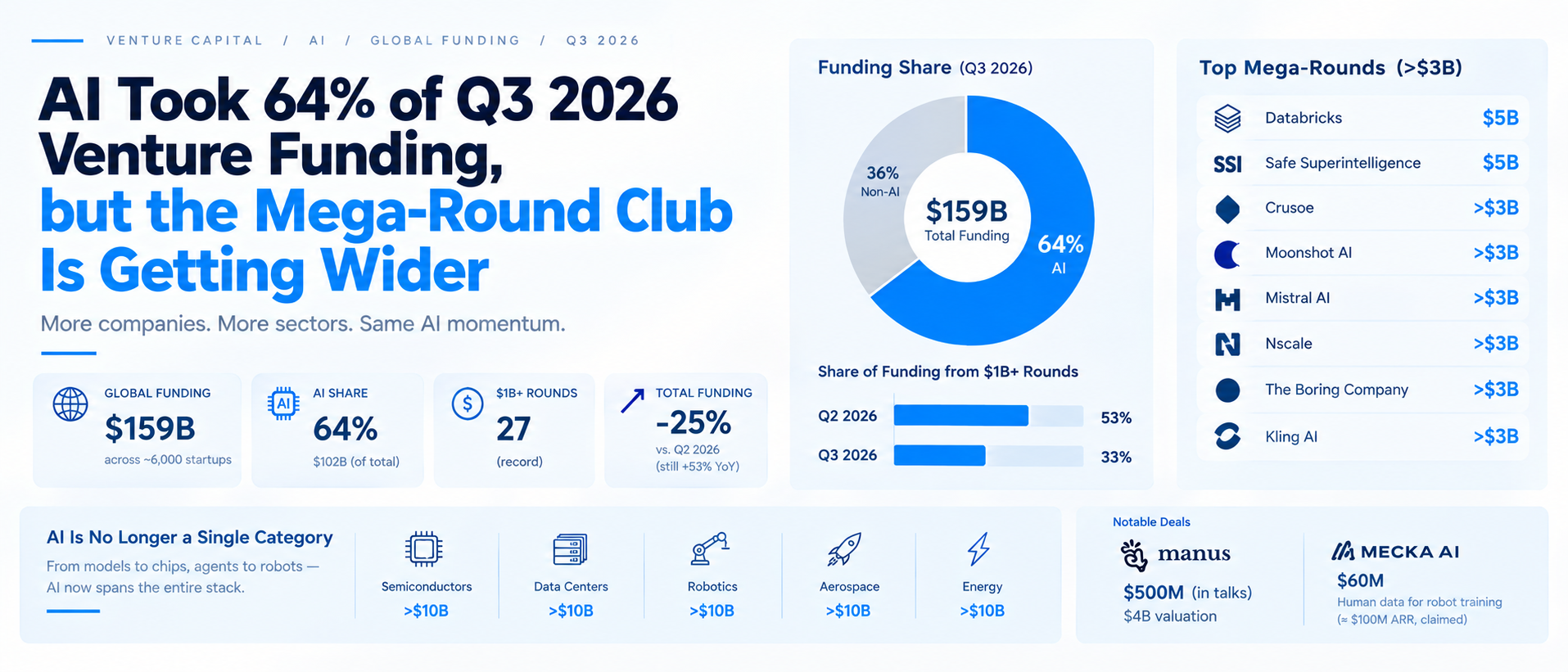
A record 27 startups raised $1B+ rounds in Q3 2026, yet their share of funding fell from 53% to a third as AI hit 64% of the $159B total.
Q3 2026 venture capital, AI startup funding 2026, Crunchbase Q3 2026, billion-dollar funding rounds, AI share of venture capital, physical AI funding, Manus funding round, Mecka AI, global startup funding.
Q3 2026 venture capital, AI startup funding 2026, Crunchbase Q3 2026, billion-dollar funding rounds, AI share of venture capital, physical AI funding, Manus funding round, Mecka AI, global startup funding.
AI Took 64% of Q3 2026 Venture Funding, but the Mega-Round Club Is Getting Wider
Everyone expects the headline from this quarter's venture data to be "AI hoards the money." The more interesting detail is buried a layer down: a record number of companies raised $1 billion or more, yet those deals made up a smaller slice of total funding than last quarter. Capital isn't just concentrating. It is spreading across a wider set of AI-adjacent winners.
The Numbers Behind the Quarter
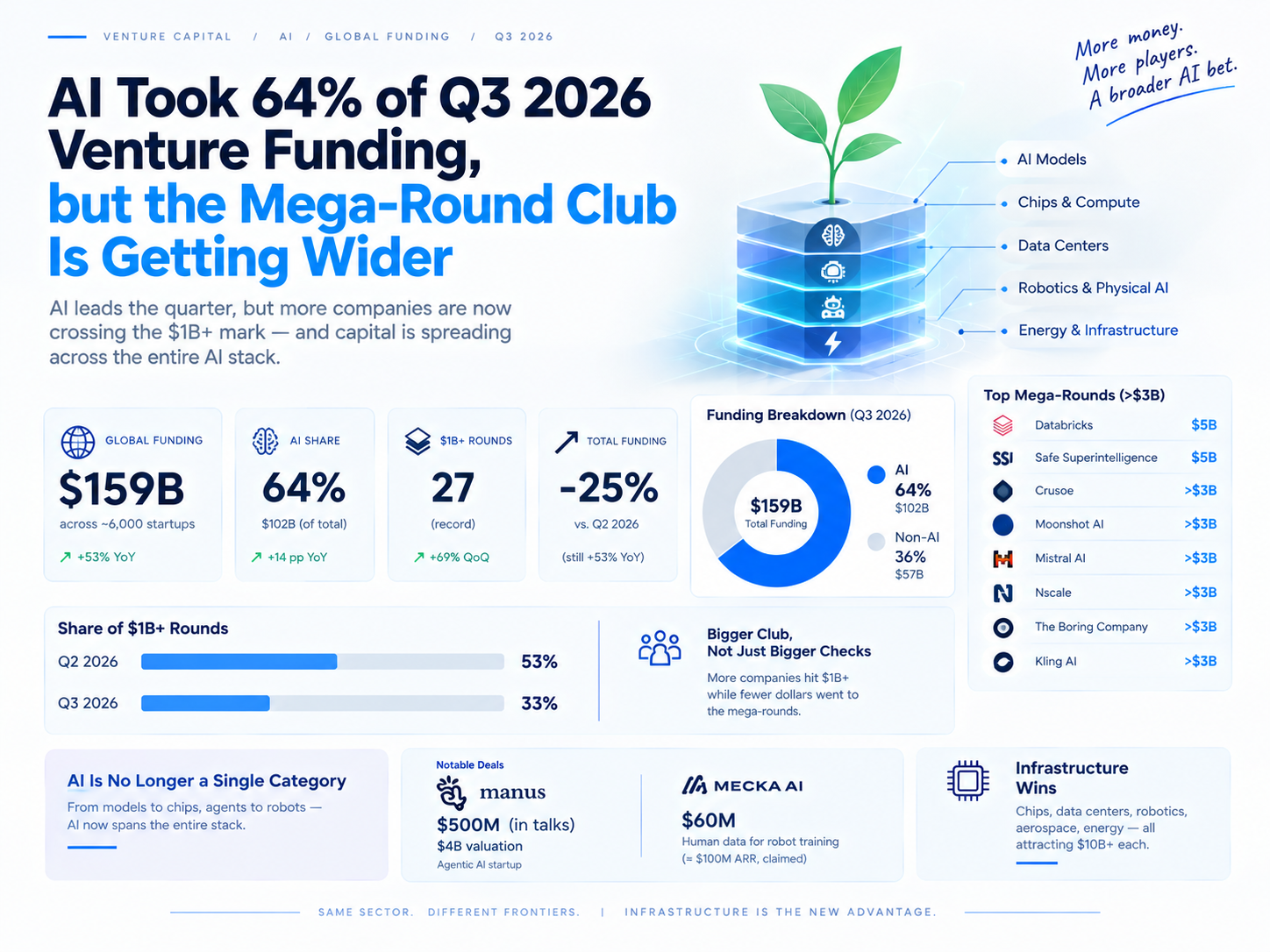
Global startups raised $159 billion in Q3 2026 across nearly 6,000 funded companies, according to Crunchbase. AI-driven startups took $102 billion of that, or 64%, which is 14 percentage points higher than the same quarter last year. A record 27 companies raised rounds of $1 billion or more, up from 16 in Q2 and 14 in Q1, and eight of them raised at least $3 billion. Databricks and Safe Superintelligence led with $5 billion each, followed by Crusoe, Moonshot AI, Mistral AI, Nscale, The Boring Company and Kling AI, each above $3 billion.
Total funding fell 25% from the $212 billion recorded in Q2, but it still rose 53% year over year. Nine-month funding has reached $679 billion, the strongest first three quarters on record.
Fewer Dollars in the Mega-Rounds, More Companies in the Club
Here is the part that complicates the "winner-takes-all" story. In Q2, 16 billion-dollar rounds totaled $108.6 billion, or 53% of the quarter's funding. In Q3, 27 such rounds took only about a third. Q2 was dominated by a handful of enormous deals, including a reported $65 billion raise by Anthropic, which makes the sequential drop look steeper than the underlying activity.
So the better reading is that the top tier is broadening. More companies now clear the $1 billion bar, while no single deal distorts the quarter the way a $65 billion round does. Late-stage funding reached $105 billion, up 73% from Q3 2025, while early-stage funding hit $40.6 billion, up 25%. Roughly half of Q3 dollars went to companies founded since 2022, a sign that new entrants are still winning allocation.
"AI" Now Means the Whole Stack
At 64% of all venture dollars, "AI" has stopped being a single category. It now spans models, chips, data centers, agents and robots. Even outside the AI label, the money is flowing to physical infrastructure: aerospace, robotics, data centers, semiconductors and energy each cleared more than $10 billion in Q3, according to ValueAdd VC's read of the Crunchbase data. The non-AI remainder was only about $57 billion.
The individual deals show the range. Manus, the agentic AI startup, is reportedly in talks to raise $500 million at a $4 billion valuation, doubling the $2 billion value at which its founders and backers bought back Meta's stake after Beijing forced the acquisition to unwind. The round has not been confirmed as closed. At the physical end, Mecka AI disclosed $60 million to supply robot training data collected from human body sensors and iPhones, and claims a $100 million annual run rate from signed contracts, though it has not named customers.
What Investors Are Really Pricing
Taken together, the quarter suggests investors are paying less for general-purpose model capability and more for the layers that make AI usable: compute capacity, workflow agents, and the data that teaches machines to act in the physical world. Exits tell a similar story. Nvidia's $12.9 billion deal for Hugging Face led US M&A activity, a reminder that strategic buyers are also competing for the same infrastructure layers.
The open question for Q4 is whether this broadening can hold. If AI's share stays above 60% for a fourth straight quarter, the "AI sector" will be effectively indistinguishable from "venture capital," and the real differentiator will be which parts of the stack can turn billion-dollar rounds into revenue.

Vicky Galfat
University of Mumbai/BCA
Learning, building, and exploring the world of technology one project at a time.