Back to News
News AlertWorld of Startup’s
Hard Tech Returns: Why Chips, EVs & Defense Are Out-Raising Software
V
Author
Vicky Galfat
Published
October 3, 2026
Reading Time
4 MIN READ
Spread the Word
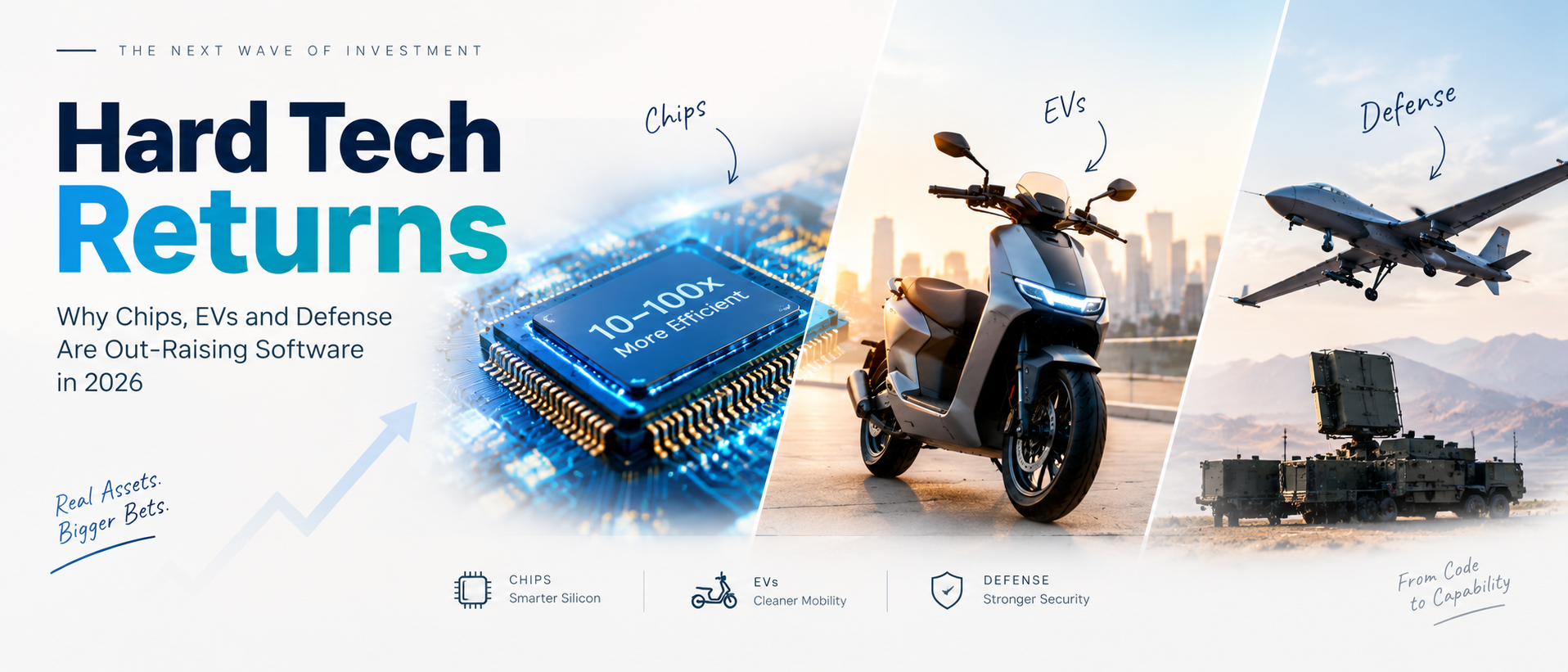
Efficient Computer raised $100M for chips 10-100x more power-efficient than Nvidia's, as AI's energy crunch pulls capital from software into physical hardware.
hard tech investing 2026, dataflow chip architecture, Efficient Computer funding, Simple Energy Series C, alternative chip architectures, AI energy bottleneck, electric two-wheeler funding India, defense dual-use startups
For most of the last decade, the biggest venture checks went to whoever could ship software fastest. In 2026, a quieter but more consequential shift is underway: the largest capital allocations are going to companies that make physical things — chips, vehicles, and defense hardware — not apps. Three deals from the past week show why the smart money is moving from bits back to atoms.
The Chip Betting Against Nvidia's Own Playbook
Efficient Computer, a semiconductor startup spun out of Carnegie Mellon University, just raised $100 million at a $650 million valuation to scale its "data-flow" processor architecture — a design in which computation moves through the chip as data arrives rather than following the rigid, step-by-step instruction cycles that define conventional CPUs and GPUs. The company claims this approach can deliver 10 to 100 times better energy efficiency than the x86 and ARM-based chips from Intel and Nvidia that currently dominate AI workloads, and its first commercial processor, Electron E1, is already shipping into drones and small robots before the company attempts to scale the same architecture toward data-center-class computing. Reuters
Why Energy, Not Raw Power, Is the New Bottleneck
The timing isn't coincidental. As AI infrastructure spending races toward hundreds of billions of dollars annually, the binding constraint has shifted from capital availability to power availability — data centers are now competing with entire cities for grid capacity, and battery-powered edge devices can't run modern AI workloads without burning through charge in minutes. Efficient Computer's CEO has described the company's approach as threading the needle between being easy to program, fast, and efficient, which matters because the hardest problem for any alternative chip architecture has never been raw performance — it's convincing developers to leave the mature software ecosystems built around x86 and ARM. Finimize
India's EV Manufacturers Are Making the Same Bet, On Wheels
A parallel dynamic is playing out in Indian electric mobility. Bengaluru-based Simple Energy closed a ₹1,750 crore (roughly $180 million) Series C round — its largest to date and the third-largest ever raised by an Indian electric two-wheeler manufacturer — led by the family office of Dr. Arokiaswamy Velumani, the founder of diagnostics chain Thyrocare. The capital will fund a new manufacturing facility, production scale-up, hiring, and retail network expansion, with the company targeting a 2028 IPO. Simple Energy builds its chassis, battery, motor, and software in-house, and was reportedly the first Indian EV maker to commercially produce heavy rare-earth-free motors — a detail that matters given how dependent global EV supply chains remain on Chinese rare-earth processing. YourStory
Defense Hardware Completes the Pattern
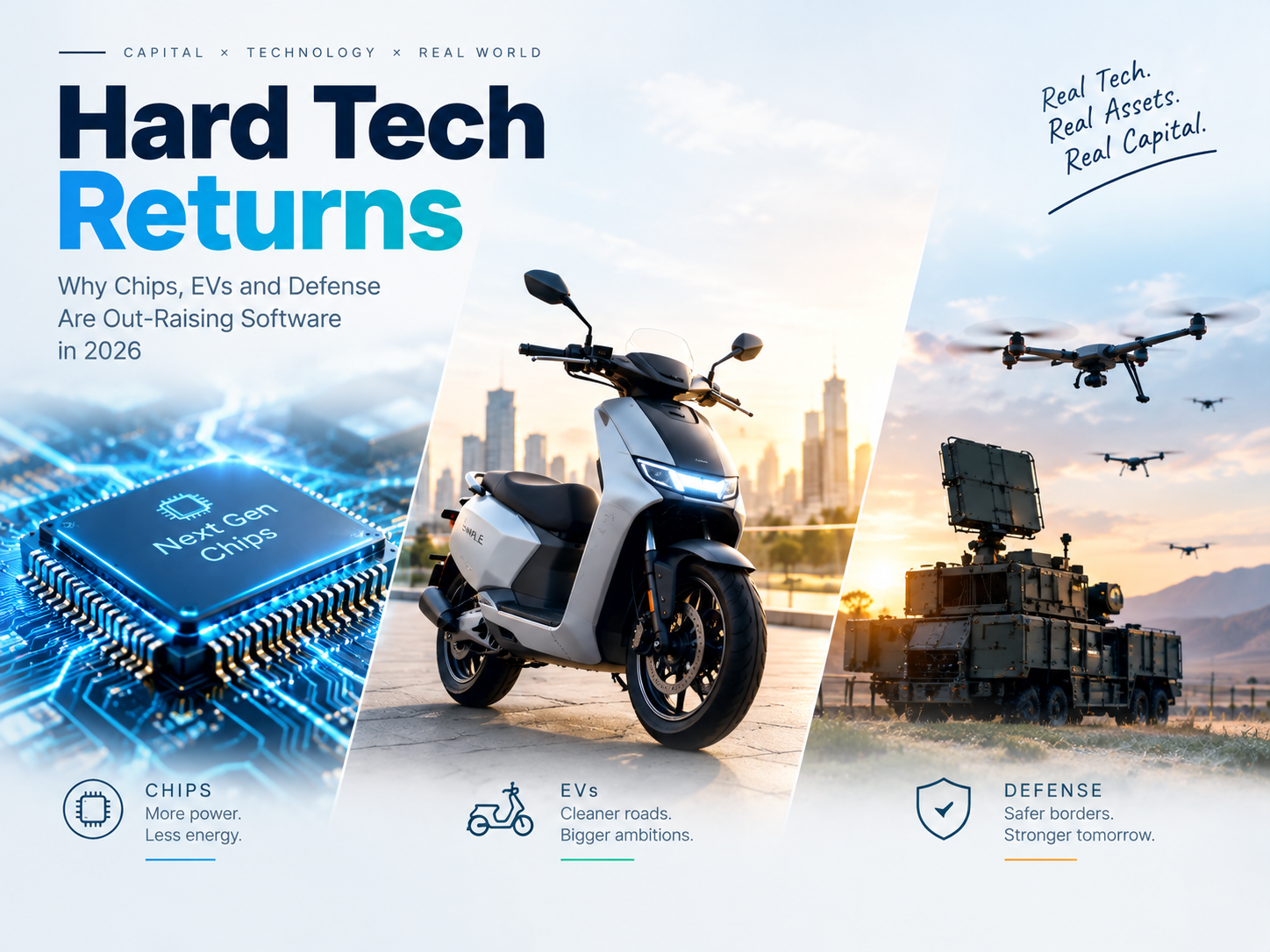
The same capital logic extends to defense and dual-use aerospace, where global military spending is pivoting hard toward autonomous systems, strategic electronics, and the kind of specialized hardware that can't be assembled from off-the-shelf cloud services. Growth-equity investors who once avoided the sector's long sales cycles and regulatory friction are now treating it as a core allocation, not a niche bet — drawn by the same thesis driving chip and EV investment: that durable advantage increasingly lives in physical infrastructure governments and militaries cannot simply license or outsource.
The Common Thread
What connects a Pittsburgh chip startup, a Bengaluru scooter maker, and the broader defense-tech buildout is a shared recognition that software alone can't solve the next decade's hardest constraints — energy, supply-chain sovereignty, and physical manufacturing capacity. Efficient Computer is betting that the AI boom's real bottleneck is joules per computation, not lines of code. Simple Energy is betting that owning the full manufacturing stack, down to rare-earth-free motors, insulates it from geopolitical supply shocks. And defense investors are betting that autonomous hardware, not another SaaS dashboard, is where the next generation of strategic value gets built.
If this pattern holds, the next big venture outcome stories may not come from a chat interface or a productivity app — they'll come from a factory floor. The open question is whether public markets, which have spent fifteen years rewarding asset-light software margins, are actually ready to re-price capital-intensive hardware at the premium these raises imply.
V
Vicky Galfat
University of Mumbai/Major
Learning, building, and exploring the world of technology one project at a time.