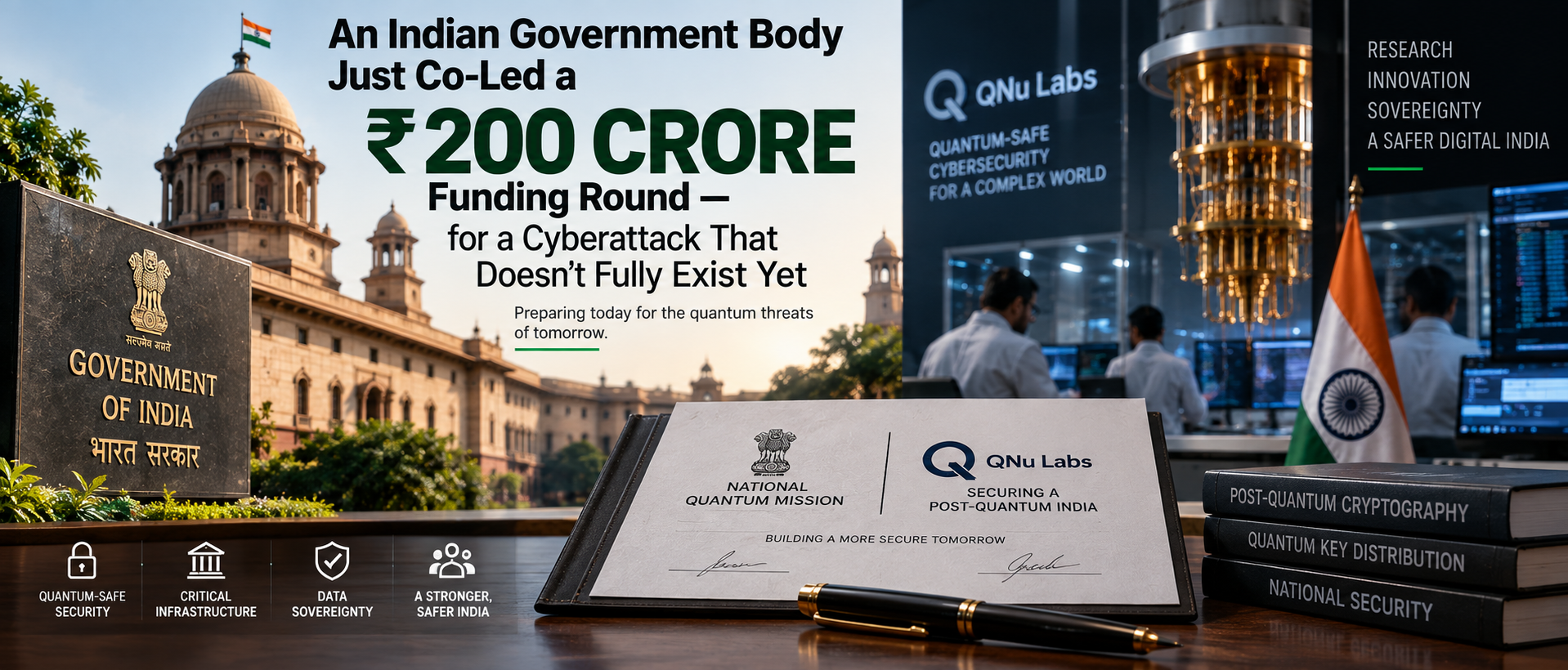
An Indian Government Body Just Co-Led a ₹200 Crore Funding Round — for a Cyberattack That Doesn't Fully Exist Yet
What actually happened
QNu Labs, a deep-tech cybersecurity company incubated at IIT Madras in 2016, raised ₹200 crore in a Series A1 round co-led by India's National Quantum Mission and Speciale Invest, with Sony Innovation Fund, Gaja Capital, and Artha Ventures also participating. The round takes QNu Labs' total capital raised to ₹375 crore. Roughly 80% of this round came from investors new to the company, which its CEO pointed to as a signal that global conviction in quantum-safe security is building rather than staying a niche, government-only concern. The company builds quantum key distribution and other quantum-resistant cryptography products, already deployed across Indian government agencies, critical infrastructure, and banking and financial services clients, with a team of roughly 160 engineers, physicists, and mathematicians. Part of the new capital will go toward QNu's contribution to a government-funded project building the technology backbone for India's Quantum Secure and Sensing Networks. Entrackr , Business Standard
Why a threat that doesn't fully exist yet is getting funded now
Who else is racing in the same space
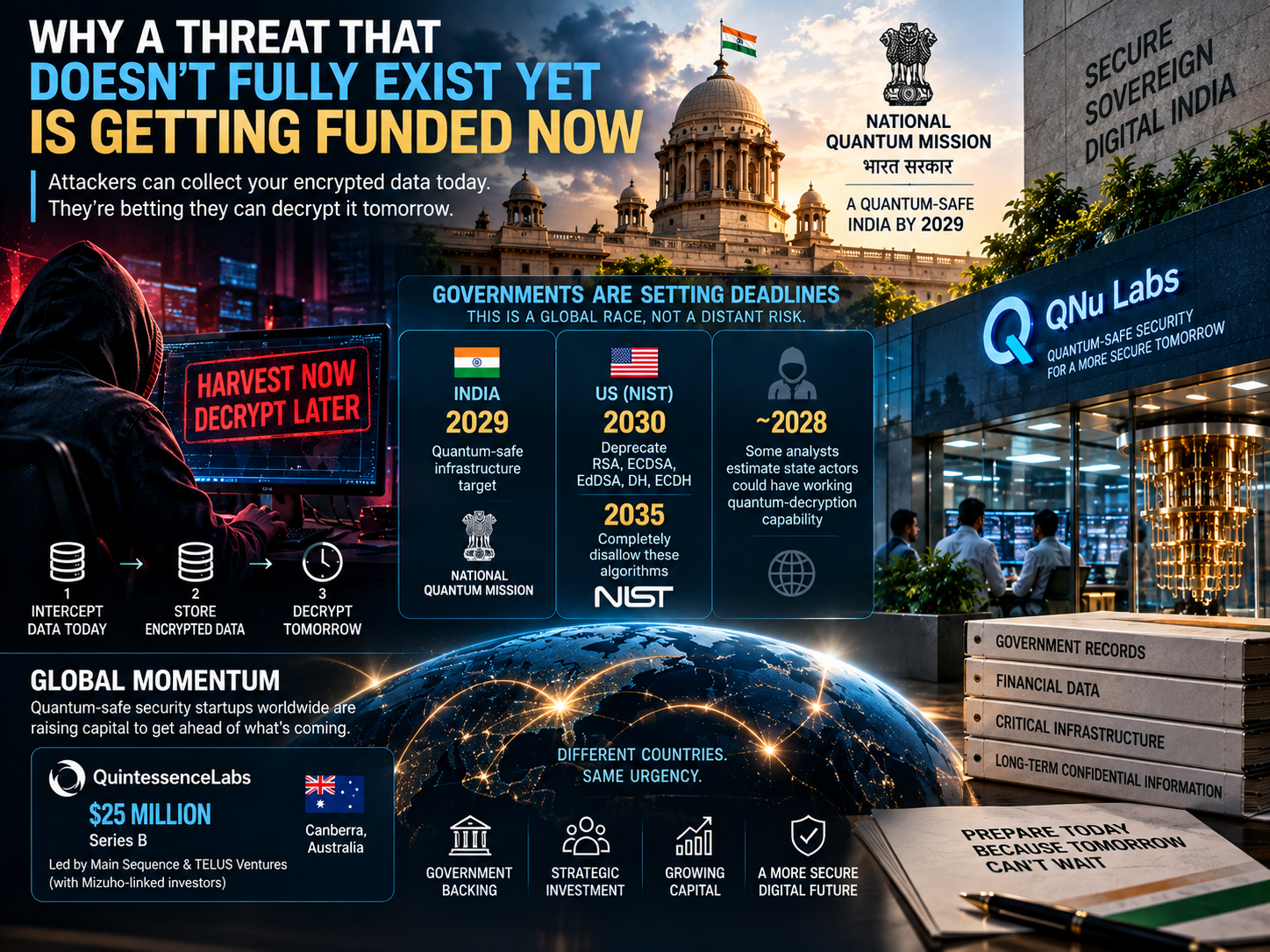
QNu Labs isn't the only quantum-safe cybersecurity company pulling in fresh capital right now — Canberra-based QuintessenceLabs, which builds quantum random number generators and data access control software, raised $25 million in a Series B round led by Main Sequence and TELUS Ventures around the same period, with backing from Mizuho-linked investors.
That parallel raise matters for how QNu's round should be read: this isn't one Indian company getting ahead of a distant, theoretical risk on its own — it's part of a wider pattern of capital moving into quantum-safe infrastructure across multiple countries at roughly the same time, each backed by domestic strategic interest rather than a single company's sales pitch. What sets QNu's round apart within that pattern is the direct government co-investment, rather than purely private-market backing.
TechCrunch
Why it matters
What makes this round unusual isn't the cybersecurity pitch — it's who's writing part of the check. Most government involvement in critical-infrastructure security shows up as regulation, procurement contracts, or grants; here, the National Quantum Mission is directly co-leading a private equity round alongside venture investors, treating quantum-safe migration as a strategic capability worth owning a stake in rather than just mandating. That's a meaningfully different posture than most countries have taken toward quantum-security preparedness so far, and it puts India in a position to export sovereign quantum-safe technology rather than import it once global demand catches up to the threat. With the same AI systems now accelerating cryptographic research on both the offense and defense side, the pressure to move early on "harvest now, decrypt later" risk is compounding faster than most enterprises are currently planning for. Business Standard
FAQ
What does QNu Labs actually build?
Quantum-safe cybersecurity products, including quantum key distribution (QKD) and other cryptographic technologies designed to protect data against both current threats and future quantum-computing-capable attacks.
How much did QNu Labs raise, and from whom?
₹200 crore in a Series A1 round, co-led by India's National Quantum Mission and Speciale Invest, with Sony Innovation Fund, Gaja Capital, and Artha Ventures also participating. Total capital raised to date is ₹375 crore.
What is "harvest now, decrypt later"?
An attack pattern where adversaries collect and store encrypted data today, betting they'll be able to decrypt it once quantum computers become powerful enough — making long-lived sensitive data vulnerable even before quantum-breaking computers exist.
Why is an Indian government body co-leading a startup funding round?
India's National Quantum Mission has set a 2029 target for national quantum-safe infrastructure migration, and is treating investment in domestic quantum-security capability as a strategic priority rather than only a regulatory one.
Is India's 2029 deadline unusual globally? No — it lines up with a broader global push. The US NIST has set 2030 as the deadline to deprecate current encryption algorithms (RSA, ECDSA, and others) and 2035 for full disallowance, with some analysts estimating state actors could have working quantum-decryption capability as early as 2028.

Tarun Punde
B.Tech AIADS@ Shri Balaji Institute of Technology & Management
I write at Metaplugs — breaking down the latest in tech, economics, and business into simple, impactful stories for everyday readers. Passionate about software testing and global finance.