Venture Capital Mega-Funds Pour Billions Into AI and Deep Tech in 2026
DoorDash Doesn't Operate in India. So Why Did It Just Fund an Indian Drone Startup's Government Deal?
What actually happened
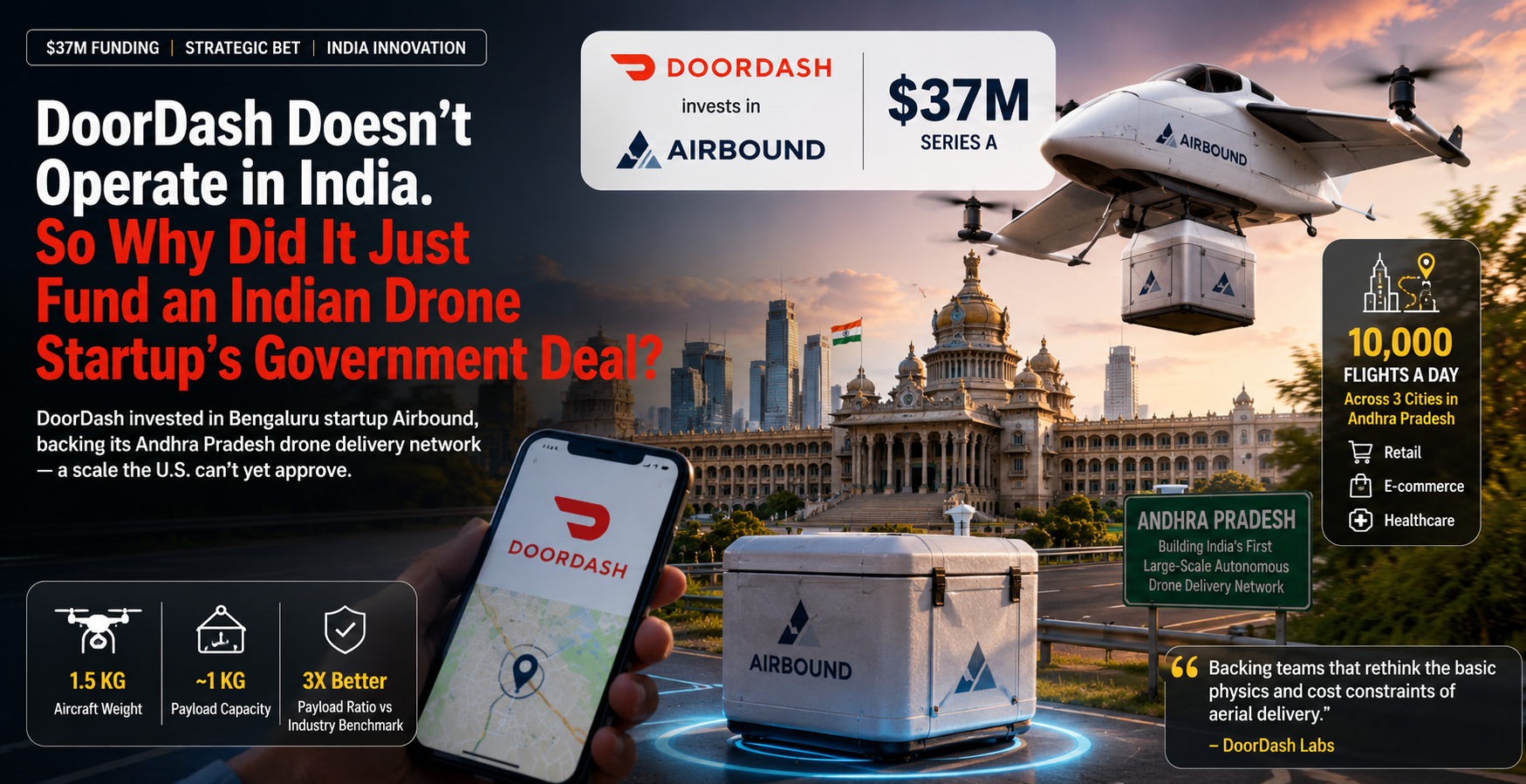
Airbound, a Bengaluru-based aerospace startup, closed a $37 million Series A round on August 25, led by Greenoaks, with DoorDash joining alongside Lachy Groom, Lightspeed, and Humba Ventures. The round takes Airbound's total funding to nearly $50 million since it started building. The company makes lightweight autonomous aircraft — a blended-wing-body "tailsitter" design that takes off vertically and flies on fixed wings — aimed at making aerial delivery cost-competitive with trucks rather than staying a novelty. Its current aircraft weighs about 1.5 kilograms and carries roughly 1 kilogram of payload, a ratio Airbound says beats the typical industry benchmark by three times.
The company isn't just testing in a lab. It has already run more than 1,000 autonomous flights with zero mission failures in partnership with Narayana Health, moving diagnostic samples between facilities and cutting delivery times from hours to minutes. Alongside the funding round, Airbound signed a commercial deployment agreement with the Andhra Pradesh state government to build an autonomous drone delivery network connecting three cities — with a stated target of 10,000 flights a day across retail, e-commerce, and healthcare deliveries.
Why now
DoorDash's own explanation, via its head of product for DoorDash Labs, framed the investment around backing teams willing to rethink the basic physics and cost constraints of aerial delivery — not around any near-term India expansion. That's worth taking at face value, because DoorDash has a problem Airbound happens to solve: it wants exposure to autonomous aerial delivery technology, but the US market doesn't currently offer anywhere to actually run it at scale. Beyond-visual-line-of-sight drone operations remain tightly restricted under US aviation rules, and no American city or state has handed a startup an open mandate to build a 10,000-flight-a-day public delivery network the way Andhra Pradesh just did.
India, in other words, isn't the destination for DoorDash's investment — it's the testing ground. A state government willing to approve real infrastructure at real volume is now doing double duty as the regulatory sandbox that companies like DoorDash can't access in their own backyard.
WATCH: Airbound’s 10,000-Flight Drone Delivery Network
Why it matters
This is a pattern worth watching beyond just this one deal: foreign strategic capital — chipmakers, cloud platforms, and now delivery companies — increasingly treating India not as a market to sell into, but as the place where the actual technology gets tested at a scale their home regulators won't yet permit. That's a genuine opportunity for Indian startups and state governments willing to move fast on approvals. It's also a real question for those same state governments: when a foreign-backed, VC-funded startup is generating the flight data and safety record for a first-of-its-kind public airspace network, who ultimately owns the lessons learned — and who benefits when that technology is exported back to markets that were too cautious to test it themselves?
The open question
If Andhra Pradesh ends up being where autonomous aerial delivery is actually proven at scale — not California, not Texas — what does that entitle the state to when the technology it helped de-risk gets commercialized somewhere else? Right now, that's a question nobody involved in this deal has had to answer yet.
Sources:
India's Airbound bags $37M to take on trucks with rocket-like drones — TechCrunch

Tarun Punde
B.Tech AIADS@ Shri Balaji Institute of Technology & Management
I write at Metaplugs — breaking down the latest in tech, economics, and business into simple, impactful stories for everyday readers. Passionate about software testing and global finance.