Back to News
News AlertWorld of Startup’s
More Money, Fewer Deals: Q3 2026 Venture Funding and the Seed Squeeze
V
Author
Vicky Galfat
Published
October 14, 2026
Reading Time
4 MIN READ
Spread the Word
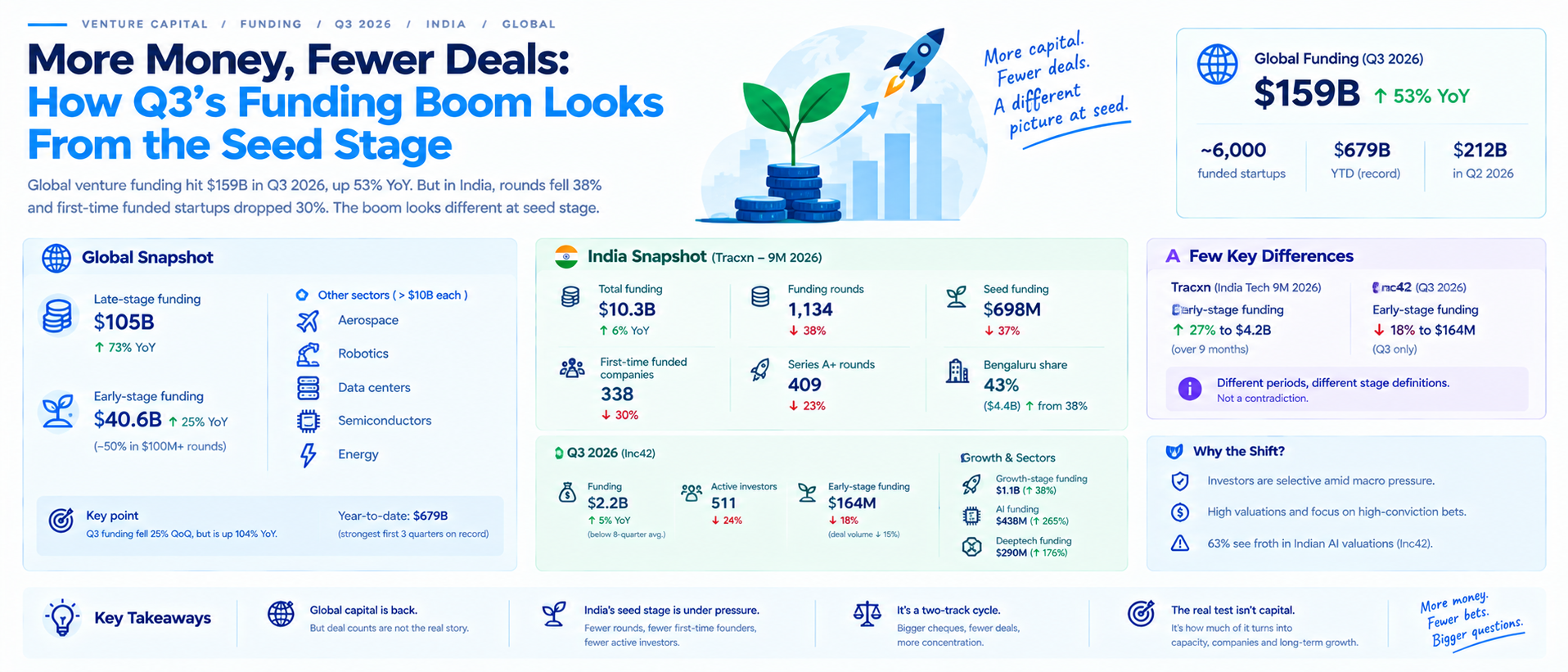
Global VC hit $159B in Q3, up 53% YoY, yet India's funding rounds fell 38% and first-time funded startups 30%. The boom looks different at seed stage.
Venture funding Q3 2026, India startup funding 2026, seed funding decline, Tracxn India Tech report, fewer funding rounds, Crunchbase Q3 2026, early-stage funding squeeze, deep tech funding, first-time funded startups, venture capital concentration.
Venture funding Q3 2026, India startup funding 2026, seed funding decline, Tracxn India Tech report, fewer funding rounds, Crunchbase Q3 2026, early-stage funding squeeze, deep tech funding, first-time funded startups, venture capital concentration.
More Money, Fewer Deals: How Q3's Funding Boom Looks From the Seed Stage
Global venture funding hit $159 billion in the third quarter of 2026, up 53% on a year earlier. But look at India's startup data and the same period reads like a squeeze: funding rounds are down 38%, and the number of companies funded for the first time has fallen 30%. Both are true, and the gap between them is the real story of this funding cycle.
The Global Picture, Briefly
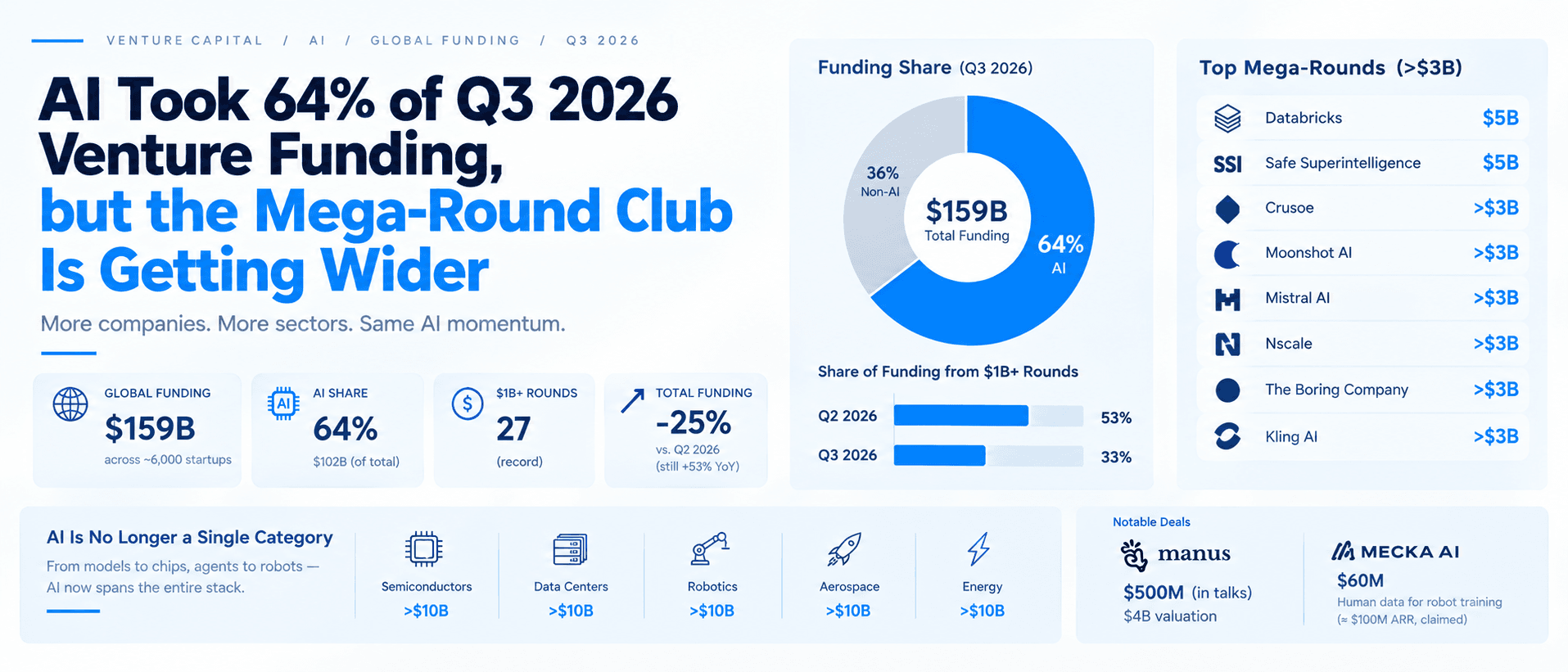
According to Crunchbase, Q3 funding came from close to 6,000 funded startups. It was down 25% from Q2's $212 billion, a quarter inflated by mega-deals including a reported $65 billion raise by Anthropic, and up from $104 billion in Q3 2025. Year-to-date funding stands at $679 billion, the strongest first three quarters on record.
Late-stage funding reached $105 billion, up 73% year over year, while early-stage funding was $40.6 billion, up 25%, with about half of that in rounds of $100 million or more. The money is also moving beyond software: ValueAdd VC's read of the data shows aerospace, robotics, data centers, semiconductors and energy each raised more than $10 billion in the quarter.
India: Where the Squeeze Shows Up
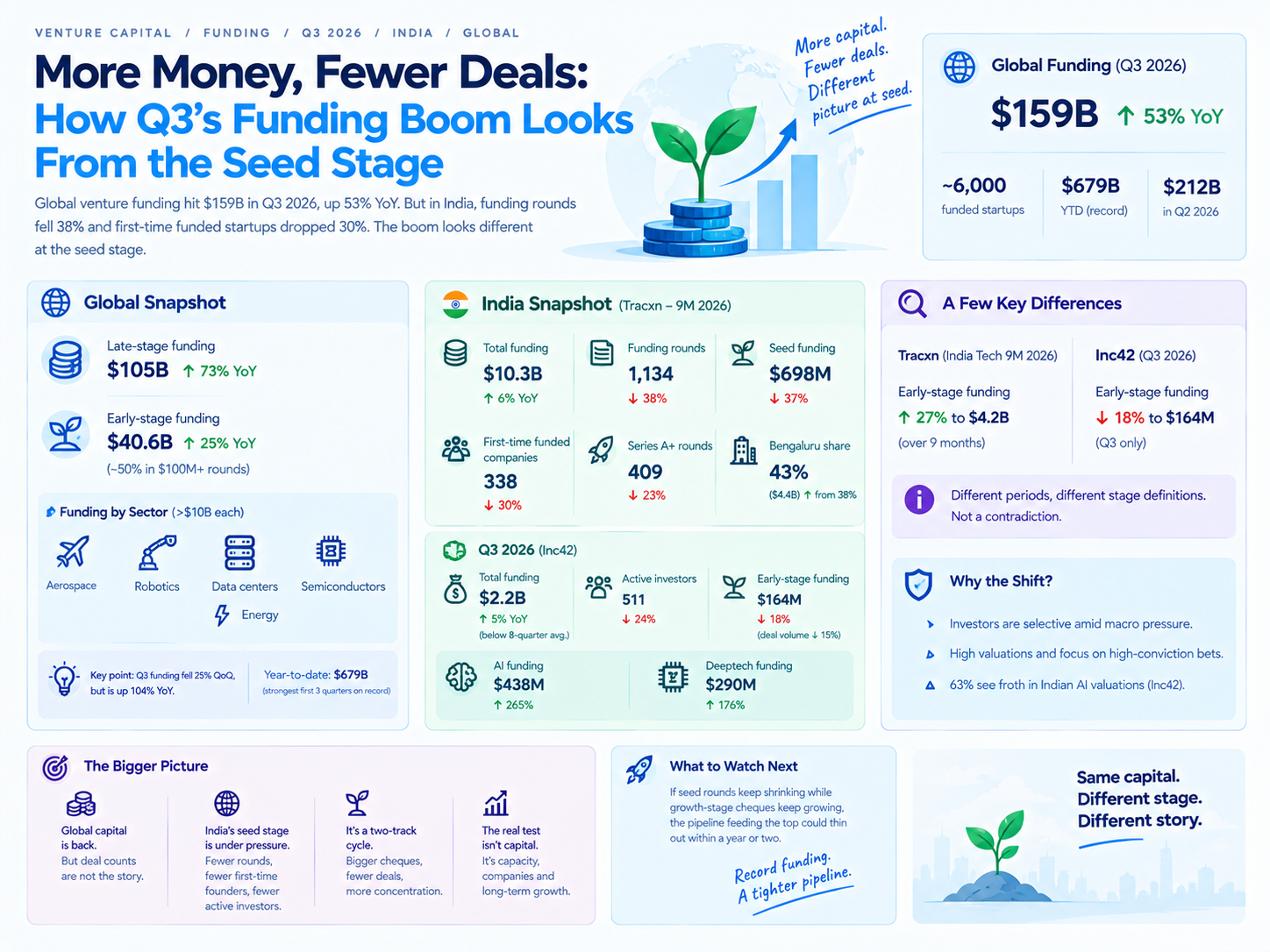
Tracxn's India Tech 9M 2026 report covers 1 January to 21 September. Indian tech startups raised $10.3 billion, up from $9.7 billion a year earlier, but the number of funding rounds fell 38%, from 1,838 to 1,134. Seed funding dropped 37% to $698 million, and first-time funded companies fell 30% to 338. Rounds at Series A and later fell 23% to 409, while India saw 18 rounds of $100 million or more. Bengaluru took $4.4 billion, or 43% of all funding, up from 38% a year earlier.
Inc42's look at Q3 alone shows the same pattern. Indian startups raised $2.2 billion, up 5% year over year, but below the roughly $2.7 billion eight-quarter average, and the number of active investors fell 24% to 511. Growth-stage funding rose 38% to $1.1 billion across 90 deals, while early-stage funding fell 18% to $164 million, with deal volume down 15%. AI took the largest share at $438 million, up 265%, and deeptech raised $290 million, up 176%.
Two Trackers, Two Definitions
A note for anyone writing about this: Tracxn reports early-stage funding in India up 27% to $4.2 billion over nine months, while Inc42 reports early-stage funding down 18% in Q3. They are not contradicting each other. The two cover different periods and define stages differently. Mixing figures from different trackers in the same sentence is the fastest way to publish a wrong number.
Why Cheques Are Getting Bigger and Fewer
The sources point to caution rather than collapse. Inc42 describes investors deploying capital more selectively amid macroeconomic pressure, elevated valuations and a focus on high-conviction bets. It also found that 63% of surveyed investors see froth in Indian AI valuations, even as AI draws the most money. That helps explain how funding can rise while deal counts fall: a smaller group of companies is absorbing larger cheques, and the largest AI and deep-tech rounds pull totals up on their own.
Concentration Depends on Where You Look
This is where the usual "capital consolidation" framing needs care. Globally, the top tier actually broadened in Q3. A record 27 companies raised $1 billion or more, yet those rounds took about a third of funding, down from more than half in Q2. In India, the narrowing happened at the base: fewer rounds, fewer first-time funded companies, and fewer active investors.
One thing the data does not show is a global fall in deal counts. Crunchbase's Q3 release gives the number of funded companies but, in the coverage reviewed, no year-over-year deal-count comparison, so claims of a worldwide deal contraction would go beyond the evidence
Seed rounds are where tomorrow's Series A companies come from. If India's first-time funded companies keep shrinking while growth-stage cheques keep growing, the pipeline feeding the top could thin out within a year or two. Whether that happens, or whether fewer but better-funded seed companies prove stronger, is something this quarter's data cannot yet answer.

Vicky Galfat
University of Mumbai/BCA
Learning, building, and exploring the world of technology one project at a time.