Venture Capital Mega-Funds Pour Billions Into AI and Deep Tech in 2026
TCS Is Cutting Thousands of Jobs and Building a Billion-Dollar AI Bet, at the Same Time
12,200 Cut, 85,000 Hired — TCS's Same-Year Workforce Swap
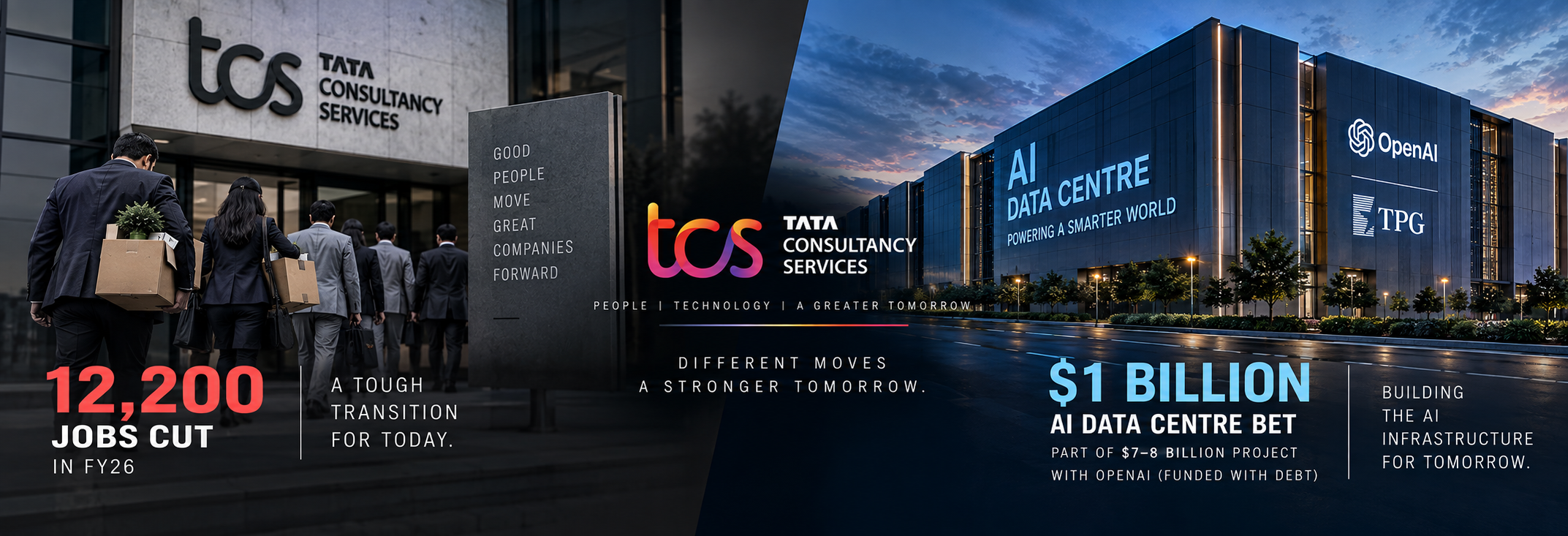
TCS confirmed it will cut about 12,200 jobs in FY26 — 2% of a workforce of more than 613,000 — primarily hitting middle and senior management, as the company cited AI rollout, delayed client decision-making, and an uncertain demand environment, according to Reuters. By the June 2026 quarter, AI-linked revenue had crossed $2.3 billion even as net headcount fell by 23,460 over the same stretch, Hindustan Herald reported.
A $7–8 Billion Bet With OpenAI, Funded on Debt — Not Reinvested in Its Own Workforce
The capital story explains the timing. TCS announced at India's AI Impact Summit in February that it would partner with OpenAI to build data-centre facilities scaling from 100 megawatts up to a full gigawatt — a project that would normally cost $35–50 billion, except TCS isn't bearing that full cost, Staffing Industry reported. It's funding the structure itself (racks, connectivity, power, cooling), a slice priced at roughly $7–8 billion, with TCS putting in $1 billion, partner TPG matching that, and the rest financed through debt. Krithivasan was explicit about the motive: "We are looking at a fairly attractive IRR."
That single sentence explains who this is really for. This isn't capacity being built to employ the 12,200 people being let go, or even primarily to serve TCS's existing services clients — it's an infrastructure bet built to generate investor returns, positioned against India's own projected AI compute shortfall (the country needs roughly 10 gigawatts of AI data-centre capacity by 2030, against 5–6 gigawatts currently announced, by TCS's own estimate). The capital is going toward compute that global AI demand will rent, not toward the job security of the managers whose roles are being eliminated.
Why TCS's Choice Sets the Template for Every Startup Competing for the Same Talent
For India's broader tech and startup labour market, TCS is the biggest single data point in a pattern that's already visible lower down the stack. Indian startups shed an estimated 20,000–25,000 jobs in 2025 as venture funding tightened and AI efficiency reduced the need for the teams that over-hired during 2020–21, per Borderless; home-décor platform Livspace alone cut roughly 1,000 roles this year as part of an AI-driven cost rationalisation, and gaming, quick-commerce, and SaaS companies have all reported cuts through early 2026. TCS operating at 50x the scale of any single startup layoff means its choices about who gets displaced and who gets retrained set the template — and the signal — for the rest of the ecosystem competing for the same shrinking pool of experienced tech talent.
The scale problem isn't unique to India either, which is what makes TCS's specific choices worth watching rather than dismissing as one company's cost-cutting. Tracking cited by Career Cracker counted 134,603 tech layoffs globally in 2026 across 212 events — roughly 868 job losses a day — led by Oracle (over 30,000), Amazon (19,100), Meta (16,900) and Nokia (14,000), with the US accounting for about 97,000 of those cuts against roughly 3,170 in India. TCS's 12,200 is a small slice of that global number, but it's the clearest single Indian example of the same underlying trade being made everywhere else: fewer experienced generalists, more capital-intensive AI infrastructure.

Genuine Reskilling, or a Slower Version of the Same Swap?
TCS's own messaging holds both halves of this story without trying to reconcile them: machine revenue accelerating, human investment continuing, reported side by side in the same quarterly filings. The open question for India's tech workforce is whether "human investment continuing" means what it sounds like — genuine reskilling into the creative and business-facing roles Krithivasan describes — or whether it's simply a slower-moving version of the same swap already visible in the numbers: senior, experienced, expensive workers replaced by a leaner mix of freshers, AI tools, and capital that answers to TPG's return targets rather than to anyone's job security.
Sources
- Reuters (via Yahoo Finance) — https://finance.yahoo.com/news/indian-tech-company-tcs-cut-103558769.html
- Hindustan Herald — https://hindustanherald.in/tcs-ai-revenue-job-cuts-india-fy26/
- Staffing Industry Analysts — https://www.staffingindustry.com/news/global-daily-news/tcs-reshaping-business-model-to-capitalize-on-ai
- Yahoo Finance — https://finance.yahoo.com/news/tcs-cut-more-12-000-091131053.html
- Career Cracker — https://www.careercracker.com/insights/tcs-layoffs-2026
- Borderless — https://www.hireborderless.com/post/navigating-layoffs-and-labor-laws-guide-for-tech-companies-in-india-borderless

Tarun Punde
B.Tech AIADS@ Shri Balaji Institute of Technology & Management
I write at Metaplugs — breaking down the latest in tech, economics, and business into simple, impactful stories for everyday readers. Passionate about software testing and global finance.