LATEST NEWS
Swiggy Didn't Sell Its B2B Arm for Cash — It Bought Into the Company Buying It
September 9, 2026 5M
Back to News
News AlertWorld of Startup’s
Driverless Trucks Just Raised $200M. A Forehead Wearable Just Bought a Clinic. Startups Are Automating the Boring — and the Biological
V
Author
Vishal Sable
Published
August 28, 2026
Reading Time
4 MIN READ
Spread the Word
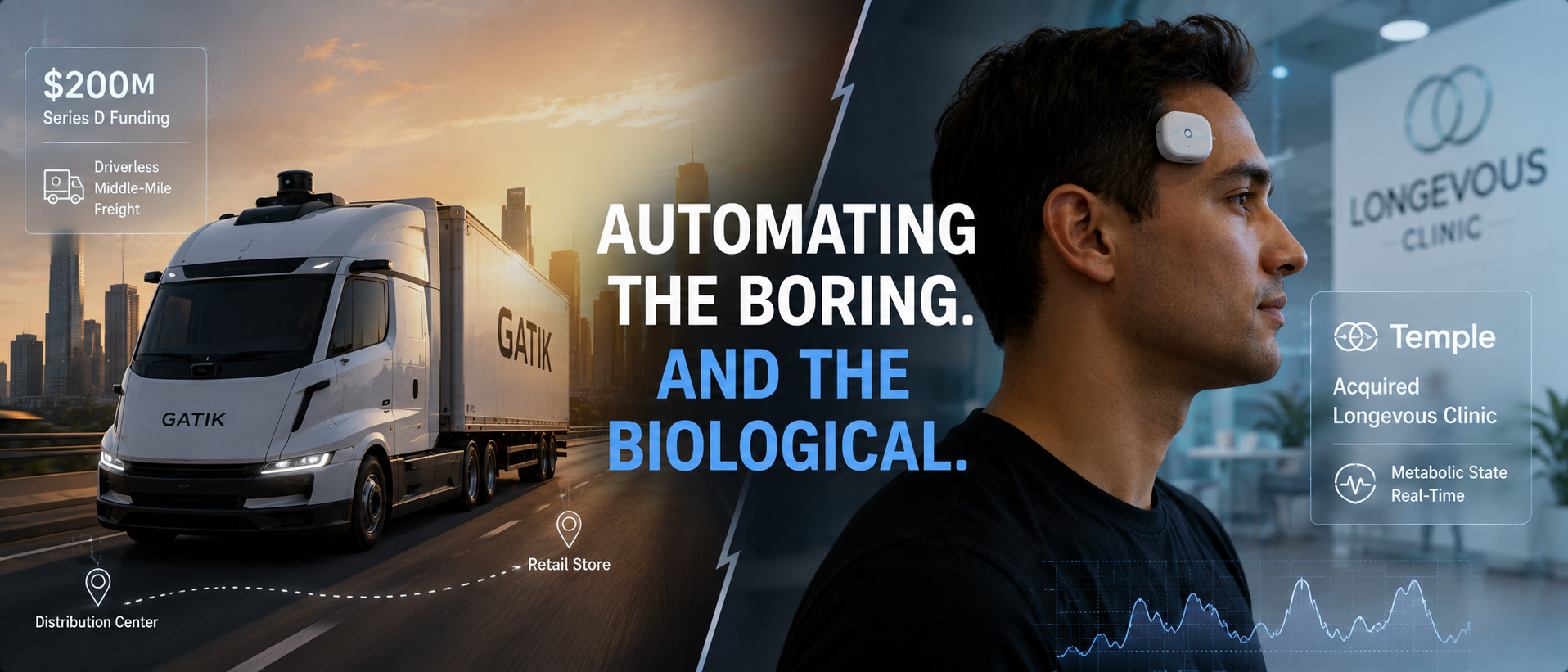
Gatik raised $200M for autonomous middle-mile freight while Deepinder Goyal's Temple acquired longevity clinic Longevous. Two very different startups, one shared bet: machine intelligence replacing human judgment.
Two headlines, one pattern
Two headlines, one pattern
This week, two startups in completely different industries made moves that point at the same shift: machine intelligence is quietly taking over judgment calls that used to require a human in the loop.
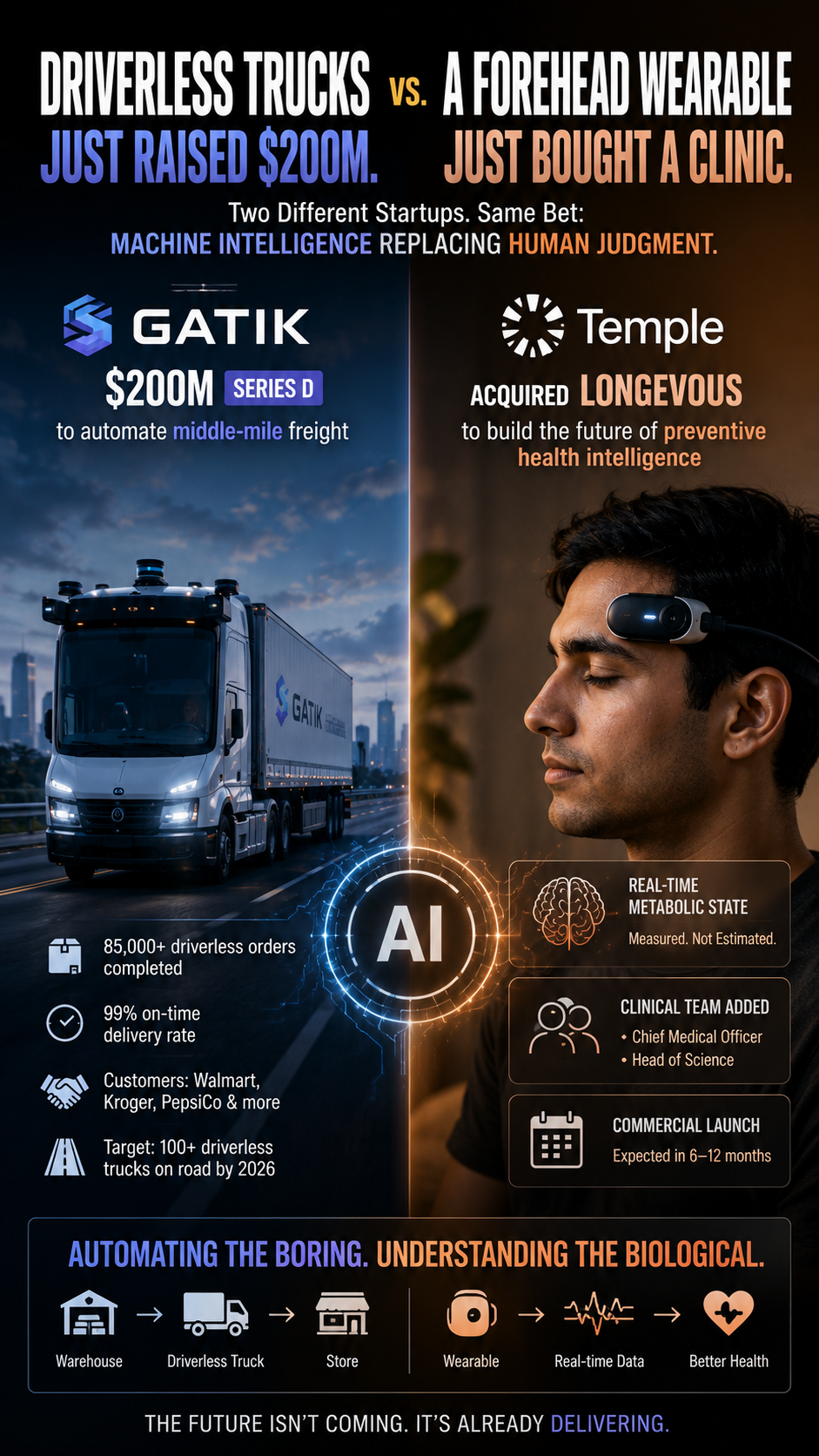
Gatik, the autonomous trucking startup, raised $200 million in Series D funding — its largest round yet — led by Qatar Investment Authority and Koch Disruptive Technologies. The company already has $600 million in contracted revenue, has completed 85,000 fully driverless orders, and runs at a 99% on-time delivery rate moving goods for Walmart, Kroger, and PepsiCo. It's targeting over 100 driverless trucks on the road by the end of 2026.
On the same week, Deepinder Goyal's wearable startup Temple acquired Longevous, a London-based longevity medicine practice, bringing on its two founders as Chief Medical Officer and Head of Science ahead of Temple's commercial launch — a bean-shaped wearable worn at the temple that claims to measure metabolic state directly, in real time, instead of relying on heart rate as a proxy.
One company is removing the driver. The other is trying to remove the guesswork from how you understand your own body. Same instinct, different battlefield.
Gatik: the "boring middle" gets automated first
Gatik: the "boring middle" gets automated first
Gatik didn't chase the flashy part of autonomous vehicles — robotaxis, highway trucking, long-haul freight. It went after the middle mile: the short, repetitive, high-frequency runs between distribution centers and retail stores. That's the unsexy logistics layer that keeps shelves stocked, and it turns out to be one of the easiest places to prove autonomous freight actually works commercially, not just in demos.
The round was validation as much as capital. Gatik didn't raise this on a pitch deck — it raised it on real revenue and a live customer base, including a multi-year deal with PepsiCo signed earlier this year. That's the detail that should matter most to anyone watching the AI/logistics space: this wasn't hype capital, it was growth capital for a business that already works.
Temple: buying clinical credibility before launch
Temple has spent the past year and a half building hype around a wearable most doctors haven't been able to independently verify yet — and that's exactly the gap the Longevous acquisition is built to close. By bringing in a board-certified physician and an Oxford-trained biomedical scientist as CMO and Head of Science, Temple is trying to answer the obvious skepticism head-on: can a skin-mounted sensor near your temple actually tell you anything real about your brain?
The acquisition lands right before Temple's expected commercial launch, reportedly six to twelve months out, at a rumored price point near $1,000 and a startup valuation pushing toward $500 million. Buying a clinical team isn't just a hiring move — it's Temple trying to convert "interesting biosignal gadget" into "wellness device backed by peer-reviewed science" before regulators and doctors get the chance to ask first.
The pattern underneath both stories
Neither of these companies is selling AI as a concept. Both are selling AI as a replacement for a specific human function — a driver on a fixed route, a doctor's periodic checkup — done continuously, automatically, and (they're betting) more reliably.
That's the real story here. Early-stage capital isn't chasing "AI" as a category anymore. It's chasing AI doing one narrow, previously-human job extremely well — moving a truck safely between two points, or reading your body's real-time metabolic signals instead of waiting for your next physical.
Which is the bigger leap of faith: trusting a truck with no driver, or trusting a sensor to know your body better than your doctor does?
---
Sources: Reuters, Forbes, Unite.AI, Inc42, Business Today, TechCrunch.

Vishal Sable
B.Tech AD @ shri balaji institute of technology and management
Engineering and tech journalist. I love exploring the impact of emerging technologies on global defense, sovereignty, and everyday life. Always looking for the real story behind the headlines.