LATEST NEWS
Swiggy Didn't Sell Its B2B Arm for Cash — It Bought Into the Company Buying It
September 9, 2026 5M
Back to News
News AlertWorld of Startup’s
Physical AI Investment Hits Record Highs: SoftBank Backs Gravis Robotics, Groq Raises $350M
V
Author
Vishal Sable
Published
August 26, 2026
Reading Time
6 MIN READ
Spread the Word
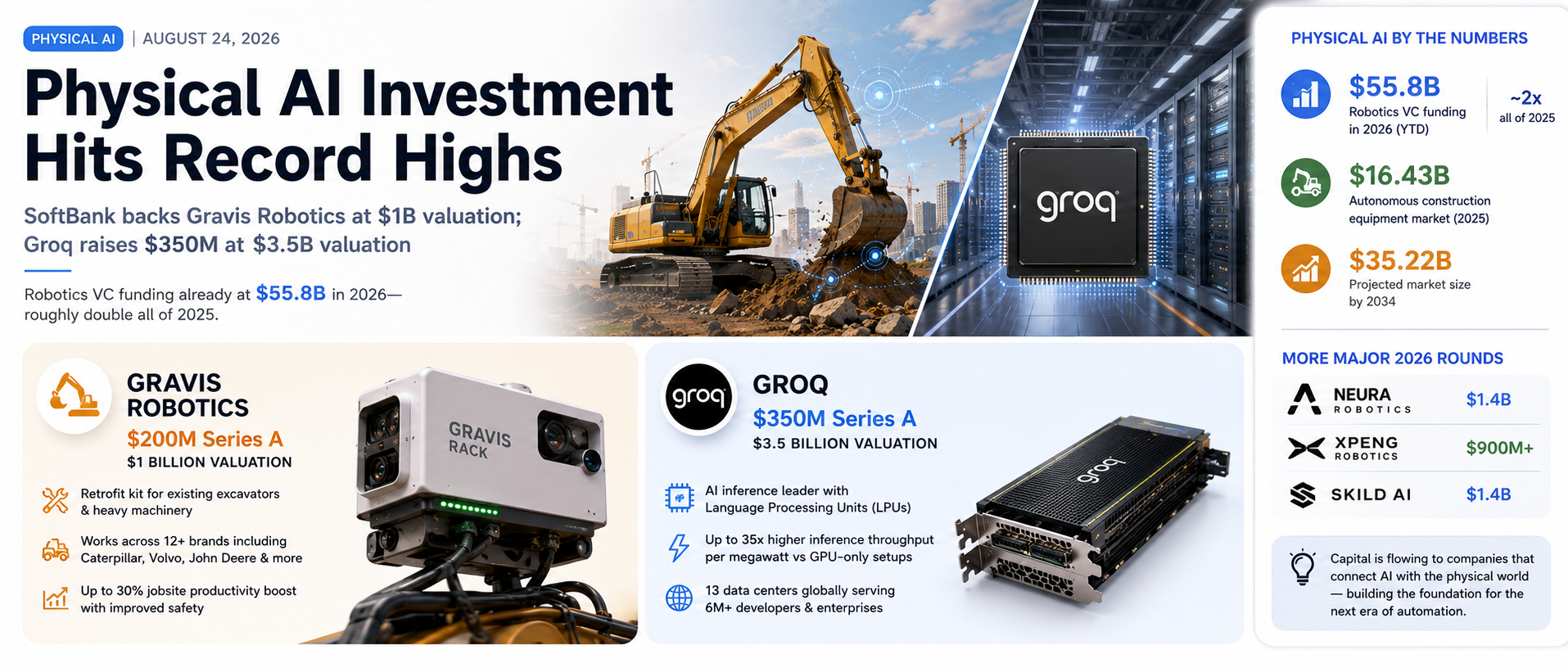
SoftBank invested $200 million in Swiss construction robotics startup Gravis Robotics at a $1 billion valuation. Days later, AI inference company Groq closed a $350 million Series A at a $3.5 billion valuation. Together, the two megadeals confirm that "Physical AI" — the fusion of AI with machinery, robotics, and inference hardware — is 2026's dominant venture capital thesis, with robotics funding already at $55.8 billion year-to-date, roughly double all of 2025.
Zurich / San Francisco — August 24, 2026
Key Takeaways --
Gravis Robotics raised $200M from SoftBank at a $1B valuation — the largest-ever Series A in construction robotics
Groq raised $350M at a $3.5B valuation, down from a $6.9B peak in September 2025
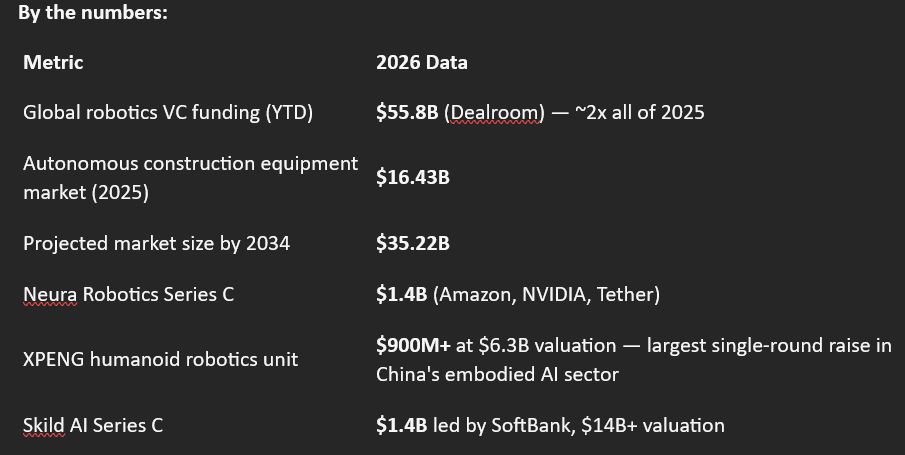
Robotics VC funding has hit $55.8B through mid-2026 (Dealroom data), nearly 2x all of 2025
The global autonomous construction equipment market is projected to grow from $16.43B (2025) to $35.22B by 2034
Other major 2026 Physical AI rounds: Neura Robotics ($1.4B), XPENG humanoid unit ($900M+), Skild AI ($1.4B)
SoftBank's $200M Bet on Gravis Robotics: Retrofitting the World's Excavators
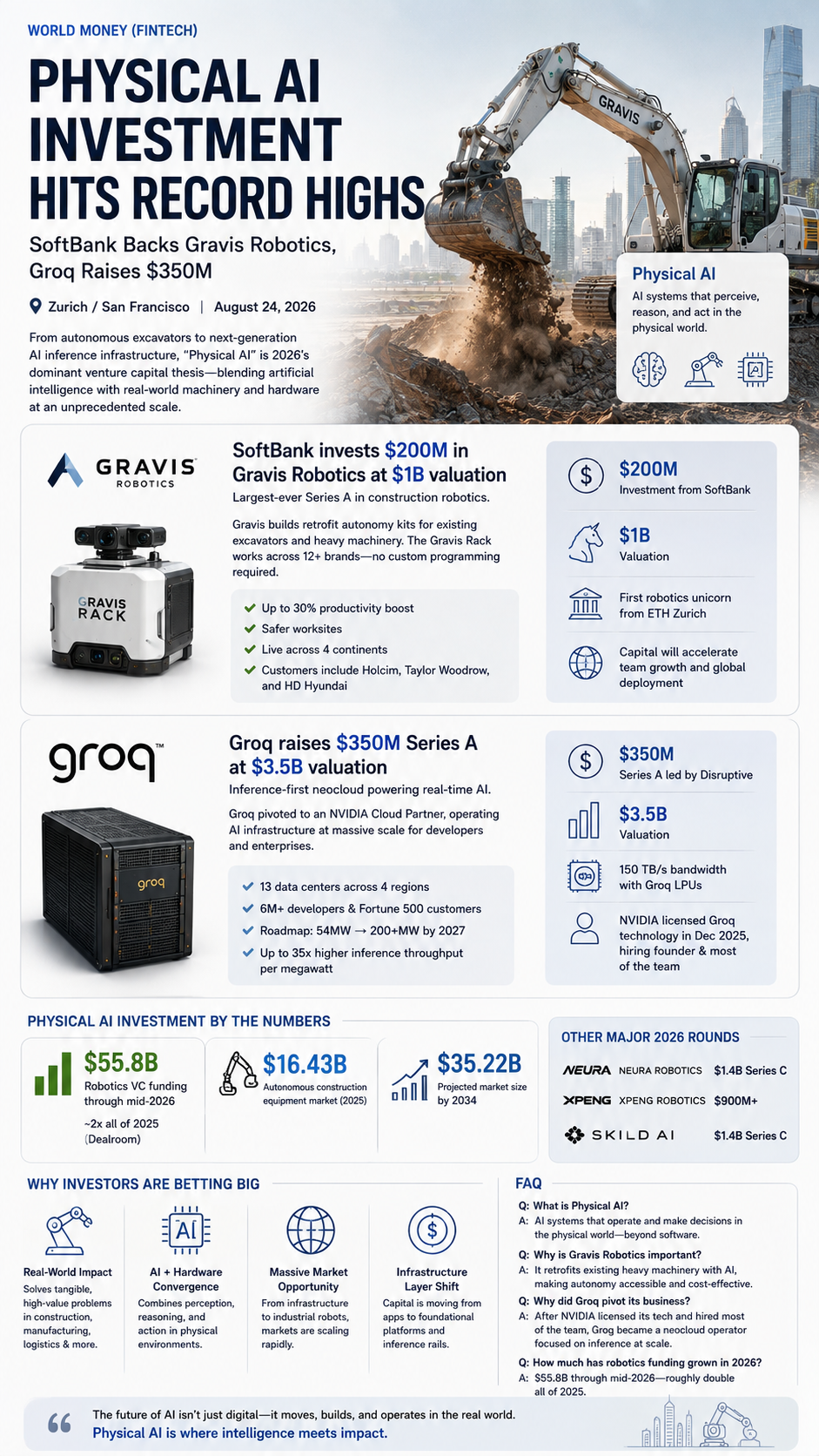
SoftBank has invested $200 million in Gravis Robotics, a Zurich-based ETH Zurich spinout, valuing the company at $1 billion — the largest Series A funding round ever recorded in construction robotics. SoftBank was the sole investor in the round, which brings Gravis's total disclosed funding to roughly $223 million and makes it Europe's newest robotics unicorn, and the first to emerge from ETH Zurich.
What Gravis Robotics Actually Does
Founded in 2022 by Ryan Luke Johns and Dominic Jud — who met in Professor Marco Hutter's robotics lab at ETH Zurich — Gravis has built the Gravis Rack, a retrofit kit combining sensors, onboard computing, and autonomy software for existing excavators and heavy machinery.
Instead of forcing construction companies to buy new autonomous fleets, the Gravis Rack works across more than a dozen brands and machine classes — from 10-ton excavators to large Caterpillar equipment — including:
Caterpillar
Case
Develon
John Deere
JCB
Hitachi
Sumitomo
Yanmar
Volvo
No custom reprogramming is required per machine. The system is already live across four continents, with customers including Holcim, Taylor Woodrow, and HD Hyundai.
The Technical Challenge: Reading the Earth in Real Time
Autonomous excavation is a harder problem than autonomous driving. A self-driving car navigates a largely static environment; an excavator physically reshapes the ground with every pass.
"Skilled operators read the earth through subtle physical feedback, listening to the engine strain, sensing the machine vibration, and reacting to hydraulic resistance," said Gravis CTO Dominic Jud. "Our AI takes that same physical input and grounds it in machine telemetry, responding to varying subterranean forces and soil mechanics at microsecond speeds."
The result, according to the company: up to a 30% jobsite productivity boost compared to peak manual operation, alongside improved worksite safety.
Why SoftBank Is Betting Big on Robotics
The Gravis deal is one piece of a much larger SoftBank robotics strategy. The group is:
Acquiring ABB's industrial robotics division for $5.4 billion
Consolidating roughly 20 robotics companies, including Skild AI and Agile Robots
Pursuing chairman Masayoshi Son's publicly stated goal of becoming the "overwhelming world No. 1 robotics company"
Already mass-producing Physical-AI-based robots
Gravis CEO Ryan Luke Johns framed the raise as an acceleration mandate: "Whether we are building housing, modernising energy grids or scaling data centres, every project starts with moving earth." The capital will fund team expansion, international growth, and deployment of Gravis-powered autonomy on "every major jobsite."
Groq's $350M Series A: The Inference-First Neocloud Pivot
While Gravis automates earthmoving, Groq is racing to dominate AI inference — the process of running trained models in production, as opposed to training them.
Groq's $350 million Series A was led by Disruptive, with planned participation from NVIDIA, at a $3.5 billion valuation. Combined with $650 million raised in June 2026, the company has now raised $1 billion in roughly two months.
From Chipmaker to NVIDIA Cloud Partner
That $3.5B valuation is a sharp reset from Groq's $6.9 billion peak in September 2025. The turning point came in December 2025, when NVIDIA agreed to pay a reported $20 billion to license Groq's inference technology and hire founder Jonathan Ross, president Sunny Madra, and roughly 90% of Groq's engineering team.
Since then, Groq has repositioned itself as an NVIDIA Cloud Partner — a certified neocloud operator that designs, deploys, and operates NVIDIA-accelerated computing infrastructure, rather than competing as an independent chipmaker.
Groq today operates:
13 data centers across North America, Europe, the Middle East, and Asia Pacific
Service for 6M+ developers and Fortune 500 enterprises
A roadmap from 54 megawatts to 200+ megawatts of data center capacity by 2027
Why Inference Is the New Battleground
Groq's Language Processing Units (LPUs) use on-chip SRAM to deliver up to 150 terabytes per second of bandwidth — roughly 7x the bandwidth of NVIDIA's Rubin GPU. In combined GPU-plus-LPU deployments, Groq claims up to 35x higher inference throughput per megawatt versus GPU-only setups.
As Groq Executive Chairman Alex Davis put it: "Inference will without a doubt become the largest and most critical layer of AI infrastructure."
The Bigger Picture: Why Physical AI Investment Is Hitting Record Highs in 2026
Gravis and Groq aren't isolated stories — they're symptoms of a structural shift in venture capital toward AI that touches the physical world.
The pattern across every deal is the same: capital is migrating from pure-software AI plays toward startups that connect digital intelligence to physical outcomes — whether that's an excavator moving earth or a data center moving tokens.
What This Means for Each Industry
Construction: Gravis's retrofit-first model gives contractors a lower-friction path to automation — upgrading existing fleets with AI rather than replacing them outright.
AI infrastructure: Groq's pivot from chip vendor to neocloud operator reflects a maturing market where running models at scale is becoming as commercially important as training them.
FAQ: Physical AI Investment in 2026
What is "Physical AI"? Physical AI refers to artificial intelligence systems designed to operate in and interact with the physical world — construction equipment, industrial robots, and the inference hardware that powers real-time AI decision-making — as opposed to purely digital/software AI applications.
How much has SoftBank invested in Gravis Robotics? SoftBank invested $200 million in Gravis Robotics, valuing the company at $1 billion, in the largest Series A round ever recorded in construction robotics.
Why did Groq's valuation drop from $6.9B to $3.5B? After NVIDIA licensed Groq's inference technology and hired most of its engineering team for a reported $20 billion in December 2025, Groq restructured as an NVIDIA Cloud Partner and neocloud operator, resetting its valuation on this new business model.
How much has robotics venture funding grown in 2026? Robotics investment has reached $55.8 billion through mid-2026, roughly double the total raised across all of 2025, according to Dealroom.

Vishal Sable
B.Tech AD @ shri balaji institute of technology and management
Engineering and tech journalist. I love exploring the impact of emerging technologies on global defense, sovereignty, and everyday life. Always looking for the real story behind the headlines.