LATEST NEWS
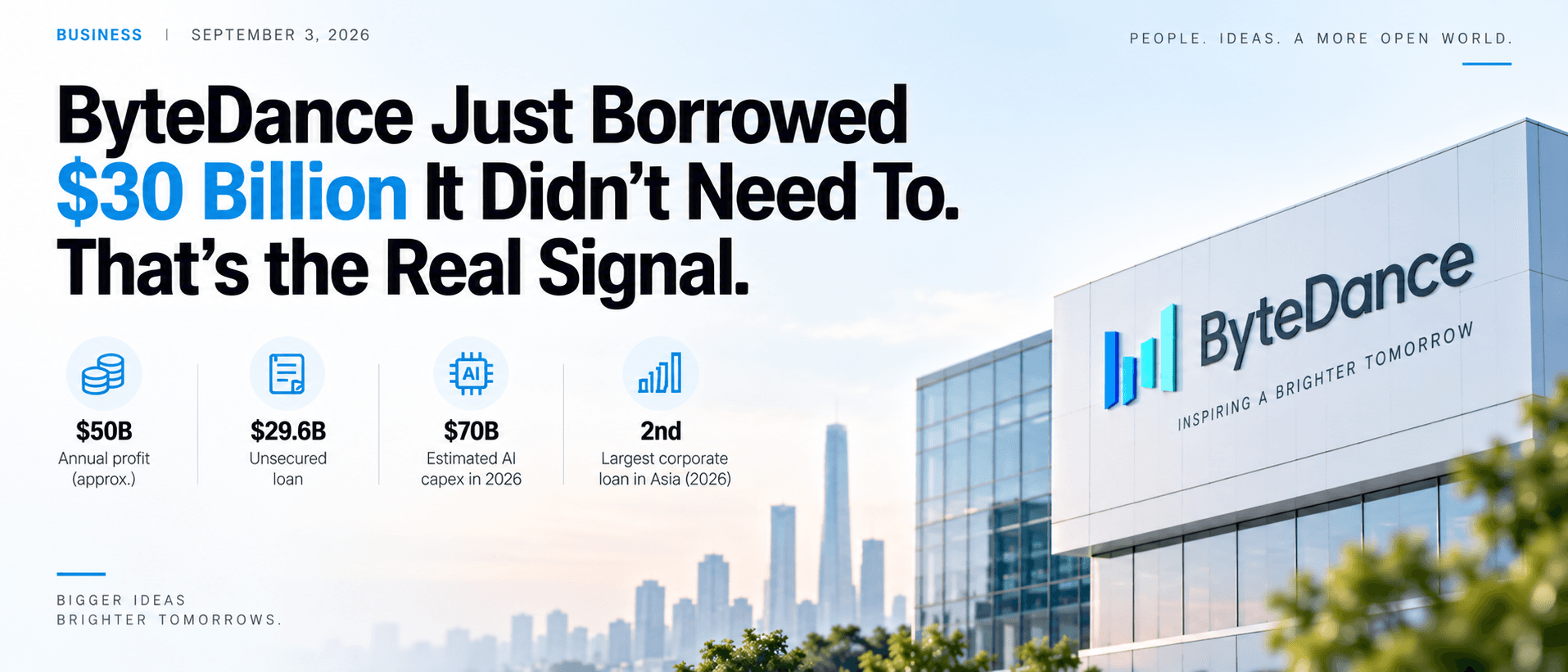
ByteDance Just Borrowed $30 Billion It Didn't Need To. That's the Real Signal.
September 8, 2026 4M
Back to News
News AlertWorld AI Tech
Anthropic Disrupts the Market with Claude Sonnet 5
V
Author
Vishal Sable
Published
July 3, 2026
Reading Time
6 MIN READ
Spread the Word
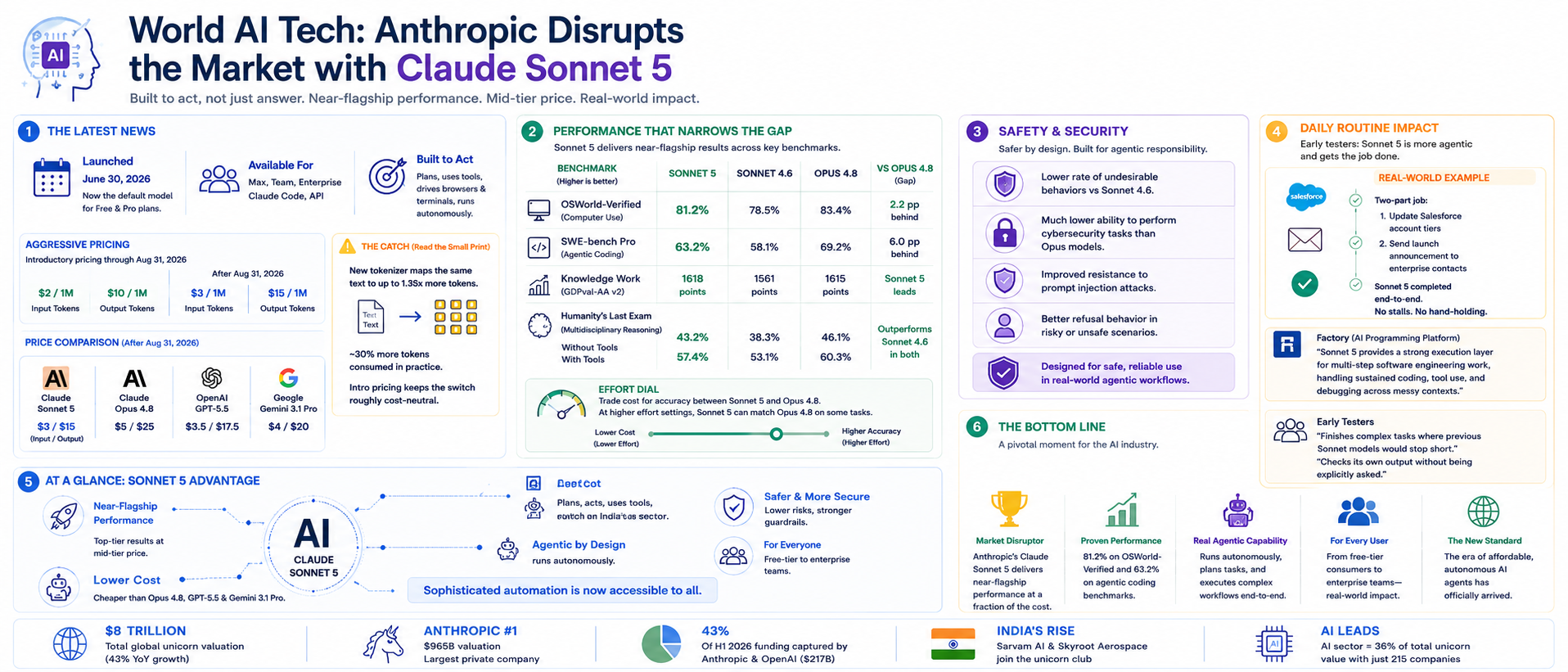
Artificial intelligence platforms are aggressively competing to lower the operational costs of automated systems for daily workflows. On June 30, Anthropic officially launched Claude Sonnet 5, marking a decisive shift in the enterprise AI landscape. The company built the model to act, not just answer—it can make plans, drive browsers and terminals, and run autonomously for long stretches. That level of capability required larger, more expensive models just a few months ago.
The Latest News
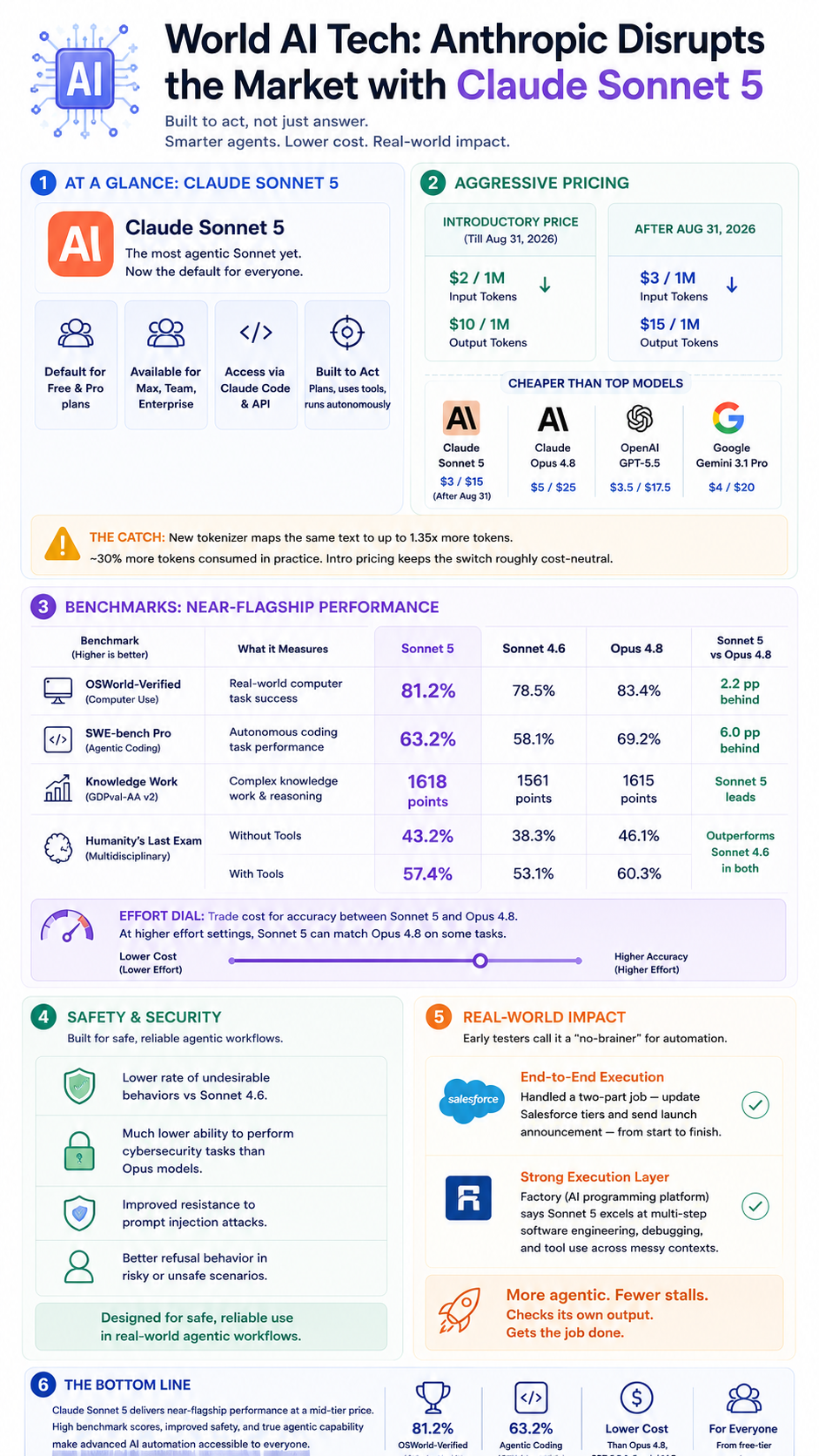
Anthropic made Claude Sonnet 5 the default model for Free and Pro plans, while also making it available to Max, Team, and Enterprise users, as well as through Claude Code and the Claude API. The launch positions Sonnet 5 as the centerpiece of Anthropic's mainstream product line.
The pricing strategy is aggressive. Sonnet 5 launches with an introductory price of $2 per million input tokens and $10 per million output tokens through August 31, 2026. After that, pricing increases to $3 per million input tokens and $15 per million output tokens. By contrast, Anthropic's flagship Opus 4.8 costs $5 and $25. That makes Sonnet 5 cheaper than Opus 4.8, as well as OpenAI's GPT-5.5 and Google's Gemini 3.1 Pro.
However, there is a catch in the small print. Sonnet 5 uses a new tokenizer that can map the same text to up to 1.35 times more tokens than before. Developers have noted that while the headline rate appears unchanged from Sonnet 4.6, the actual token consumption increases by about 30%. Anthropic set the introductory price so the switch stays roughly cost-neutral, but the token count can climb.
Performance That Narrows the Gap
Sonnet 5 delivers near-flagship performance at a mid-tier price. It narrows the gap with Opus 4.8 while delivering substantial improvements over its predecessor, Sonnet 4.6, in reasoning, tool use, coding, and knowledge work.
The benchmark results are striking:
OSWorld-Verified (computer use): Sonnet 5 scores 81.2%, up from 78.5% for Sonnet 4.6. Opus 4.8 leads slightly at 83.4%, narrowing the gap to just 2.2 percentage points.
SWE-bench Pro (agentic coding): Sonnet 5 achieves 63.2%, compared to 58.1% for Sonnet 4.6 and 69.2% for Opus 4.8.
Knowledge work (GDPval-AA v2): Sonnet 5 scores 1618 points, slightly outperforming Opus 4.8's 1615 points.
Humanity's Last Exam (multidisciplinary reasoning): Sonnet 5 recorded 43.2% without tools and 57.4% with tools, outperforming Sonnet 4.6 in both categories.
Anthropic also offers an "effort" dial, letting developers trade cost for accuracy between Sonnet 5 and Opus 4.8. At higher effort settings, Sonnet 5 can match Opus 4.8 on some tasks.
Safety and Security
Safety assessments found that Sonnet 5 shows an overall lower rate of undesirable behaviors than Sonnet 4.6 and is generally safer to use in agentic contexts. Evaluations also show it has a much lower ability to perform cybersecurity tasks than current Opus models. The model demonstrates improved resistance to prompt injection attacks and better refusal behavior.
Daily Routine Impact
Early testers have been consistent in their feedback: Sonnet 5 is much more agentic than its predecessors. It finishes complex tasks where previous Sonnet models would stop short, and it checks its own output without being explicitly asked.
In one example, a tester handed Sonnet 5 a two-part job—update Salesforce account tiers and send a launch announcement to enterprise contacts—and it finished end to end. That used to stall halfway. For day-to-day automation, testers described it as a "no-brainer". AI programming platform Factory noted that Sonnet 5 provides a strong execution layer for multi-step software engineering work, handling sustained coding, tool use, and debugging well across messy technical contexts.
The Bottom Line
July 2026 marks a pivotal moment in the AI industry's evolution. Anthropic's Claude Sonnet 5 delivers near-flagship performance at a fraction of the cost, directly addressing the pain point of ballooning enterprise AI bills. The model's 81.2% score on OSWorld-Verified and 63.2% on agentic coding benchmarks prove that sophisticated, multi-step automation is no longer the exclusive domain of expensive frontier models. The era of AI agents that can run autonomously, plan tasks, and execute complex workflows end-to-end—without stalling or requiring human verification—has arrived for every user, from free-tier consumers to enterprise teams.

Vishal Sable
B.Tech AD @ shri balaji institute of technology and management
Engineering and tech journalist. I love exploring the impact of emerging technologies on global defense, sovereignty, and everyday life. Always looking for the real story behind the headlines.