Back to News
News AlertWorld Defence Tech
APKWS II Integrated on Eurofighter for C-UAS; Modular Counter-Drone Fleets Scale
V
Author
Vishal Sable
Published
August 25, 2026
Reading Time
3 MIN READ
Spread the Word
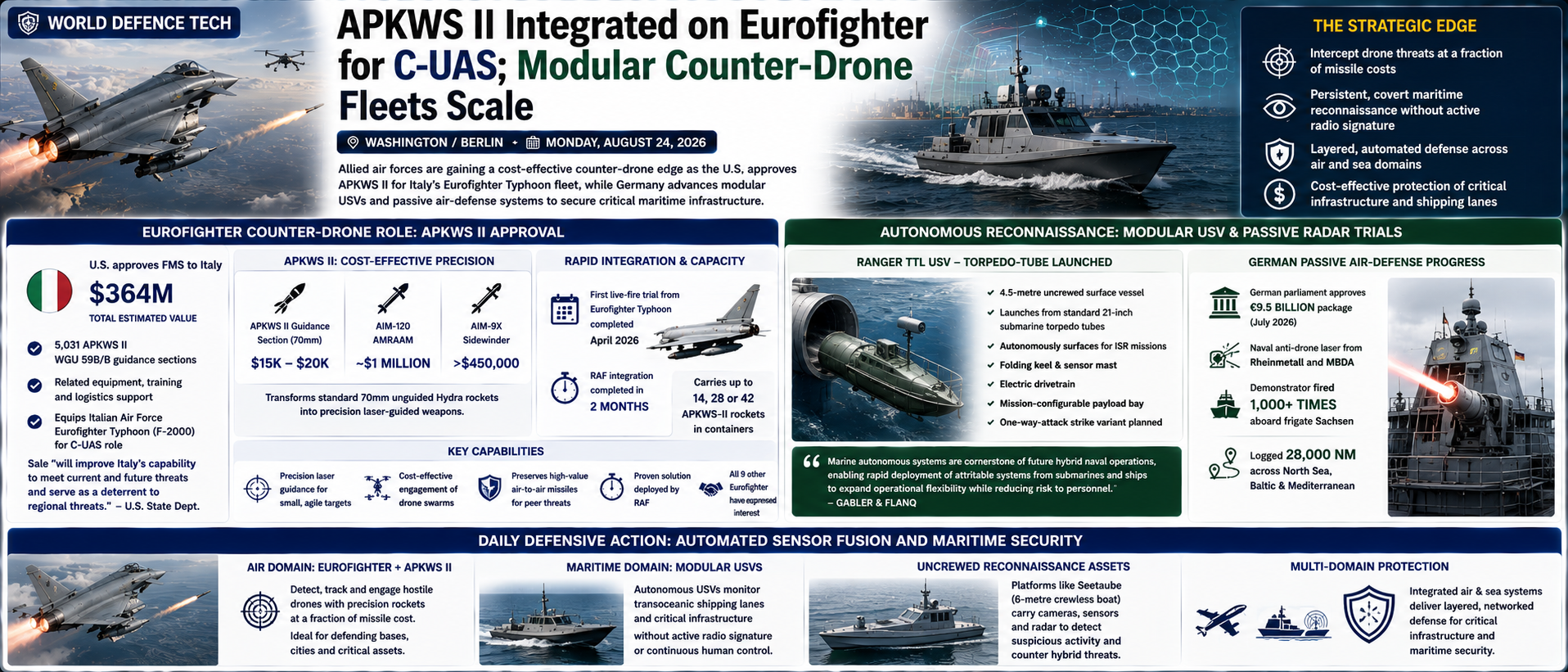
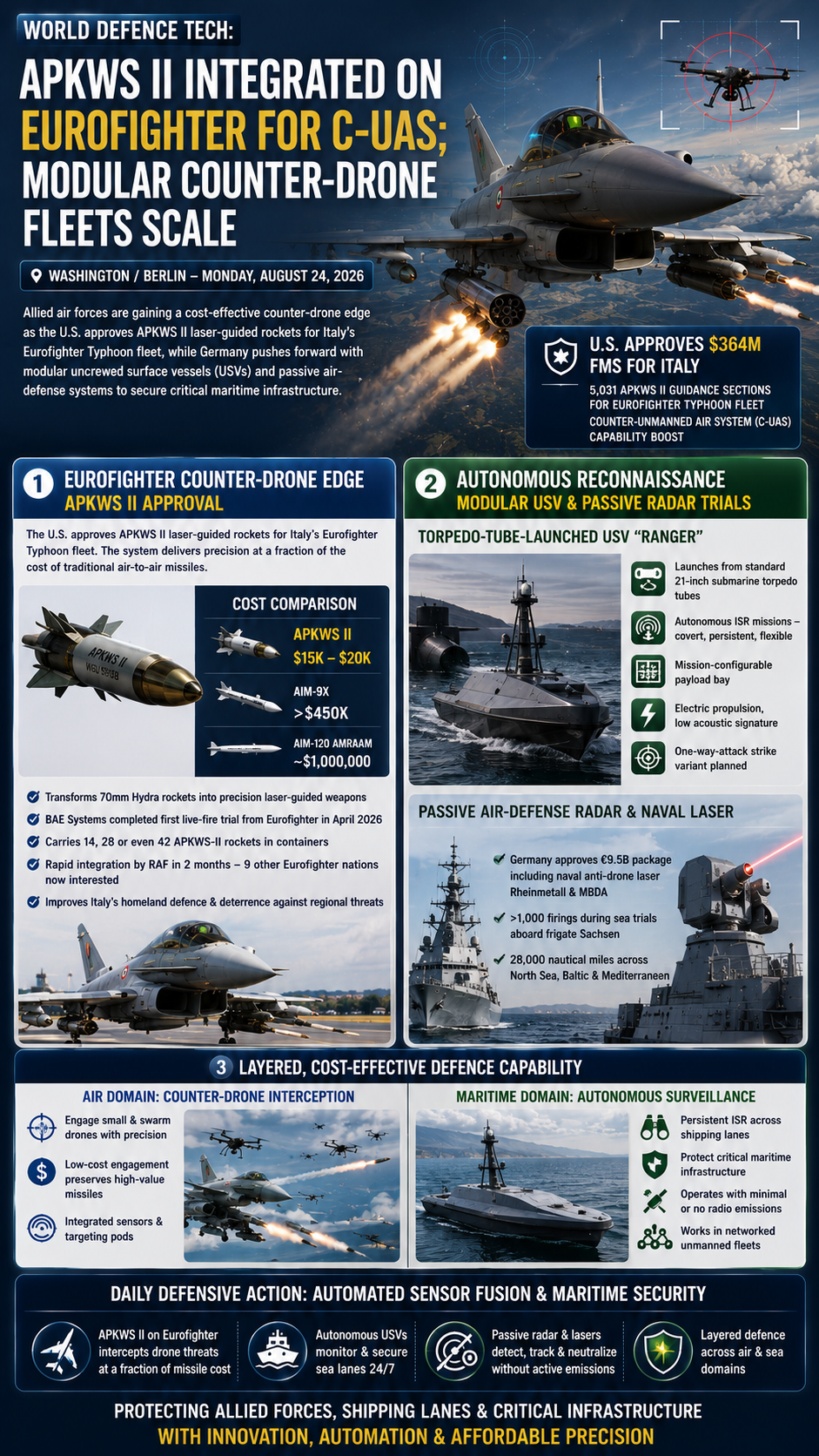
Allied air forces are gaining a cost-effective counter-drone edge as the U.S. approves APKWS II laser-guided rockets for Italy's Eurofighter Typhoon fleet, while Germany pushes forward with modular uncrewed surface vessels (USVs) and passive air-defense systems to secure critical maritime infrastructure.
EUROFIGHTER COUNTER-DRONE ROLE: APKWS II Approval
The U.S. Department of State has approved the Foreign Military Sale (FMS) of 5,031 BAE Systems APKWS II WGU 59B/B air-to-air guidance sections, related equipment, and support to Italy for an estimated $364 million. The laser-guided rockets will equip the Italian Air Force's Eurofighter Typhoon (designated F-2000) for the counter-unmanned aircraft system (C-UAS) role, joining the UK Royal Air Force, which already deployed the system on its Eurofighters after rapid testing and integration completed in two months.
The APKWS II transforms standard 70mm unguided Hydra rockets into precision laser-guided weapons. The guidance section is estimated to cost between $15,000 and $20,000—compared with approximately $1 million for an AIM-120 AMRAAM and over $450,000 for an AIM-9X. This cost advantage allows allied air forces to engage hostile drones without expending high-value air-to-air missiles. The U.S. State Department noted the sale "will improve Italy's capability to meet current and future threats by strengthening its homeland defence and serving as a deterrent to regional threats".
BAE Systems completed the first APKWS live-fire trial from a Eurofighter Typhoon in April 2026. The integration gives the Eurofighter the ability to carry up to 14, 28, or even 42 APKWS-II rockets in containers, making it a key system for defending against drone swarm attacks. Following the RAF's rapid integration, all nine other Eurofighter customer nations have indicated interest in fielding the combination.
AUTONOMOUS RECONNAISSANCE: Modular USV and Passive Radar Trials
Germany and allied partners are simultaneously scaling operational trials of modular uncrewed surface vessels and passive air-defense radar systems. German defence technology companies GABLER and FLANQ successfully completed Sea Acceptance Tests in June 2026 for the "Ranger" Torpedo-Tube-Launched Uncrewed Surface Vessel (TTL USV). The 4.5-metre platform launches from standard 21-inch submarine torpedo tubes, autonomously surfacing to conduct covert intelligence, surveillance, and reconnaissance missions.
The Ranger features a folding keel and sensor mast, electric drivetrain, and a mission-configurable payload bay. A one-way-attack strike variant is also planned. The companies described marine autonomous systems as "cornerstone of future hybrid naval operations", enabling rapid deployment of attritable systems from submarines and ships to expand operational flexibility while reducing risk to personnel.
Germany is also advancing passive air-defense radar systems. In July 2026, the German parliament approved a €9.5 billion package that includes a naval anti-drone laser from Rheinmetall and MBDA. The demonstrator has already fired more than 1,000 times while deployed aboard the frigate Sachsen, logging 28,000 nautical miles across the North Sea, the Baltic, and the Mediterranean.
DAILY DEFENSIVE ACTION: Automated Sensor Fusion and Maritime Security
The integration of APKWS II on Eurofighter and modular USV trials reflects a broader shift toward automated sensor fusion and distributed defensive architectures. Eurofighters equipped with APKWS II can now intercept drone incursions at a fraction of traditional missile costs, while autonomous USVs monitor transoceanic shipping lanes and critical maritime infrastructure continuously without active radio signatures. German forces are deploying uncrewed reconnaissance vessels like the Seetaube—a six-metre crewless boat carrying cameras, sensors, and radar—to detect suspicious activity and counter hybrid threats in maritime zones. Together, these capabilities provide allied forces with layered, cost-effective protection across both air and sea domains.

Vishal Sable
B.Tech AD @ shri balaji institute of technology and management
Engineering and tech journalist. I love exploring the impact of emerging technologies on global defense, sovereignty, and everyday life. Always looking for the real story behind the headlines.