Back to News
News AlertWorld Defence Tech
"Robotic Sovereignty" Is Now a Funded Business Category. Here's What That Actually Means — and What It Doesn't Yet.
V
Author
Vishal Sable
Published
September 2, 2026
Reading Time
6 MIN READ
Spread the Word
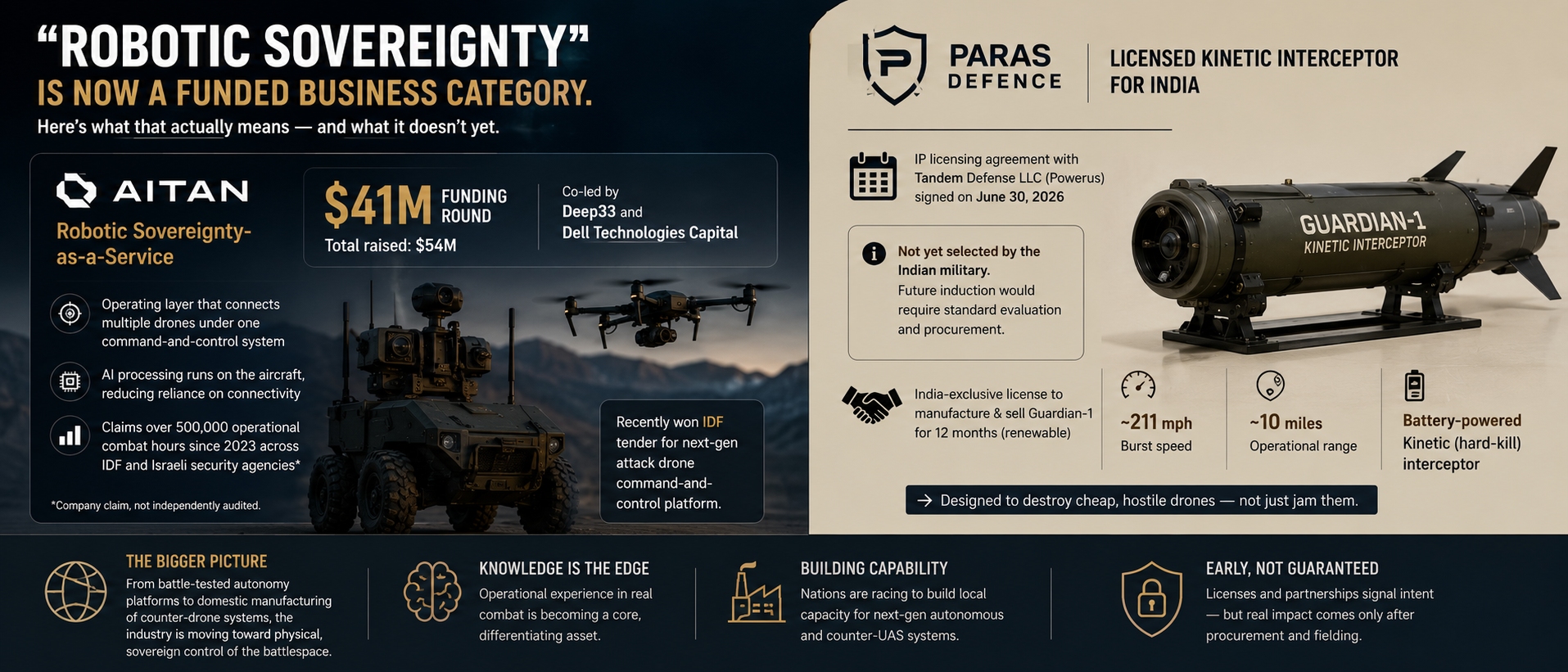
Aitan raised $41M to sell "Robotic Sovereignty-as-a-Service" while Paras Defence licensed a US kinetic interceptor for India. Neither story is quite what the headlines suggest.
robotic sovereignty as a service, Aitan funding Dell Technologies, kinetic drone interceptor India, Guardian-1 Paras Defence, counter-UAS hard-kill systems
robotic sovereignty as a service, Aitan funding Dell Technologies, kinetic drone interceptor India, Guardian-1 Paras Defence, counter-UAS hard-kill systems
A new category gets a name — and a price tag
"Robotic sovereignty" isn't a phrase that existed as a business category a year ago. This week it became one, formally, when Israeli defense-tech company Aitan emerged from stealth with a $41 million funding round co-led by Deep33 and Dell Technologies Capital, bringing its total raised to $54 million. The pitch: help allied militaries build and control their own autonomous robotic combat systems, rather than depending on hardware and software controlled by someone else.
On a related but separate track, India's Paras Defence has been getting fresh attention for an agreement that gives it exclusive rights to manufacture a US-designed kinetic drone interceptor domestically — a deal being read as part of the same broader shift toward physically knocking hostile drones out of the sky instead of jamming them electronically.
Both stories are real. Neither is quite as tidy as the framing suggests.
What Aitan is actually selling
Aitan — formerly known as eyesAtop, rebuilt under founders Udi Oster and Daniel Almog, both former officers in Israel's Unit 8200 — describes its product as an operating and orchestration layer that connects drones from different manufacturers under one command-and-control system, with AI processing running on the aircraft itself rather than depending entirely on a remote connection. The company says its systems have been battle-tested since 2023 and have accumulated more than 500,000 operational combat hours across the Israel Defense Forces and Israeli national security agencies, and that it recently won a joint tender to build the IDF's command-and-control platform for its next generation of attack drones.
One detail worth being upfront about: the 500,000-hours figure, along with Aitan's other operational and readiness claims, comes from the company itself. It hasn't been independently audited, which doesn't make it false, but it does mean it should be read as a company claim rather than a verified statistic — a standard caveat that applies to most young defense-tech startups making battlefield-scale claims before public procurement records catch up.
Deep33's Lior Prosor made the more interesting structural point in the funding announcement: Israel, he said, is one of the only places with the combat experience and flight hours to develop robotic weapon systems at genuine scale — meaning Aitan's core asset isn't just its software, it's years of real battlefield feedback most competitors don't have access to. That's the actual thesis behind "sovereignty-as-a-service": selling not just hardware, but the accumulated operational knowledge of how to keep autonomous systems working in contested, jammed, fast-changing conditions.
The Guardian-1 deal: older, and more limited, than it looks
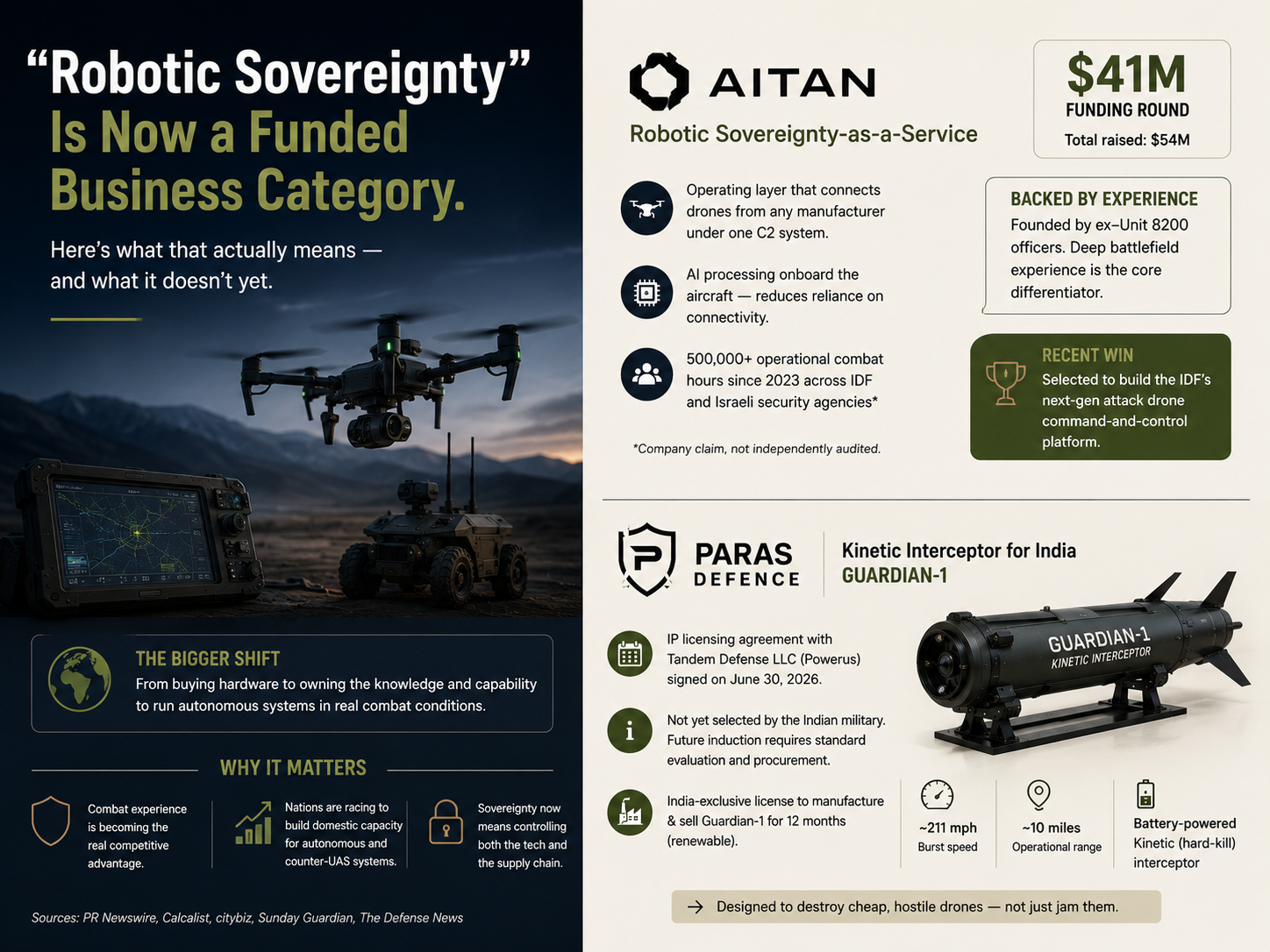
The Paras Defence-Powerus story needs a clearer timeline than most coverage is giving it. The actual IP licensing agreement between Paras and Tandem Defense LLC (Powerus's subsidiary) was signed on June 30, 2026 and first announced in early July — this is not a new deal from this week. What's happening now is renewed attention, driven by fresh analysis published August 31 based on Powerus's own US SEC filings, which added a detail most of the original coverage skipped: the Guardian interceptor has not been selected by the Indian military. Any future induction into Indian service would still require going through the standard evaluation and procurement process. What Paras actually holds is a 12-month renewable, India-exclusive license to manufacture and sell the Guardian-1 — an industrial and commercial opportunity, not a confirmed defense contract.
That distinction matters because it changes what the news actually is. The Guardian-1 itself is a real, specific system: a battery-powered kinetic interceptor with a cruise speed around 100 mph, a burst speed near 211 mph, and roughly 10 miles of operational range, designed to physically chase down and destroy cheap hostile drones rather than jam them electronically. It's a genuine answer to a real problem — traditional missile-based air defense is expensive to use against a $500 quadcopter. But right now, it's a manufacturing license looking for a buyer, not a system already headed for Indian frontlines.
Where the two stories actually connect
Set side by side, Aitan and the Guardian-1 deal describe two different stages of the same shift. Aitan represents the mature end: a company with years of real combat data now selling the accumulated knowledge of running autonomous systems, not just the hardware. Paras-Powerus represents the earlier, more speculative end: a licensing agreement that creates domestic manufacturing capacity for a proven interceptor design, well ahead of any confirmed military demand for it in India. Both are genuine signs that kinetic, physical counter-drone capability is becoming a serious commercial category — but only one of them currently has customers using it in anger.
Why it matters
For India specifically, the Paras-Powerus deal is worth watching less as an operational milestone and more as a bet: Paras is building manufacturing capability now, on the assumption that the Indian Army and Air Force's active interest in hard-kill counter-drone systems eventually turns into a real procurement decision. That's a reasonable bet given the stated demand, but it's still a bet. For the broader industry, Aitan's funding round is the clearer signal — investors are now willing to price "the accumulated experience of running robots in real combat" as a defensible, fundable business on its own, separate from the hardware itself.
If the real value in robotic warfare is turning out to be the operational knowledge of running these systems under fire — not just the drones themselves — does that make combat experience the actual scarce resource in this market, and if so, which countries besides Israel and Ukraine currently have enough of it to compete?
---
Sources : [PR Newswire] - (https://www.prnewswire.com/news-releases/aitan-emerges-from-stealth-defines-new-defense-category-of-robotic-sovereignty-as-a-service--closes-41-million-funding-round-to-scale-its-battle-proven-technology-globally-302867620.html),
[Calcalist] - (https://www.calcalistech.com/ctechnews/article/b1dz1kbdme),
[citybiz] - (https://www.citybiz.co/article/897712/aitan-raises-41m-to-scale-ai-powered-robotic-defense-systems/),
[Sunday Guardian] - (https://sundayguardianlive.com/news/top-5/us-counter-drone-tech-enters-indias-manufacturing-chain-272982/),
[The Defense News] - (https://www.thedefensenews.com/Paras-Defence-Partners-with-US-Firm-Powerus-to-Produce-Guardian-1-Counter-Drone-System-in-India/).
[Calcalist] - (https://www.calcalistech.com/ctechnews/article/b1dz1kbdme),
[citybiz] - (https://www.citybiz.co/article/897712/aitan-raises-41m-to-scale-ai-powered-robotic-defense-systems/),
[Sunday Guardian] - (https://sundayguardianlive.com/news/top-5/us-counter-drone-tech-enters-indias-manufacturing-chain-272982/),
[The Defense News] - (https://www.thedefensenews.com/Paras-Defence-Partners-with-US-Firm-Powerus-to-Produce-Guardian-1-Counter-Drone-System-in-India/).

Vishal Sable
B.Tech AD @ shri balaji institute of technology and management
Engineering and tech journalist. I love exploring the impact of emerging technologies on global defense, sovereignty, and everyday life. Always looking for the real story behind the headlines.