Back to News
News AlertWorld Defence Tech
India Tried to Build Javelin Missiles With Tata Once Before. It Never Happened. Here's Why This Time Might Be Different.
V
Author
Vishal Sable
Published
September 1, 2026
Reading Time
5 MIN READ
Spread the Word
A deal India has chased before
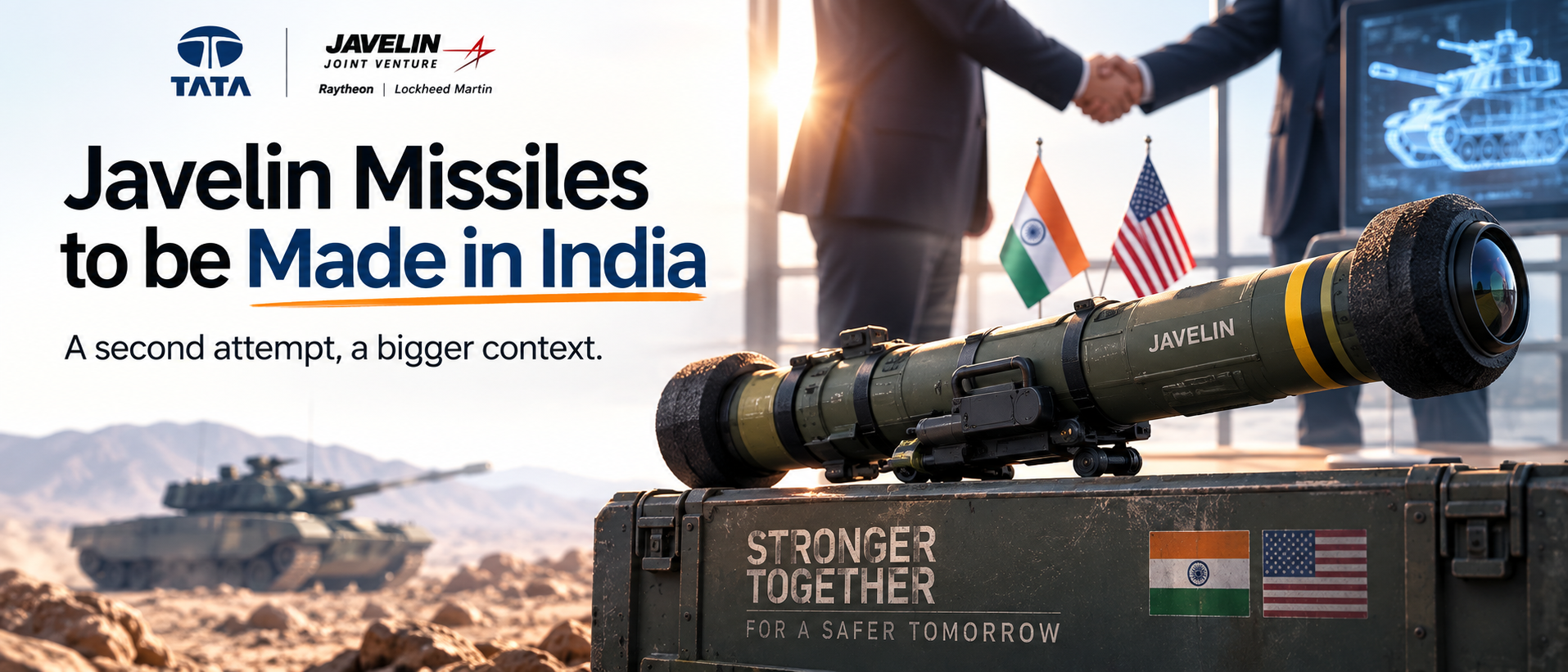
Tata Advanced Systems Limited and the Javelin Joint Venture — a partnership between Raytheon and Lockheed Martin — signed a memorandum of understanding this week to co-produce the Javelin All Up Round anti-tank missile in India. Headlines are calling it historic. It isn't the first time these two names have tried this: Lockheed Martin and Raytheon signed a co-development deal with Tata Power for the same missile system back in 2010. It went nowhere. India ultimately walked away, and DRDO argued its own indigenous Nag missile was superior anyway.
Sixteen years later, the same basic pitch — Tata, Javelin, local assembly — is back on the table. What's different this time is everything happening around it.
What's actually in the new agreement
Under the MoU, Tata Advanced Systems was selected by the Javelin Joint Venture as its prime Indian partner after evaluating multiple domestic companies on capability and expertise. The two sides will explore establishing a dedicated final assembly and integration facility for the complete Javelin AUR in India, along with component manufacturing — sub-assembly kits and guidance electronics units shipped from the US for final assembly and integration on Indian soil.
Crucially, this MoU landed just days after India signed an actual government-to-government purchase : a ₹292 crore Foreign Military Sales deal for Javelin systems for the Indian Army, using the Emergency Procurement route. That sequencing matters — the 2010 attempt was a co-development pitch with no confirmed buyer behind it. This time, India is already a paying customer before the co-production conversation even started.
Why this attempt has better odds
Three things separate 2026 from 2010. First, there's a live contract — India isn't exploring a hypothetical partnership, it's already bought the system through FMS, giving JJV a concrete reason to build local capacity rather than just explore it. Second, the JJV frames co-production explicitly as a way to hit economic order quantities — more total production volume, split across countries, lowers unit costs for everyone, including the US government's own procurement. That's a commercial incentive that didn't exist in the same form in 2010. Third, the regional framing has changed: JJV is positioning India's facility as a supply source for Indo-Pacific partner nations, not just the Indian Army — turning this into an export play, not a one-off domestic deal.
The company has already produced over 55,000 Javelin missiles and 12,000+ reusable launch units globally, so this isn't a startup trying to prove a concept — it's an established program looking for a second, cheaper manufacturing base as global demand climbs.
Meanwhile, in Southeast Asia: drones become the new decentralization story
On the same day, a structurally similar story played out in a different theater. Japan's Terra Drone signed a strategic partnership with DRB-HICOM Defence Technologies (DEFTECH), Malaysia's largest state-linked defense manufacturer — best known for building the AV8 Gempita armored vehicle for the Malaysian Army — to jointly develop ISR drones and counter-UAS systems across ASEAN, covering maritime and border surveillance plus interceptor drones and integrated command systems.
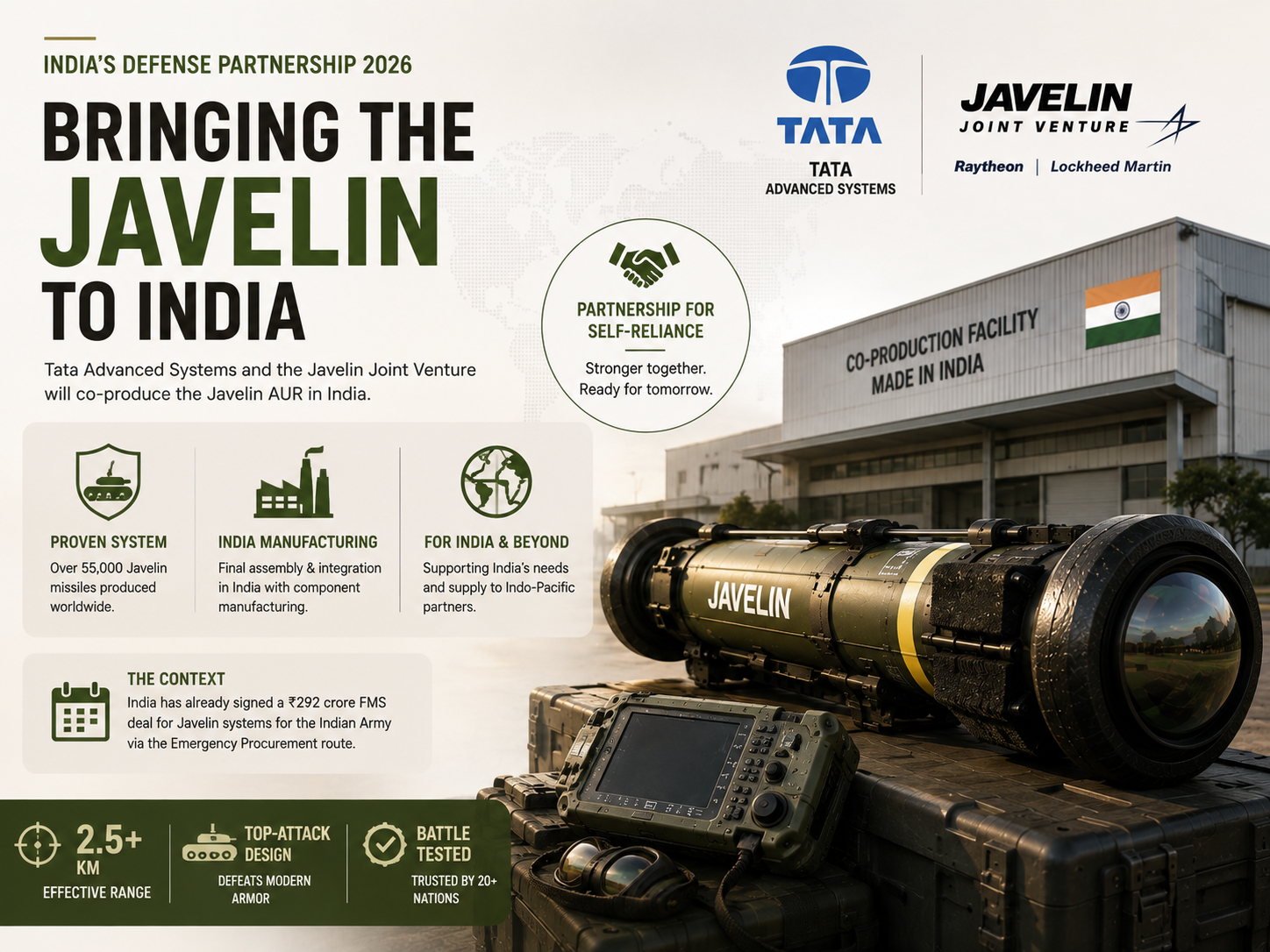
Terra Drone didn't stop there. The same day, it separately announced it's building a standalone Counter-Unmanned Aircraft System (C-UAS) specifically to protect civilian critical infrastructure — oil and gas facilities, power plants, airports, ports, and telecom sites — from hostile drones, using AI-based target tracking, layered sensor fusion (radar, RF, and electro-optical/infrared), and both non-kinetic jamming and kinetic interceptor drones as countermeasures.
This wasn't a first move either. Terra Drone only entered the defense sector this past March with a US subsidiary; the DEFTECH deal and the C-UAS program mark its expansion from a standing start into two new fronts — ASEAN military partnerships and civilian infrastructure protection — inside the same five months.
The connecting thread
Both stories describe the same underlying shift, from two different angles. Tata-Javelin is a government buying a foreign weapon system and immediately localizing its production through private industry, rather than waiting for a state lab to build an equivalent. Terra Drone-DEFTECH is a commercial drone company — barely a defense player five months ago — being trusted to build the airspace-defense layer for an entire region's power plants and airports, a job that used to sit squarely inside state militaries.
In both cases, the actor providing critical defense capability isn't the traditional state-owned prime contractor. It's a private company that entered the deal because a government needed capacity faster than its own institutions could deliver it.
Why it matters
For India specifically, the gap between the failed 2010 Tata-Javelin attempt and this one is a useful signal: co-production deals succeed not when the technology or the manufacturer changes, but when there's a confirmed buyer and a genuine cost incentive behind them. For the wider region, Terra Drone's rapid pivot from civilian UAM company to ASEAN's counter-drone infrastructure partner in under half a year suggests the barrier to entry for "who gets to build sovereign defense capability" has dropped further and faster than most governments' own procurement rules have caught up to.
If a commercial drone company can go from zero defense experience to protecting a region's airports and power plants in five months, how many other critical-infrastructure defense roles are quietly up for grabs by companies that weren't defense contractors a year ago?
---
Sources : The Print - (https://theprint.in/defence/tata-signs-agreement-for-javelin-co-production-in-india-numbers-for-anti-tank-missile-to-ramp-up/3029479/) , Business Standard - (https://www.business-standard.com/external-affairs-defence-security/news/tata-advanced-systems-to-explore-co-production-of-javelin-missiles-in-india-126083101007_1.html) , Army Technology - (https://www.army-technology.com/news/india-javelin-missile-production/) , DroneLife - (https://dronelife.com/2026/08/31/terra-drone-signs-deftech-for-malaysia-defense-hub-and-begins-c-uas-system-for-critical-infrastructure/) , Terra Drone official release - (https://terra-drone.net/global/2026/08/31/28570/)

Vishal Sable
B.Tech AD @ shri balaji institute of technology and management
Engineering and tech journalist. I love exploring the impact of emerging technologies on global defense, sovereignty, and everyday life. Always looking for the real story behind the headlines.