Back to News
News AlertWorld Defence Tech
Hypersonic Industrialization: Why India's 500-Scramjet Tender Changes the Missile Math in 2026
V
Author
Vishal Sable
Published
October 19, 2026
Reading Time
4 MIN READ
Spread the Word
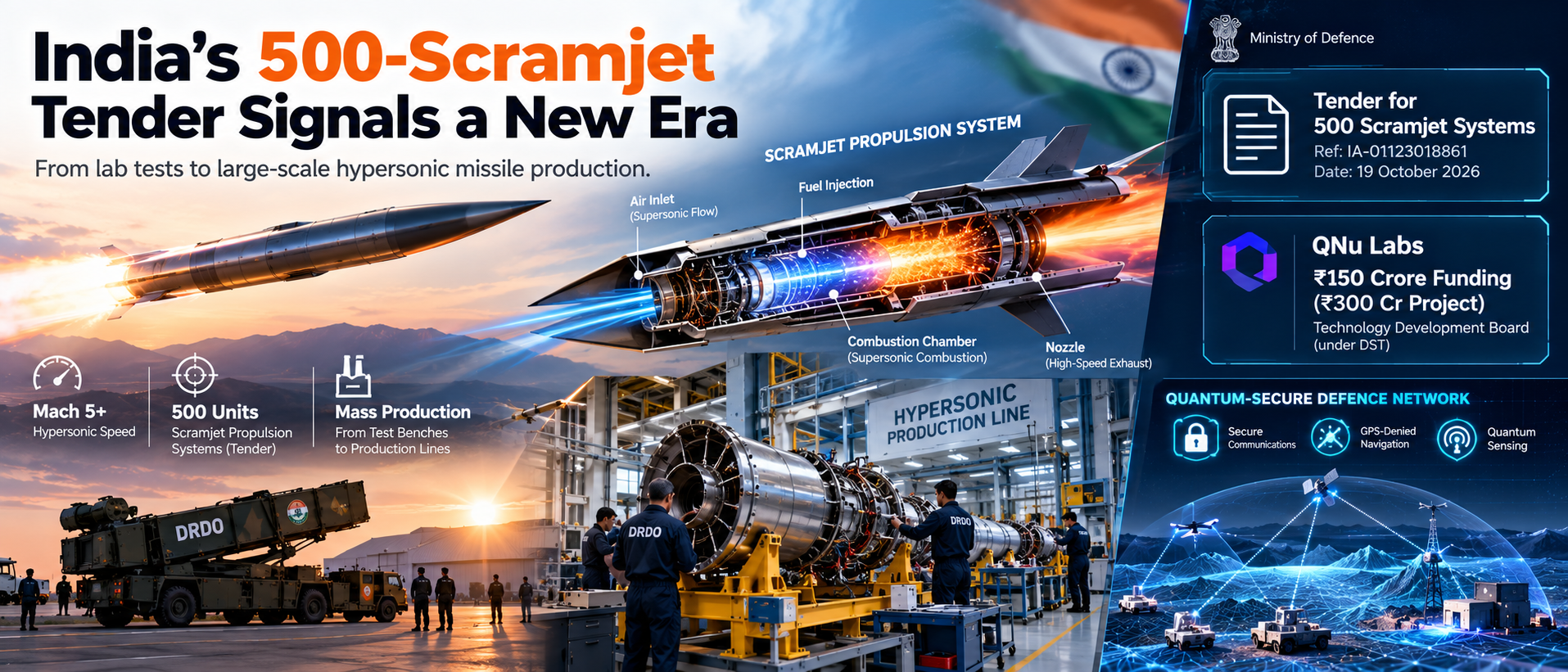
India is moving Mach 5+ propulsion from test benches to production lines — and funding a quantum shield to go with it
The numbers tell a story of scale. India's Ministry of Defence has floated a tender for 500 scramjet propulsion systems for its hypersonic missile programme, listed under reference IA-01123018861 and reported on October 19, 2026.
Five hundred is not a prototype order. It is an industrial one.
Days earlier, the Technology Development Board signed a ₹150 crore agreement with Bengaluru-based QNu Labs to build an indigenous backbone for quantum-secure and sensing networks, part of a ₹300 crore project. Read together, the two moves outline a single strategy: build weapons that cannot be intercepted, and networks that cannot be cracked.
From a 1,200-Second Test to a 500-Unit Order
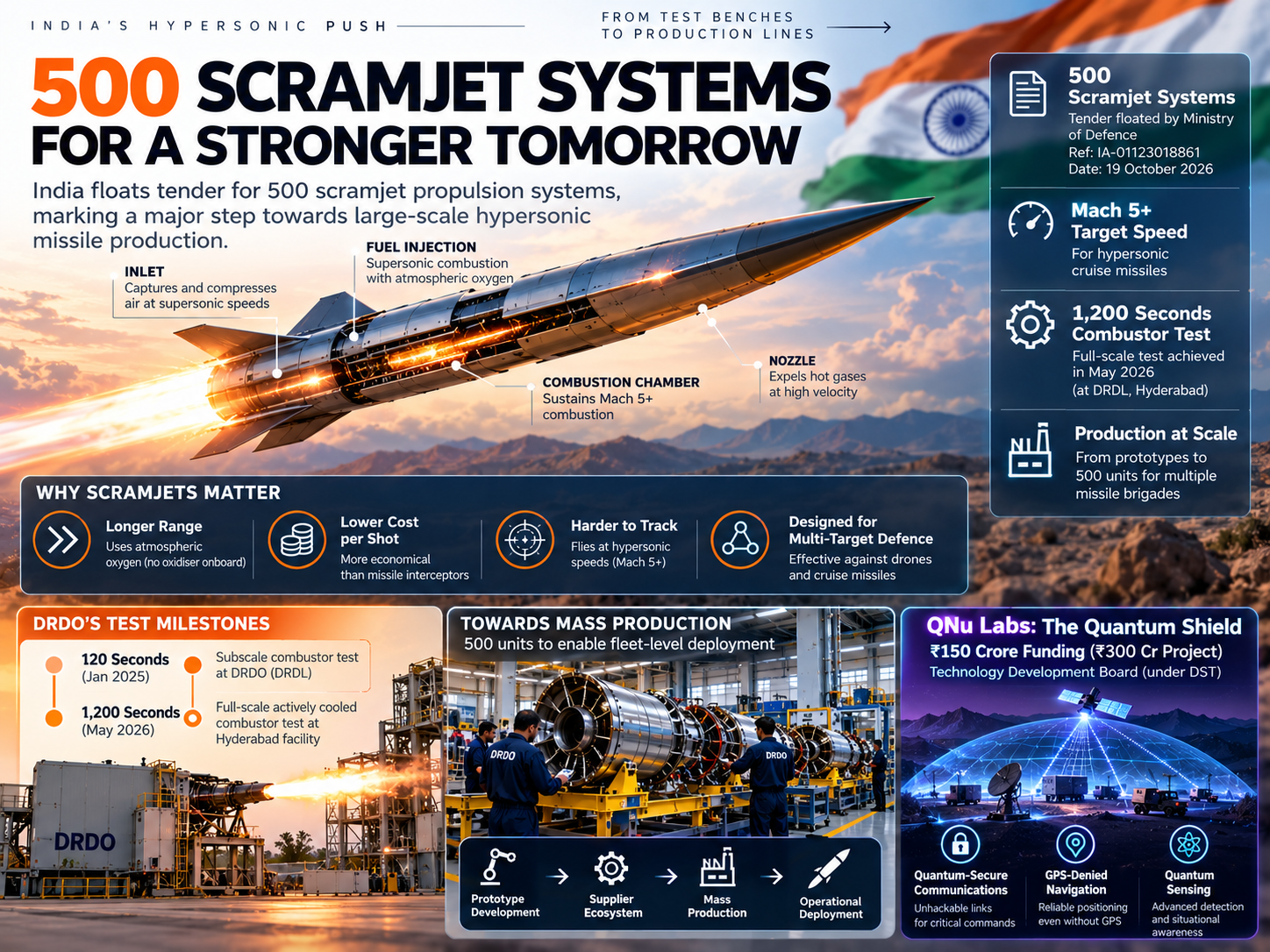
Scramjets are air-breathing engines that burn fuel while air flows through them at supersonic speeds, using atmospheric oxygen instead of carrying an oxidiser onboard. That makes them the preferred propulsion for hypersonic cruise missiles — lighter, longer-ranged and harder to track than ballistic alternatives.
India's path here was incremental. DRDO's Defence Research and Development Laboratory ran a 120-second subscale combustor test in January 2025. By May 2026 it had pushed a full-scale actively cooled combustor to 1,200 seconds at its Hyderabad facility.
The tender is the logical next step. Once combustion is stable for twenty minutes, the engineering problem becomes manufacturing: repeatability, tolerances, supply chains. A 500-unit order forces the private sector to solve exactly that.
Why 500 Is the Number That Matters
Hypersonic missile production India has historically been a story of single launches and press releases. This tender flips the model.
Five hundred propulsion units is enough to arm multiple missile brigades with standardised Mach 5+ strike systems, rather than fielding a handful of showcase weapons. It also sets a volume floor that lets private manufacturers justify dedicated production lines for high-temperature alloys, fuel injection systems and actively cooled combustor assemblies.
For the defence startup ecosystem, this is the signal investors wait for. Component suppliers now have a government-backed demand curve to plan against. Former DRDO chief Dr. G. Satheesh Reddy has called for an operational hypersonic cruise missile by 2035; mass-produced engines are the only way to hit that date with fleet-level numbers, not a single squadron.
QNu Labs and the Unhackable Backbone
Hypersonic weapons are only as useful as the command links that fire them. That is where the second story lands.
The TDB funding for QNu Labs targets three things: secure communications, GPS-denied navigation and quantum sensing. Quantum key distribution makes intercepted communications detectable by physics rather than by software, which matters when adversaries are investing heavily in signals intelligence.
The project's structure is telling. ₹150 crore from government, matched by the company and partners for a ₹300 crore total. It is the same co-investment playbook India is using across deep-tech: the state de-risks the first production-grade build, and private capital scales it.
The Industrial Base Is the Real Weapon
The common thread across both announcements is not the technology. It is who builds it.
A decade ago, scramjets and quantum encryption were strictly DRDO lab projects. In 2026, a Ministry tender and a DST funding board are pulling private firms into the production chain. That is how the United States and China industrialised their own hypersonic programmes — and India is now running the same play with domestic companies.
Expect a wave of Tier-2 suppliers in Hyderabad, Bengaluru and Pune to position for scramjet sub-assemblies, and for quantum-security startups to pitch field-deployable hardware rather than research papers.
What This Means for 2026 and Beyond
Hypersonic industrialization is the moment a missile programme becomes a manufacturing economy.
Three things to watch. First, which private consortia win scramjet production contracts and how quickly the first batch rolls out. Second, whether quantum-secured links get integrated into missile command networks or stay confined to pilot deployments. Third, the 2035 operational target — a 500-unit order makes it credible for the first time.
India is no longer testing hypersonic weapons. It is tooling up to build them at scale.

Vishal Sable
B.Tech AD @ shri balaji institute of technology and management
Engineering and tech journalist. I love exploring the impact of emerging technologies on global defense, sovereignty, and everyday life. Always looking for the real story behind the headlines.