Back to News
News AlertWorld Defence Tech
Build First, Get Paid Later: Talon Blue, PAC-3 Edge and PrSM Inc 4
V
Author
Vicky Galfat
Published
October 11, 2026
Reading Time
5 MIN READ
Spread the Word
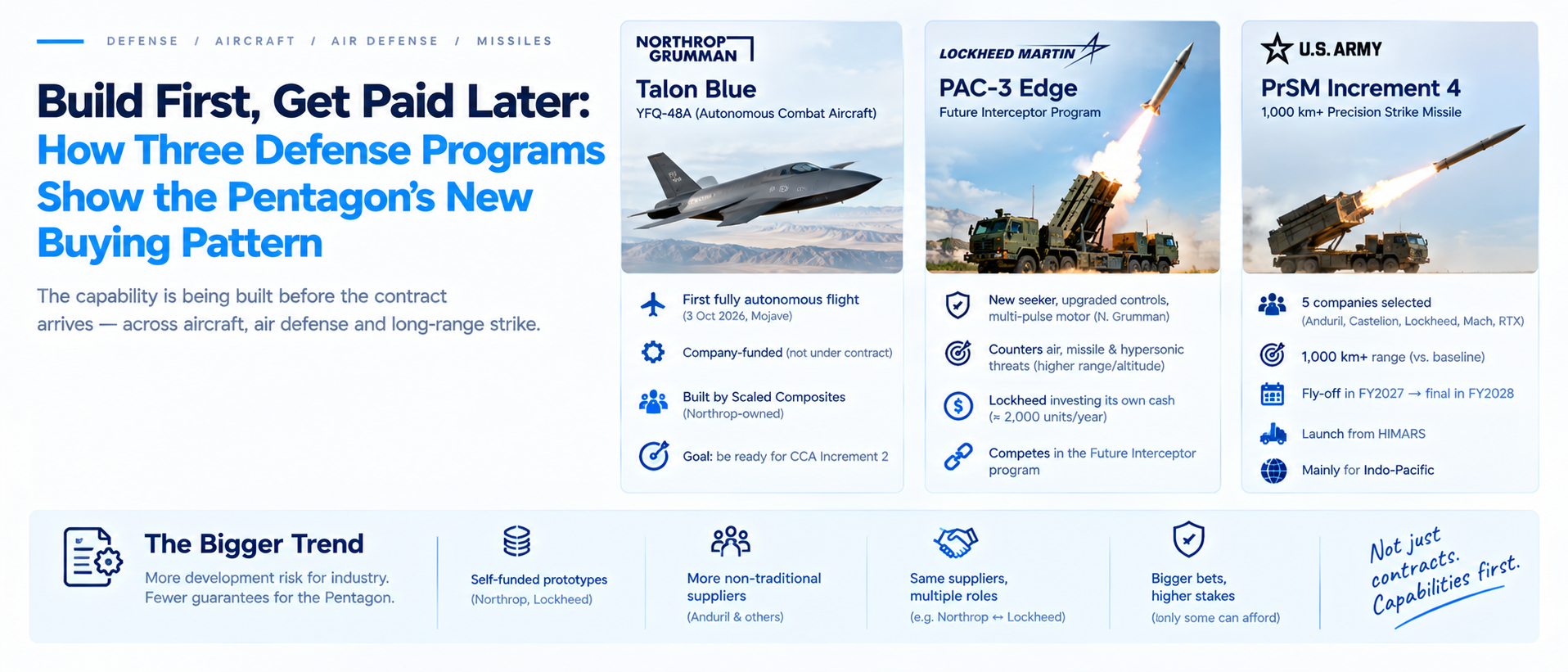
Northrop flew self-funded Talon Blue, Lockheed unveiled PAC-3 Edge, and the Army picked five firms for a 1,000 km PrSM. Defense is going build-first.
YFQ-48A Talon Blue, PAC-3 Edge, Future Interceptor program, PrSM Increment 4, 1,000 km Precision Strike Missile, Northrop Grumman autonomous aircraft, Lockheed Martin interceptor, collaborative combat aircraft, US Army missile competition, HIMARS.
Build First, Get Paid Later: How Three Defense Programs Show the Pentagon's New Buying Pattern
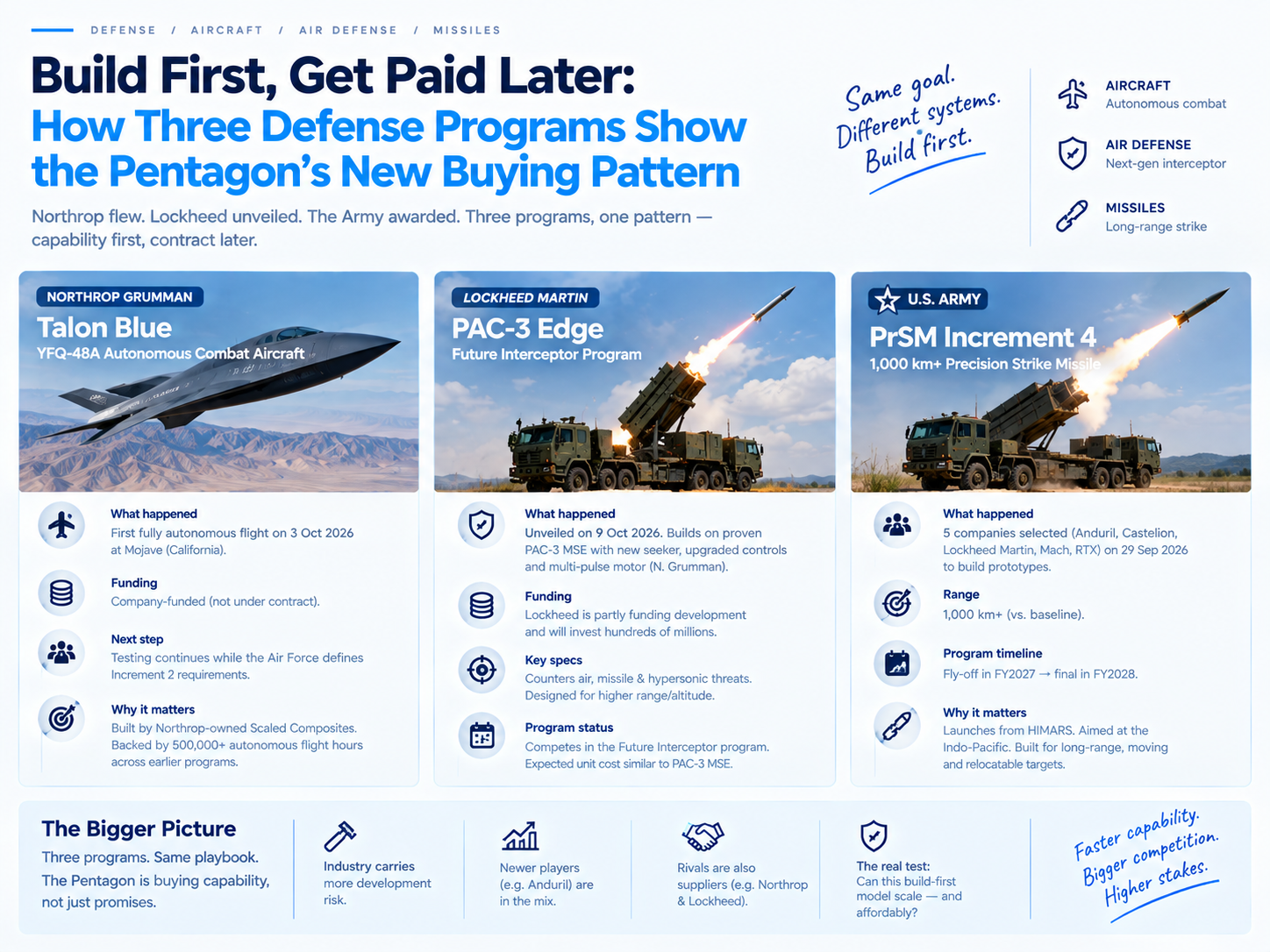
This month, Northrop Grumman flew an autonomous combat aircraft that no customer has ordered. Lockheed Martin unveiled an interceptor it is partly funding itself. And the US Army paid five companies to compete on a missile that does not yet exist. The three announcements cover aircraft, air defense and long-range strike, but they share one pattern: the capability is being built before the contract arrives.
Talon Blue Flies Without a Customer
On 3 October, Northrop Grumman's YFQ-48A Talon Blue completed its first fully autonomous flight at Mojave Air and Space Port in California, covering taxi, takeoff, in-flight manoeuvres and landing. The aircraft is company-funded and was built by Northrop-owned Scaled Composites. It is not under contract. The Air Force selected General Atomics and Anduril for the first increment of its Collaborative Combat Aircraft program, and Talon Blue enters flight testing while the service considers requirements for Increment 2.
Northrop says its customers want autonomous systems fielded faster and more affordably, and points to more than 500,000 autonomous flight hours across earlier programs such as the Global Hawk and Triton. In other words, the company is betting that a flying, proven aircraft will be in the room when Increment 2 requirements are set.
PAC-3 Edge: A Proven Missile Reopens the Contest
On 9 October, Lockheed Martin debuted PAC-3 Edge for the Army's Future Interceptor program. It builds on the combat-proven PAC-3 MSE, adding a new seeker, upgraded flight controls and a multi-pulse solid rocket motor designed by Northrop Grumman. Lockheed says it is designed to counter air, missile and hypersonic threats at higher altitudes and longer ranges, and to plug into existing systems including the Integrated Battle Command System and HIMARS Flex launchers. The company has not claimed it is built specifically for hypersonic glide vehicles.
Lockheed's president of missiles and fire control, Tim Cahill, told Reuters the unit cost would be about that of today's PAC-3 MSE, with a full-production rate of roughly 2,000 a year. He also said Lockheed is one of two companies advancing in the competition, and that it plans to invest hundreds of millions of its own dollars in the missile. The Army cancelled an earlier next-generation Patriot interceptor effort in 2024, so Edge arrives in a program that has already restarted once.
PrSM Increment 4: Five Bets on 1,000 Kilometers
On 29 September, the Army signed Other Transaction Authority agreements with Anduril, Castelion, Lockheed Martin, Mach Industries and RTX to develop prototypes for Precision Strike Missile Increment 4. The missile must launch from HIMARS and hit moving ships and relocatable land targets at 1,000 kilometers or more, about double the baseline PrSM's range. The Army says it is intended primarily for the Indo-Pacific.
The structure is the story. A competitive fly-off in fiscal 2027 leads to a first down-select, followed by a final fly-off in fiscal 2028, and only firms with effective designs may receive additional agreements. This is the second start for Increment 4, after the Army reopened the competition with a new solicitation in April. Three of the five competitors are newer entrants rather than long-established primes, in line with the Pentagon's stated push to bring nontraditional suppliers into major programs.
The demand signal is real. PrSM Increment 1 was used in combat for the first time in March during the conflict with Iran, and Lockheed won a $1.21 billion Increment 2 contract in mid-September.
What the Pattern Means
Taken together, these programs show industry carrying development risk that governments once funded. Northrop pays for its own prototype. Lockheed commits its own cash to an interceptor still in competition. Five firms build missiles for a contest in which at most a few will survive. Anduril appears in two of the three stories, as a first-increment CCA winner and a PrSM Inc 4 competitor, a sign of how widely the newer firms are spreading their bets.
The open question is who can afford that model. Self-funding a prototype works for a Northrop or a Lockheed, which can absorb a loss if Increment 2 goes elsewhere. Whether it works for smaller companies, and whether the Pentagon gets the competition it wants if only the largest can bear the cost, will decide whether build-first becomes a durable way of buying or a bet only some can afford.

Vicky Galfat
University of Mumbai/BCA
Learning, building, and exploring the world of technology one project at a time.