Back to News
News AlertWorld Defence Tech
From Demos to Mass Production: War Is Industrializing Robot Warfare
V
Author
Vicky Galfat
Published
October 5, 2026
Reading Time
4 MIN READ
Spread the Word
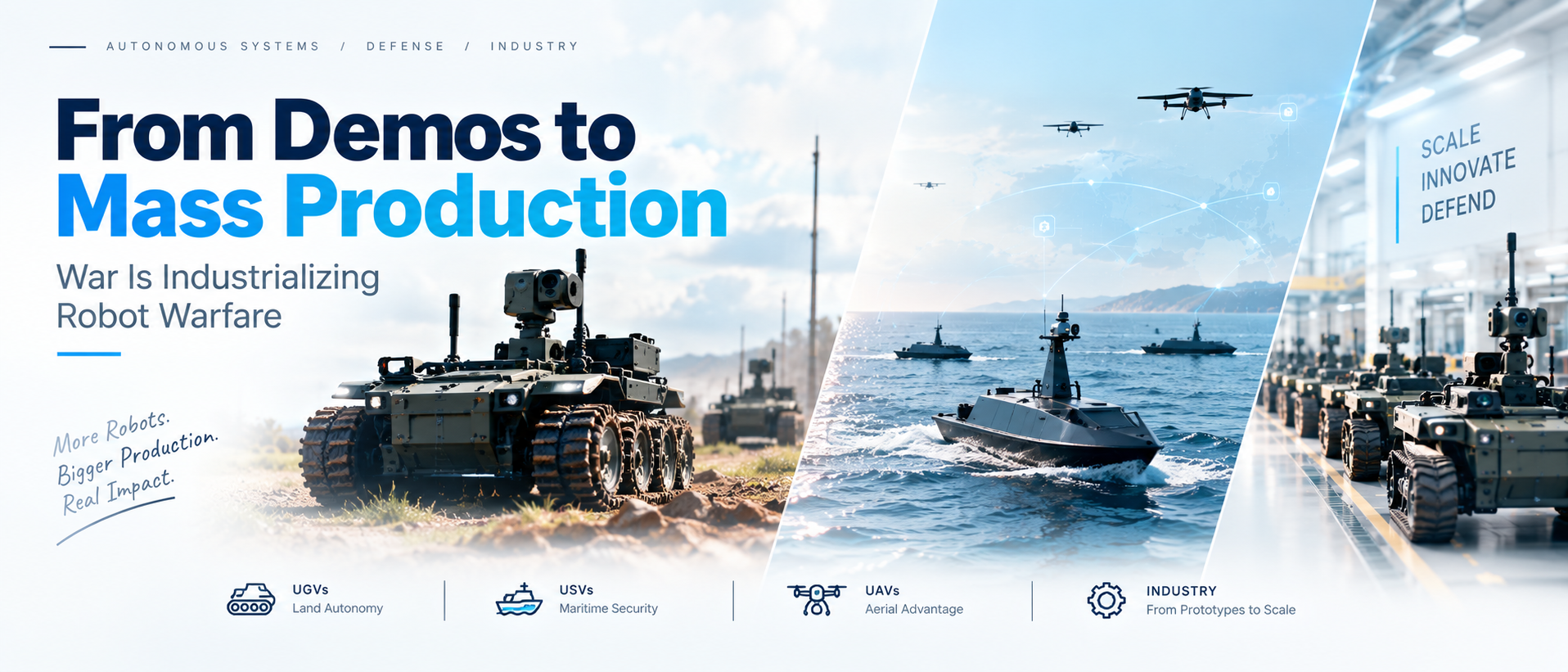
Ukraine needs 50,000 unmanned ground vehicles in 2026 alone. A new Kyiv deal shows autonomy has moved from battlefield pilot to industrial production line.
ARX Robotics Roboneers, unmanned ground vehicles Ukraine, UGV mass production, Rys Pro UGV, autonomous USV swarm, maritime ISR drones, Salaknib 2026, connected autonomy, defense robotics 2026, unmanned surface vessels
ARX Robotics Roboneers, unmanned ground vehicles Ukraine, UGV mass production, Rys Pro UGV, autonomous USV swarm, maritime ISR drones, Salaknib 2026, connected autonomy, defense robotics 2026, unmanned surface vessels
From Demos to Mass Production: War Is Industrializing Robot Warfare
Ukraine's government now estimates it needs 50,000 unmanned ground vehicles in 2026 alone. That single number explains why, this week, two defense robotics firms signed yet another agreement in Kyiv — and why militaries from the Baltic to the South China Sea are racing to turn autonomous systems from battlefield demonstrators into assembly-line products.
A Third Deal in Four Months
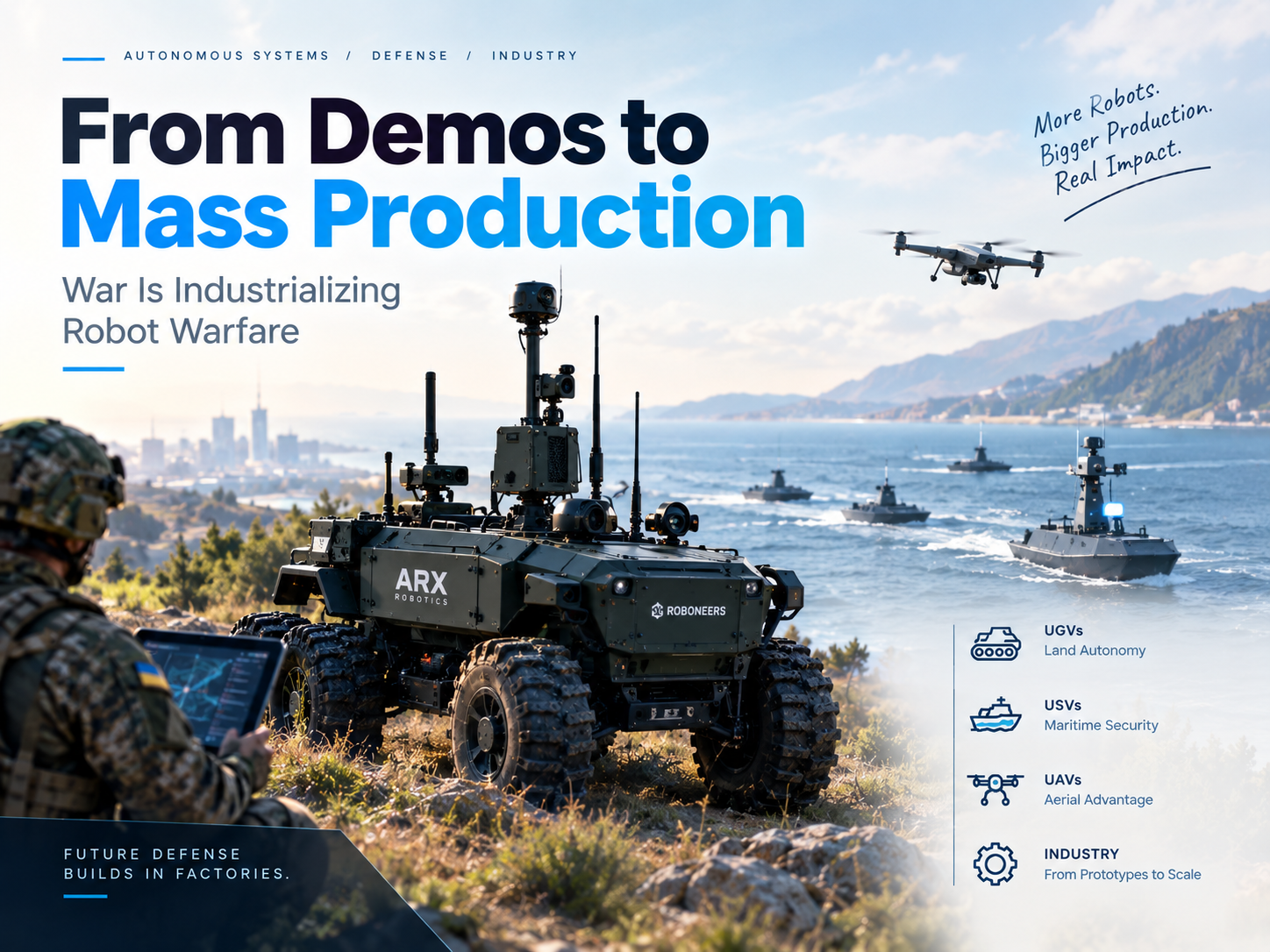
German firm ARX Robotics and Ukrainian company Roboneers signed a new agreement in Kyiv on October 4, in the presence of Chancellor Friedrich Merz and President Volodymyr Zelenskyy, deepening technical integration between their unmanned ground vehicle systems and committing both companies to joint research and development. It's the third step in an escalating partnership: the two companies first combined on production of the Lynx Pro UGV, then in June 2026 formed a joint venture called ARX Industries to mass-produce the heavier Rys Pro platform across facilities in Germany and Ukraine. That venture aims to build several thousand units in its first year, scaling to tens of thousands annually — output numbers that sound less like a defense contractor's roadmap and more like a car manufacturer's.
Why the Shift From Pilot to Production Line Matters
For years, unmanned ground vehicles were framed as experimental force multipliers — useful for scouting or resupply at the margins, but not core to how militaries fight. Ukraine's battlefield has changed that calculus. With manpower in chronically short supply and front lines saturated with drone surveillance that makes any human movement lethal, UGVs capable of autonomous reconnaissance and casualty evacuation under fire have become essential rather than experimental. ARX Robotics has already demonstrated, through collaboration with German industrial partner Deutz, that it can scale production of ground drones in a very short period — exactly the kind of industrial capacity that distinguishes a prototype program from a war-sustaining one.
The Same Industrialization Is Happening at Sea
A parallel shift is underway in maritime autonomy, where the goal is no longer proving a single unmanned surface vessel (USV) can navigate — it's proving networks of them can operate as a persistent, coordinated system. During Exercise Salaknib 2026 in the Philippines, U.S. and Philippine forces deployed a swarm of autonomous boats to form a security screen protecting a logistics vessel, compressing a commander's decision-making from hours to seconds. In Norway's Trondheim Fjord, Maritime Robotics ran a live demonstration pairing multiple USV types — one mapping the seabed, another handling autonomous navigation, smaller units deploying underwater drones — to simulate protecting a mothership in real time. Separately, a coordinated U.S. test paired Rampage-type USVs with Vatn Systems' underwater Skelmir drones, involving defense heavyweights HavocAI and Lockheed Martin, pointing toward a layered sensor network spanning sea surface and seabed.
A Race That Cuts Both Ways
This isn't a one-sided buildup. China has run its own operational tests of USV swarms, demonstrating autonomous patrol and interception off Guangdong province under a centralized command structure with decentralized execution — explicitly framed by Chinese state media as a counter to future U.S. naval operations in the Pacific. That gives the ARX-Roboneers deal and the Indo-Pacific exercises the same underlying logic: whoever industrializes autonomous production and networking fastest gains an advantage that tactical skill alone can't offset.
The open question isn't whether unmanned ground and sea systems work — repeated combat use in Ukraine and repeated exercises in the Pacific have already answered that. It's whether production capacity, supply chains, and command-and-control integration can scale fast enough to meet demand that's now measured in the tens of thousands of units, not the dozens. If Ukraine's 50,000-unit estimate is even directionally right, the deals getting signed in Kyiv this month may be remembered less as defense-industry news and more as the moment autonomous warfare stopped being a research problem and became a manufacturing one.

Vicky Galfat
University of Mumbai/Major
Learning, building, and exploring the world of technology one project at a time.