BAE Systems Just Unveiled a Cannon Shield Against Drone Swarms. Missiles Could Be the Bigger Problem.

BAE Systems MDACS, MDACS cannon system, AUSA 2026, counter-drone technology, hypervelocity projectile, drone swarm defence, layered air defence, military technology 2026, High Power Microwave
Modern air defence has an increasingly expensive problem: destroying an incoming threat can cost far more than building it. A relatively inexpensive drone can force a military to consider using an advanced interceptor designed to defeat much more dangerous targets, creating an economic imbalance that becomes difficult to sustain during prolonged conflicts. At the Association of the United States Army (AUSA) exhibition on October 12, 2026, BAE Systems introduced its Multi-Domain Artillery Cannon System (MDACS) as a potential part of the solution. Instead of relying exclusively on expensive missiles, the system uses gun-launched precision projectiles to engage aerial threats, including drones and cruise missiles. The bigger story is not simply that another weapon has been unveiled; it is that militaries are looking for more sustainable ways to defend against attacks involving large numbers of relatively inexpensive threats.
What Is BAE Systems' MDACS Cannon System?
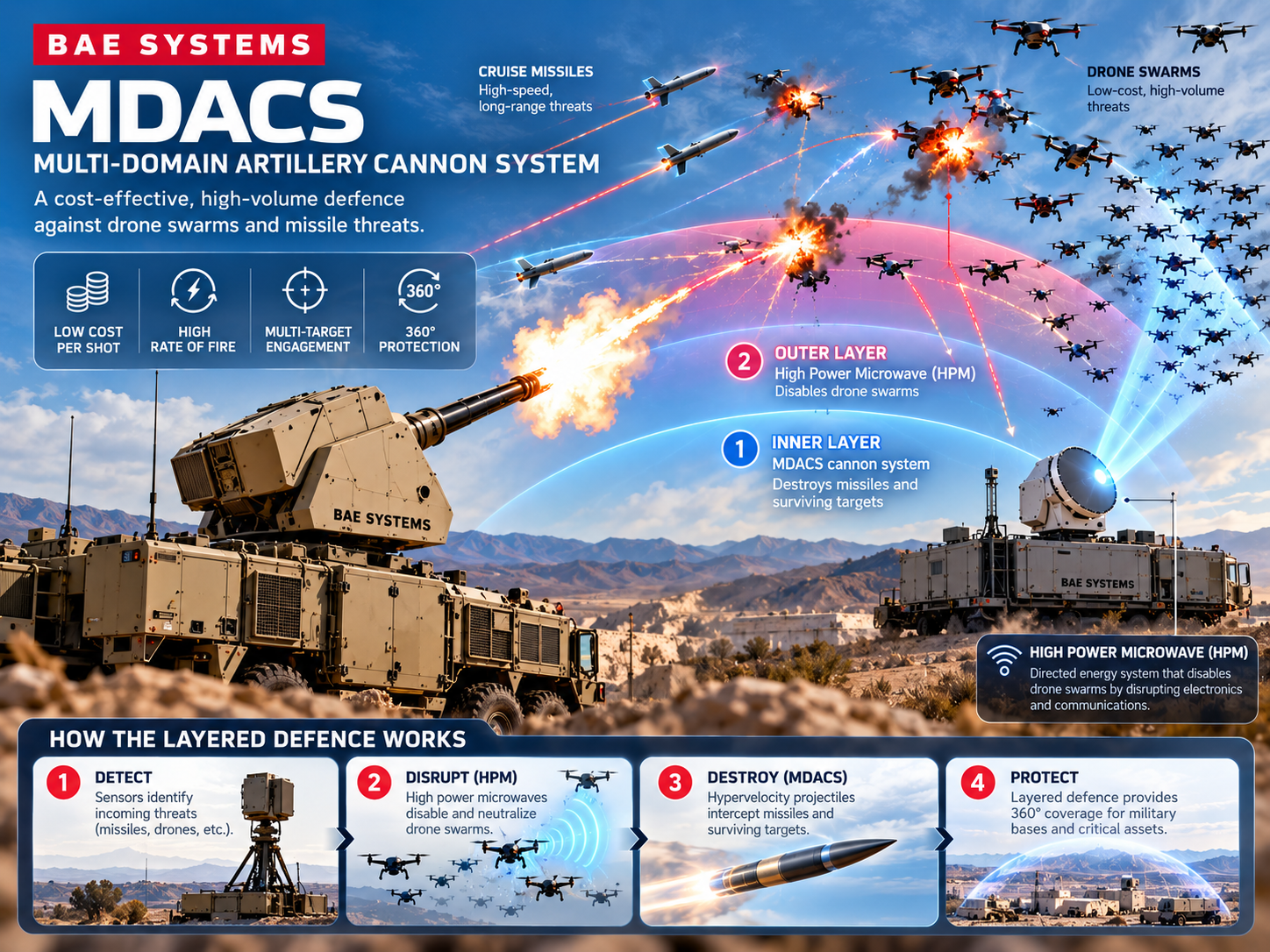
The Multi-Domain Artillery Cannon System is a mobile defence platform designed to combine a gun launcher, guided projectiles, surveillance and fire-control sensors, and software for directing engagements. According to BAE Systems, MDACS uses the Hypervelocity Projectile (HVP), a guided, low-drag projectile designed to travel at high velocity and support multiple missions. The company positions the system as a flexible addition to existing air-defence capabilities, with applications ranging from protecting important military installations to countering emerging aerial threats. Unlike a conventional interceptor that relies on a rocket-powered missile, MDACS uses a cannon-based approach intended to provide another option for engaging targets. BAE Systems presented the system alongside a separate High Power Microwave (HPM) capability at AUSA 2026, signalling that the company's approach involves combining different defensive technologies rather than depending on a single weapon.
Why Drone Warfare Is Changing Air Defence
The growing use of inexpensive unmanned aircraft has forced militaries to reconsider how they allocate their defensive weapons. A sophisticated missile interceptor may be necessary against a fast-moving cruise missile, but using the same category of expensive weapon against every small drone can rapidly consume ammunition stocks and strain defence budgets. The challenge becomes more serious when attackers launch multiple drones simultaneously, forcing defenders to track, prioritise and engage several threats within a limited period. This is where systems such as MDACS could become valuable: they offer an additional engagement option that may help preserve high-end interceptors for targets that genuinely require them. However, the actual economic advantage will depend on the complete cost of operating the system, including its ammunition, sensors, deployment, maintenance and effectiveness against different target types. A cheaper projectile is useful, but it only becomes a meaningful advantage when the entire defensive arrangement works reliably under operational conditions.
How Hypervelocity Projectiles Change the Equation
At the centre of MDACS is the Hypervelocity Projectile, a guided round intended to combine high speed, aerodynamic efficiency and precision. Its importance lies in giving gun-based defence systems an alternative way to engage aerial threats without relying exclusively on traditional missile interceptors. BAE Systems describes HVP as a multi-mission projectile compatible with several naval and land-based gun systems, while its MDACS announcement identifies the projectile as the system's primary air-defence munition. The company also says MDACS can use its Scorpio-XR precision-guided munition against fixed and moving ground targets, with the projectile designed to double the range of existing 155 mm cannon-launched projectiles. That combination gives the platform offensive as well as defensive potential, although performance against a particular aerial target will depend on detection, tracking, guidance, engagement conditions and the threat's characteristics. The technology is promising, but real-world effectiveness cannot be established through specifications or exhibition demonstrations alone.
BAE Systems Is Building a Layered Defence, Not Just a Cannon
The more interesting part of BAE Systems' announcement is that MDACS was not introduced alone. The company also presented a High Power Microwave system intended to counter drone swarms using directed energy rather than conventional ammunition. BAE describes MDACS as the kinetic layer of its approach, while HPM provides an alternative designed for sustained defence against groups of unmanned aircraft, subject to the availability of power and the system's operating limitations. These technologies address different problems: gun-launched projectiles provide a physical means of engaging selected targets, while high-power microwaves offer a different approach to dealing with groups of drones. In a layered defence architecture, multiple systems can contribute different capabilities, allowing operators to choose an appropriate response based on the threat and the circumstances. The concept is important because no single technology is likely to provide the most efficient answer to every drone, missile or saturation attack.
The Real Test Begins After the Exhibition
Despite the impressive proposition, MDACS should not be confused with a fully fielded defensive shield that has already demonstrated effectiveness against every type of drone swarm or cruise missile. BAE Systems described MDACS and HPM as capability demonstrators in its AUSA announcement. Their eventual military value will depend on further evaluation, integration with surveillance and command systems, ammunition availability, operating costs and performance against representative threats. A cannon-based system must also contend with practical constraints, including ammunition supply, target-tracking accuracy and the time available to respond to incoming threats. Meanwhile, directed-energy systems depend on electrical power and suitable engagement conditions. These are not reasons to dismiss either technology; they are the factors that determine whether an attractive concept can become a dependable defence capability. For military planners, the question is whether combining different weapons can improve overall protection while making each engagement more sustainable.
The Bigger Picture
BAE Systems' MDACS announcement reflects a broader shift in military thinking: air defence increasingly needs to account for the cost, quantity and diversity of incoming threats, not just their individual capabilities. Expensive missile interceptors will remain important against demanding targets, but militaries also need additional options for handling attacks that attempt to overwhelm their defensive capacity through numbers. By combining cannon-launched hypervelocity projectiles with a separate high-power microwave capability, BAE Systems is presenting a layered approach to that challenge. Whether MDACS ultimately delivers the expected operational and economic benefits will depend on testing, integration and real-world performance, rather than the announcement alone.
The future of air defence may not belong to one perfect weapon, but to a combination of systems that can defeat different threats without exhausting the most valuable resources first. If drone swarms continue to become cheaper and easier to deploy, will layered cannon and directed-energy systems become essential components of air defence, or will the next generation of threats find ways to overcome them?
Sources -
1. BAE Systems — Official Announcement (October 12, 2026)
BAE Systems Unveils Next-Generation Directed Energy and Kinetic Defense Systems at AUSA
Use this as your main source. It confirms the MDACS announcement at AUSA 2026, explains the Hypervelocity Projectile (HVP), and describes how MDACS fits into BAE Systems' layered air-defence approach.
2. BAE Systems — Official MDACS Product Page
Multi-Domain Artillery Cannon System (MDACS)
Use this for the system's intended role, mobility, capabilities, and air-defence applications.
3. BAE Systems — Hypervelocity Projectile Specifications
Official Hypervelocity Projectile (HVP) Overview

Vishal Sable
B.Tech AD @ shri balaji institute of technology and management
Engineering and tech journalist. I love exploring the impact of emerging technologies on global defense, sovereignty, and everyday life. Always looking for the real story behind the headlines.