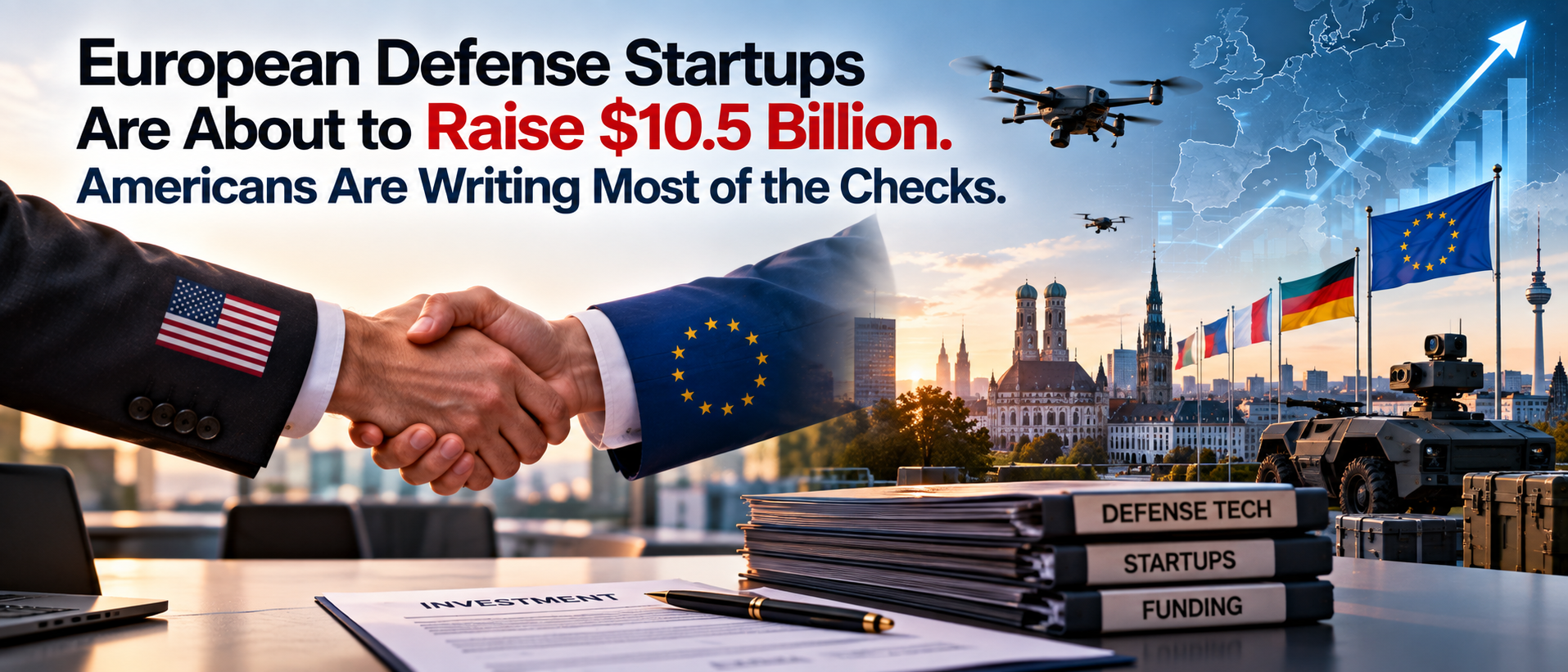
European Defense Startups Are About to Raise $10.5 Billion. Americans Are Writing Most of the Checks.
European defence tech funding 2026, Dealroom State of Defence Tech report, Helsing funding round, American investors European defense, defense startup VC boom
A genuinely record year, with an unexpected detail inside it
European defense tech startups are on track to raise $10.5 billion in venture capital by the end of 2026 — nearly four times the $2.6 billion raised across all of 2025 — according to the newly published State of Defence Tech 2026 report from Dealroom and Resilience Media, presented at the Resilience Conference in London on October 5. Defense tech now accounts for 11.1% of all European VC funding, up from under 1% before 2021. The headline number is dramatic on its own. The detail buried inside it is more interesting: a growing share of the money fueling Europe's defense-tech boom isn't coming from Europe at all. Dealroom
Where the money is actually coming from
American investors now account for 47% of European defense tech funding, up sharply from just 17% in 2020 — meaning US capital is now funding more of Europe's defense startup ecosystem than European investors are themselves, for the first time on record. Bessemer Venture Partners, a US firm, has made European defense resilience tech one of its active investment categories, with partner Alex Ferrara telling Resilience Media the opportunity is real enough to pursue directly rather than from a distance. Trending Topics
Where the money is concentrated
Germany leads European defense tech funding by a wide margin, with $3.5 billion raised so far in 2026, followed by Finland at $1.2 billion and the UK at $932 million. Munich specifically has emerged as a defense-tech hub, anchored by AI drone companies Helsing and Quantum Systems, both of which closed billion-dollar-scale rounds this year — Helsing's $1.8 billion Series E in July 2026 alone set a new European record for the largest defense tech funding round, a milestone that's been broken repeatedly in just the past few years: as recently as 2021, Helsing's own $113 million Series A was enough to set the previous record.
That concentration is a genuine structural feature of this boom, not an incidental detail: mega-rounds account for more than 85% of all European defense-tech funding recorded so far this year, meaning the headline growth figure rests heavily on a relatively small number of large, late-stage deals rather than broad-based early-stage investment across the sector. UK Defence Journal
Zooming out to the full NATO alliance, defense startups across member countries raised $27.1 billion in venture capital during 2026 — roughly 1.9 times the total raised across all of 2025 — with Dealroom tracking 455 distinct investors involved in at least one European defense deal this year, up from 408 in 2025 and just 114 in 2020. UK Defence Journal
The harder problem the report also flags: funding isn't the same as deployment
Dealroom and Resilience Media's reporting doesn't frame this purely as a success story. Separate Resilience Media coverage has specifically highlighted the real hurdles startups still face turning funding into actual government contracts in two of Europe's biggest defense markets — notably Germany, where startups reportedly struggle to move from pilot trials to real procurement contracts despite the country's defense budget exceeding €100 billion. That's a meaningful caveat sitting right alongside the record funding numbers: capital is flowing in at record pace, but the traditional, slow-moving procurement systems built for legacy prime contractors haven't necessarily caught up to match it.
Leslie Hitchcock, co-founder and publisher of Resilience Media, framed the underlying shift plainly: "National security, defence and technological innovation are now inseparable. Across NATO alliance countries, there is an urgent need to strengthen the infrastructure underpinning our collective security and resilience." UK Defence Journal , Tech Times

Why it matters
The raw funding number tells a story of genuine momentum — European defense tech going from a sector most VCs wouldn't touch five years ago to over a tenth of all European venture funding today. But the composition underneath that number tells a more complicated one: American capital increasingly dominant, funding concentrated in a handful of mega-rounds rather than spread broadly, and a real, acknowledged gap between money raised and contracts actually won. Whether Europe's defense-tech boom translates into genuine sovereign capability, or ends up building companies substantially financed and influenced by American investors building European hardware, is the real open question this report raises without fully answering.
If American investors are now funding nearly half of Europe's defense tech boom, does that strengthen European defense capability through genuine capital and expertise transfer — or does it quietly recreate the same dependency on outside powers that this entire funding surge was supposed to help Europe move away from?

Vishal Sable
B.Tech AD @ shri balaji institute of technology and management
Engineering and tech journalist. I love exploring the impact of emerging technologies on global defense, sovereignty, and everyday life. Always looking for the real story behind the headlines.