France Just Fired Its Newest Nuclear Missile From a Submarine. The Real Story Is Why It Needed To.
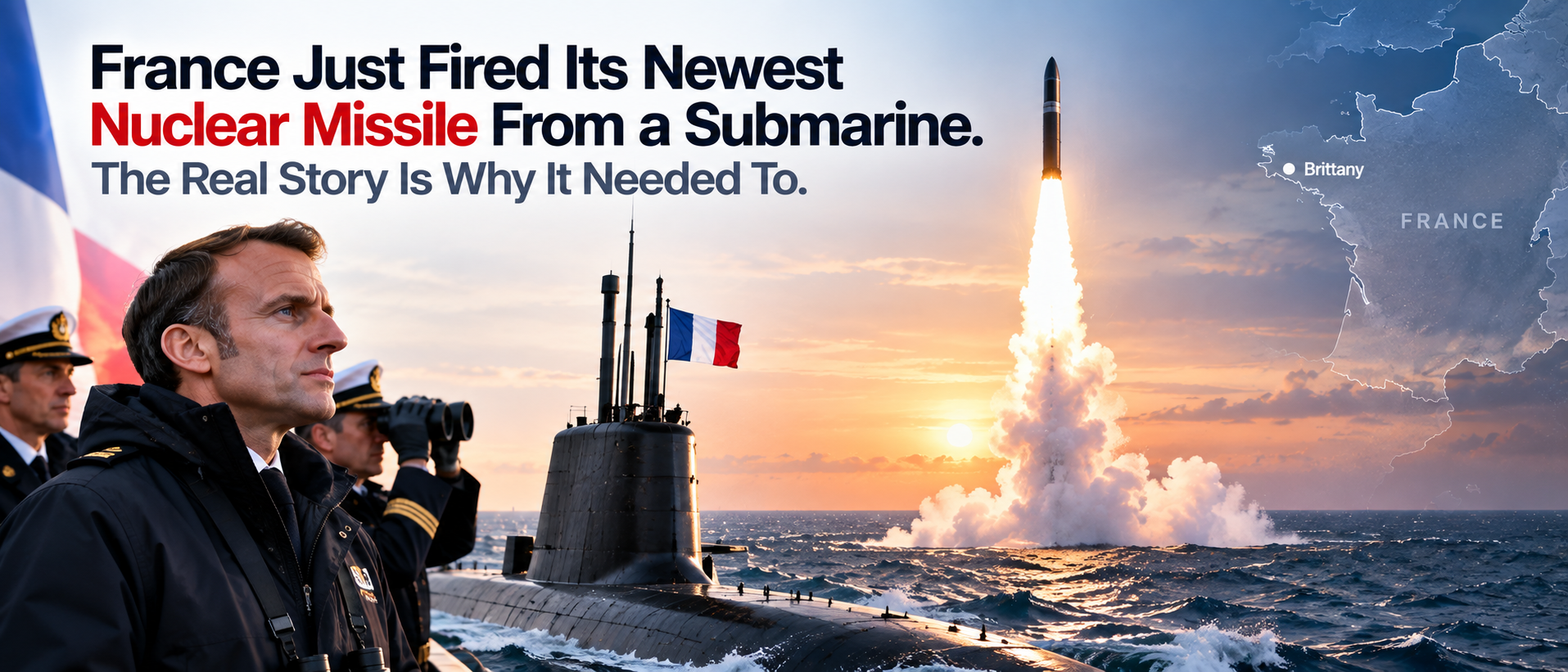
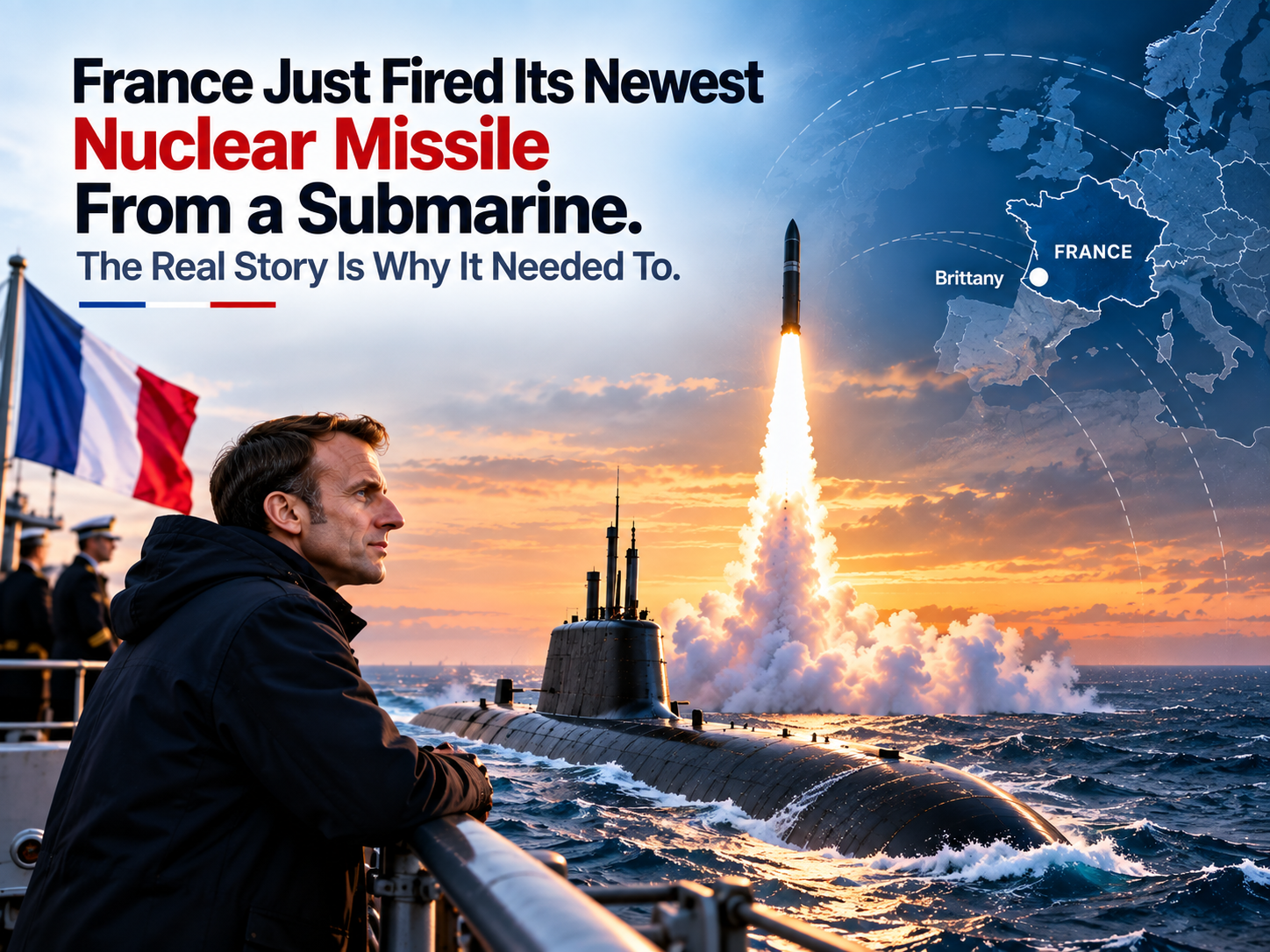
France test-fired its M51.3 SLBM from the submarine Le Vigilant, with Macron watching. The test wasn't about new weapons tech — it was about proving a submarine still works after major repairs.
France M51.3 missile test, Le Vigilant SSBN launch, Macron missile test watch, French nuclear deterrent 2026, M51 submarine ballistic missile
A missile test that's really a submarine test
On October 6, France conducted the first-ever submarine launch of its newest ballistic missile variant, the M51.3, fired from the nuclear-powered submarine Le Vigilant off the coast of Finistère in Brittany. President Emmanuel Macron personally watched the launch, calling the test's message "clear and loud, wherever it needs to be received." It's an easy story to read as a show of force aimed outward — and it partly is — but the French Ministry of Defence's own stated purpose for the test is narrower and more specific than that framing suggests. France 24
What the test actually validated
According to Naval News, the launch was conducted as part of Operation SMERTRIOS, with its explicit purpose being to confirm that Le Vigilant can once again operate the M51 missile system following its IPER — a periodic major maintenance and repair overhaul that French nuclear submarines undergo on a scheduled cycle. In other words, this was primarily an acceptance firing: proof that a submarine returning to service after extensive repair work still functions as intended, not a test built around showcasing a new offensive capability. Once certified, Le Vigilant returns to France's permanent at-sea nuclear deterrent posture — one of four Triomphant-class submarines that keep France's sea-based deterrent continuously active. Naval News
The missile itself was unarmed — fired without a nuclear payload, in what the Ministry of Defence described as strict compliance with international obligations — and impacted "in the North Atlantic, hundreds of kilometres from any coastline." France does not disclose the M51.3's range publicly.
What's actually new about the M51.3, and what isn't confirmed
The M51.3 is the third generation of France's M51 submarine-launched ballistic missile family, and it formally entered operational service on October 24, 2025. This specific test matters because it's the first submarine-launched firing of the M51.3 variant — an earlier M51.3 test in November 2023 was conducted from a land-based facility, not a submarine, making this the missile's real validation in its intended operational environment. Worth being precise about what hasn't been independently confirmed in detail: specific claims about new penetration aids or upgraded MIRV precision designed to defeat modern missile defenses aren't detailed in official French or independent defense reporting on this particular test. What is confirmed, from broader background on the M51 family, is that French SLBMs are MIRV-capable, with roughly 240 of France's 290 total warheads currently assigned across 48 MIRV-capable M51 missiles. FW-MAG Future Warfare Magazine
Why the timing matters
This test lands against a backdrop of real policy escalation in France's nuclear posture. On March 2, 2026, Macron announced France's first increase to its nuclear warhead stockpile since 1992, alongside a new framework he's called "dissuasion avancée" — advanced deterrence — that includes discussions of temporarily deploying French nuclear-capable squadrons across up to eight European countries. Read against that backdrop, the M51.3 test isn't an isolated technical milestone — it's one visible piece of a broader, deliberate French effort to project a more active, more visible nuclear deterrent posture across Europe, at a moment when European allies are increasingly weighing their own reliance on US extended deterrence. Wikipedia — France and Weapons of Mass Destruction
The submarine fleet itself is also mid-transition: the M51 missile family, now on its third generation with a fourth version (M51.4) already under contract with ArianeGroup as of September 2025, is set to remain in service aboard France's next-generation Invincible-class submarines until roughly 2090 — meaning this missile family, and the deterrence posture it represents, is built around a multi-decade horizon, not a single news cycle. FW-MAG Future Warfare Magazine
Why it matters
For France, successfully validating Le Vigilant's weapons system after major overhaul is a genuinely important operational milestone — a submarine that can't reliably fire its missile system after maintenance isn't contributing to the continuous at-sea deterrent France depends on. For the broader European security conversation, the timing — Macron personally watching a missile test weeks after announcing an expanded, more Europe-facing deterrence doctrine — reads as a deliberate signal about French nuclear capability remaining both current and visible, independent of what happens with US commitments to the continent.
If France is actively expanding its nuclear posture toward covering European allies more broadly, does a technical submarine validation test like this one function as reassurance for Europe — or does routinely turning routine maintenance validation into a presidentially-watched public event start to blur the line between proving readiness and performing it?

Vishal Sable
B.Tech AD @ shri balaji institute of technology and management
Engineering and tech journalist. I love exploring the impact of emerging technologies on global defense, sovereignty, and everyday life. Always looking for the real story behind the headlines.