The Indian Navy Is About to Release a Standard Nobody Has Described Yet. Here's What We Know About NAUSETU
The Navy's Swavlamban 2026 opens Oct 26 with a new standard called NAUSETU. Navy contracts top ₹1,900 crore, but only about half of approved projects have become contracts.
Swavlamban 2026, NAUSETU interface standards, Swavlamban 5.0 document, Indian Navy indigenisation, iDEX Navy proposals
A standard with a name, a date, and no public details
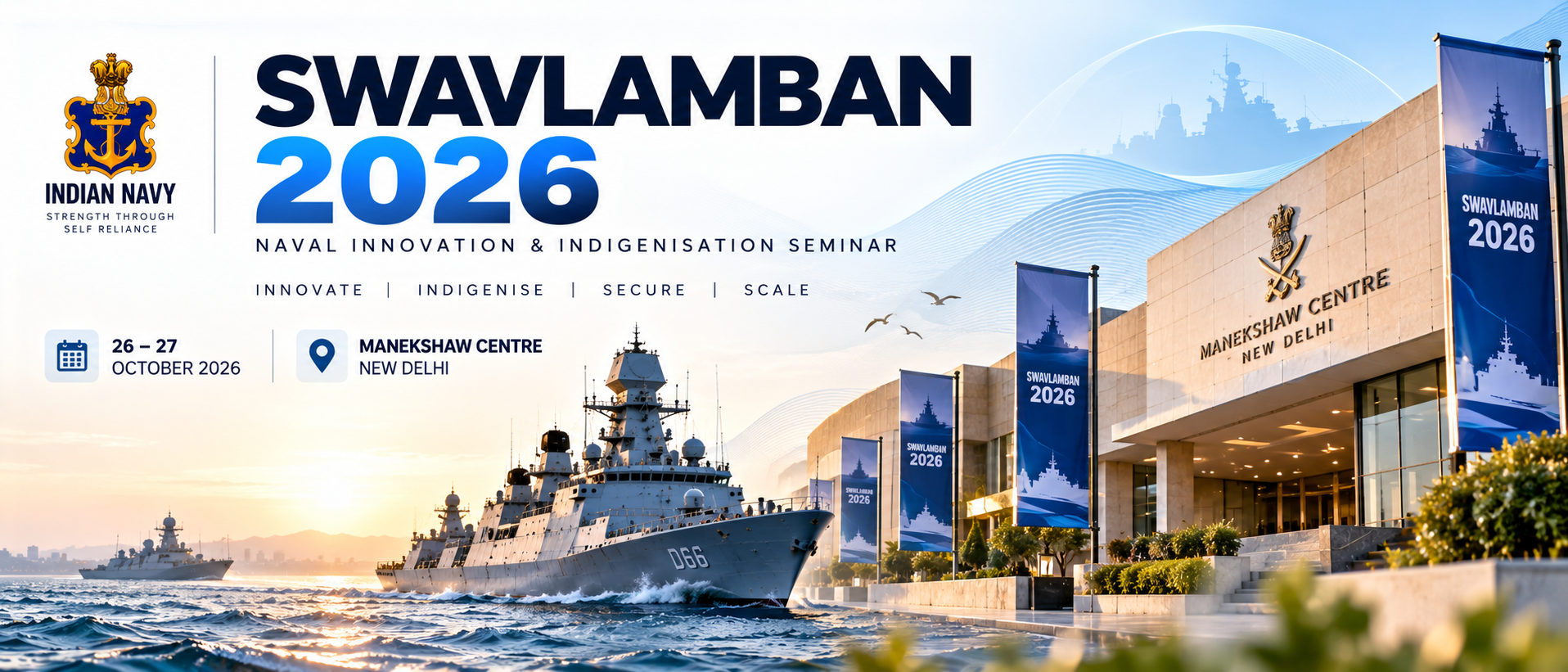
The Indian Navy will hold the fifth edition of its Naval Innovation and Indigenisation Seminar, Swavlamban 2026, at the Manekshaw Centre in New Delhi on October 26 and 27. The curtain-raiser press conference took place on October 19, chaired by Vice Admiral Ajay Kochhar, the Vice Chief of the Naval Staff. The part of the announcement worth watching is a release list that includes something new: the Naval Unified Systems, Ethernet and Tactical Utilisation (NAUSETU) Interface Standards. idrw.org
What the Navy has actually said about NAUSETU
Very little. The Ministry of Defence says the seminar will see the release of three documents: the Swavlamban 5.0 Document, a Compendium on Technology Imperatives, and the NAUSETU Interface Standards. That is the full public description. Nothing published so far explains what NAUSETU covers, which systems it applies to, or whether it is mandatory for vendors. The reading that it creates a plug-and-play Ethernet layer for sensors, AI vision suites and weapon stations is an inference from the acronym, not something the Navy has stated. The standard will be public on October 27 at the latest, and until then that reading is a guess. DD India
The numbers behind the indigenisation push
The Navy says more than 4,000 proposals have come in from Indian innovators through the iDEX framework, with around 150 MSMEs and start-ups taking part. Approved Acceptances of Necessity now exceed ₹3,500 crore, and concluded contracts have crossed ₹1,900 crore. At last year's curtain-raiser, the figures were over ₹2,700 crore approved and nearly ₹1,500 crore in contracts. That is growth of roughly ₹800 crore in approvals and ₹400 crore in contracts over a year. Outlook India
Those figures also show something the Navy didn't highlight. By my own calculation from the reported numbers, about 54% of approved value has become signed contracts this year, against roughly 56% last year. Both figures are approximate because the Navy reports them as "more than." Even so, the share of approved projects reaching contract has not improved, and the Navy itself says it wants to discuss hurdles in taking ideas forward, including supply-chain and cyber vulnerabilities and access to funding. RNA Media
The problems the Navy now wants solved
The challenges on the 2026 list are more advanced than in earlier editions: quantum positioning systems, high-power microwave directed-energy systems, extra-large autonomous underwater vehicles, and indigenous ramjet engines. The Vice Chief said the Navy is also exploring directed-energy weapons as a low-cost answer to cheap drones, so it need not fire an expensive weapon at each one. He summed up the Navy's approach in four words: "scale, sophistication, speed, and spiral development." Deccan Herald
The event itself
More than 100 exhibition stalls are planned, and the seminar will include sessions with venture capitalists and other investors on funding for promising enterprises. It is organised with support from the Ministry of Defence, the Society of Indian Defence Manufacturers and the Defence Innovation Organisation. The first edition drew around 800 participants, and the organisers expect this one to be considerably larger. Raksha Anirveda
Why it matters
Open interface standards matter because a vendor who can build to a published specification doesn't need a bespoke integration deal with each shipyard or prime contractor. If NAUSETU does that job, it could lower the barrier for MSMEs and start-ups. If it turns out to be a narrower or advisory document, the barrier stays where it is. The proposals-to-contracts conversion rate will say more about how far indigenisation is actually progressing than the headline totals will.
If the Navy's approved projects are growing year after year but the share becoming signed contracts has stayed near half, is the bottleneck now in the ideas, the funding, or the standards that NAUSETU is meant to address?

Vishal Sable
B.Tech AD @ shri balaji institute of technology and management
Engineering and tech journalist. I love exploring the impact of emerging technologies on global defense, sovereignty, and everyday life. Always looking for the real story behind the headlines.