Back to News
News AlertWorld Defence Tech
Counter-Drone Spending Is a Sensor Story: LIDS, Space Force Radars, ASC
V
Author
Vicky Galfat
Published
October 16, 2026
Reading Time
4 MIN READ
Spread the Word
Raytheon won $729M for counter-drone radars and Coyote interceptors for three nations, as Space Force radar upgrades and a $15M sensor startup follow.
Raytheon LIDS contract, Coyote interceptor, KuRFS radar, counter-UAS contracts 2026, Ground-Based Radar Digitization, Space Force early warning radar, Austin Sensing Company, counter-drone sensors, airspace awareness, drone swarm detection.
Raytheon LIDS contract, Coyote interceptor, KuRFS radar, counter-UAS contracts 2026, Ground-Based Radar Digitization, Space Force early warning radar, Austin Sensing Company, counter-drone sensors, airspace awareness, drone swarm detection.
Counter-Drone Spending Is Really a Sensor Story: LIDS, Space Force Radars and a $15M Newcomer
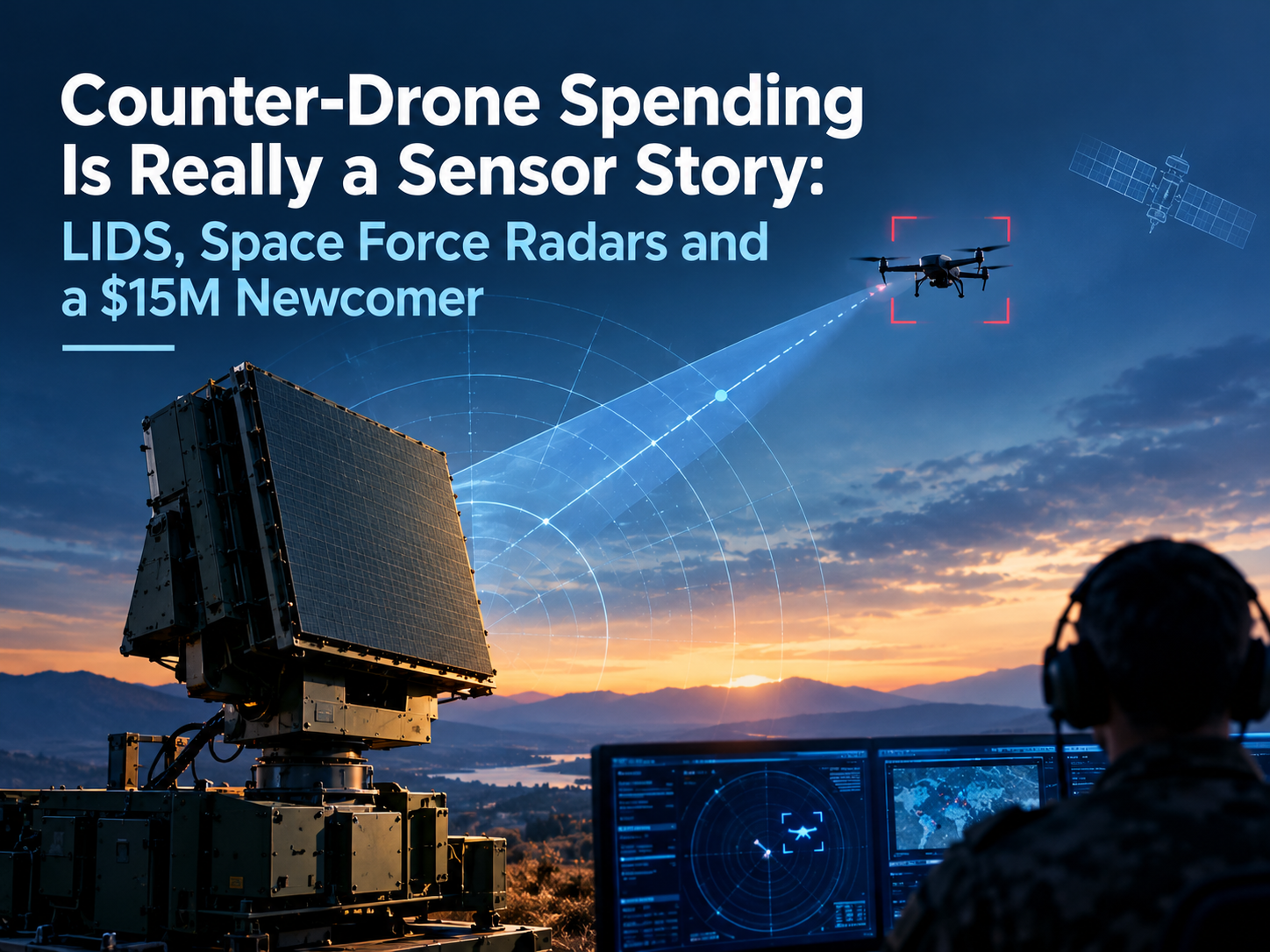
Interceptors win the headlines in counter-drone news, but three recent announcements share a quieter theme: you cannot shoot down what you cannot see. A $729 million Raytheon award, a Space Force radar overhaul and a seed-stage startup's debut all turn on sensing.
Raytheon's $729 Million LIDS Award Goes International
On 13 October, RTX's Raytheon said it was awarded $729 million to deliver components of the LIDS counter-drone system to the US Army, Qatar and Jordan. LIDS, the Low, slow, small, unmanned aircraft Integrated Defeat System, pairs Raytheon's Ku-band Radio Frequency Sensor, known as KuRFS, which provides 360-degree detection, with Coyote effectors, which defeat single drones and swarms using kinetic and non-kinetic means. Raytheon says Coyote has made hundreds of combat intercepts. The package includes fixed-site and mobile configurations and marks the first international sales of KuRFS and Coyote.
Raytheon did not disclose how the $729 million is split among the three customers, or the quantities and delivery schedules. Industry coverage links the urgency to Iranian drone attacks that damaged sites in US-allied Gulf countries. RTX says it is expanding production, and it recently reported three successful tests of the Coyote Block 2C+RM variant, which adds a rocket motor for faster launches and higher velocity, along with an updated seeker and warhead. RTX News
Space Force Radars: Same Vendor, Opposite End of the Spectrum
The Space Force's Ground-Based Radar Digitization program is not new this week, and it is not Raytheon's alone. On 17 July, the service awarded firm-fixed-price other transaction agreements worth a combined $423.4 million to three companies: Raytheon at $309.5 million, SciTec Innovations at $93.7 million and WildStar at $20.2 million. They will develop a common architecture and design for modernizing six legacy radars, five Upgraded Early Warning Radar sites and the Perimeter Acquisition Radar Attack Characterization System in North Dakota, which has operated since the 1970s. The award followed eight offers, and work runs through April 2028.
An earlier Space Force notice called for open, nonproprietary systems and commercial off-the-shelf components, to preserve vendor flexibility, with full operational capability targeted for 2030. In other words, the same company that supplies a short-range drone-detection radar is also upgrading radars that watch for missiles and track objects in space. TheDefencePost
Austin Sensing Company: A $15 Million Bet on the Sensor Layer
At the start-up end, Austin Sensing Company emerged from stealth this week with $15 million in total funding, including an $11 million seed round led by Bow Capital with Bling Capital, Draper Associates and others, according to Tectonic Defense and the company's CEO. It plans to build what it calls the full airspace sensing stack: RF detection, radar and acoustic sensors. Its first product is a tripod-mounted RF detection system covering 28 square miles per unit. CTO Isaac Duke, a former engineer at defense startup Saronic, says the goal is to make counter-UAS platforms more effective by giving operators better awareness.
The company has moved into a 20,000-square-foot factory in Austin, has units out for testing with undisclosed customers, and plans high-volume production of its radar and acoustic systems next year. It faces well-funded competitors including Echodyne, Fortem, CHAOS Industries and Hidden Level. Tectonic Defence
Two Ways of Buying Sensors
The three stories reveal a split in how sensing is bought. LIDS is an integrated package: radar, effector and software supplied together, now exported. The Space Force's radar effort pushes the opposite way, favoring open architectures so that parts can be swapped later. A startup like Austin Sensing Company needs buyers to want the second model, because its sensors must feed someone else's command system.
That is the open question for counter-drone procurement. Sensors and interceptors are both selling quickly, but whether buyers lock into one vendor's integrated stack or insist on open interfaces will decide whether newcomers can sell into the market at all.

Vicky Galfat
University of Mumbai/BCA
Learning, building, and exploring the world of technology one project at a time.