Europe's Air Defense Just Went to Orbit — on an American Rocket
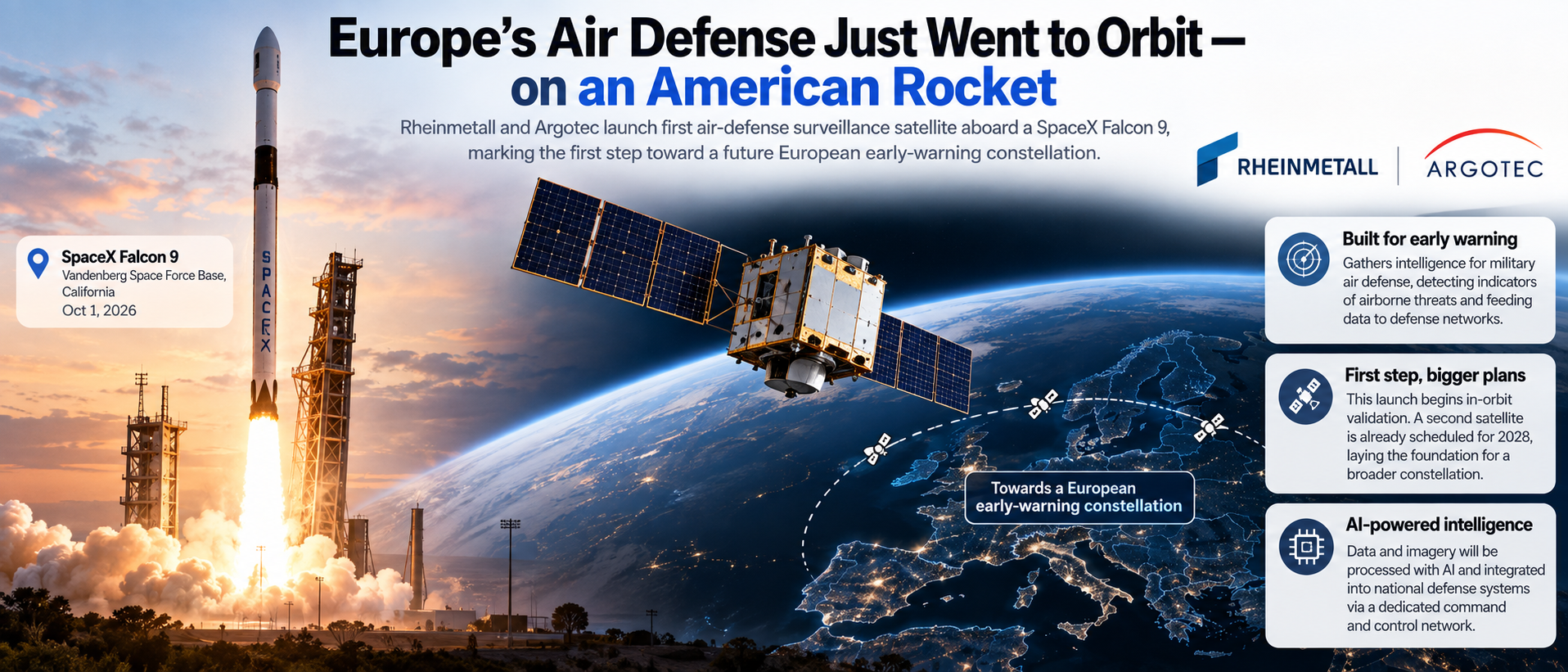
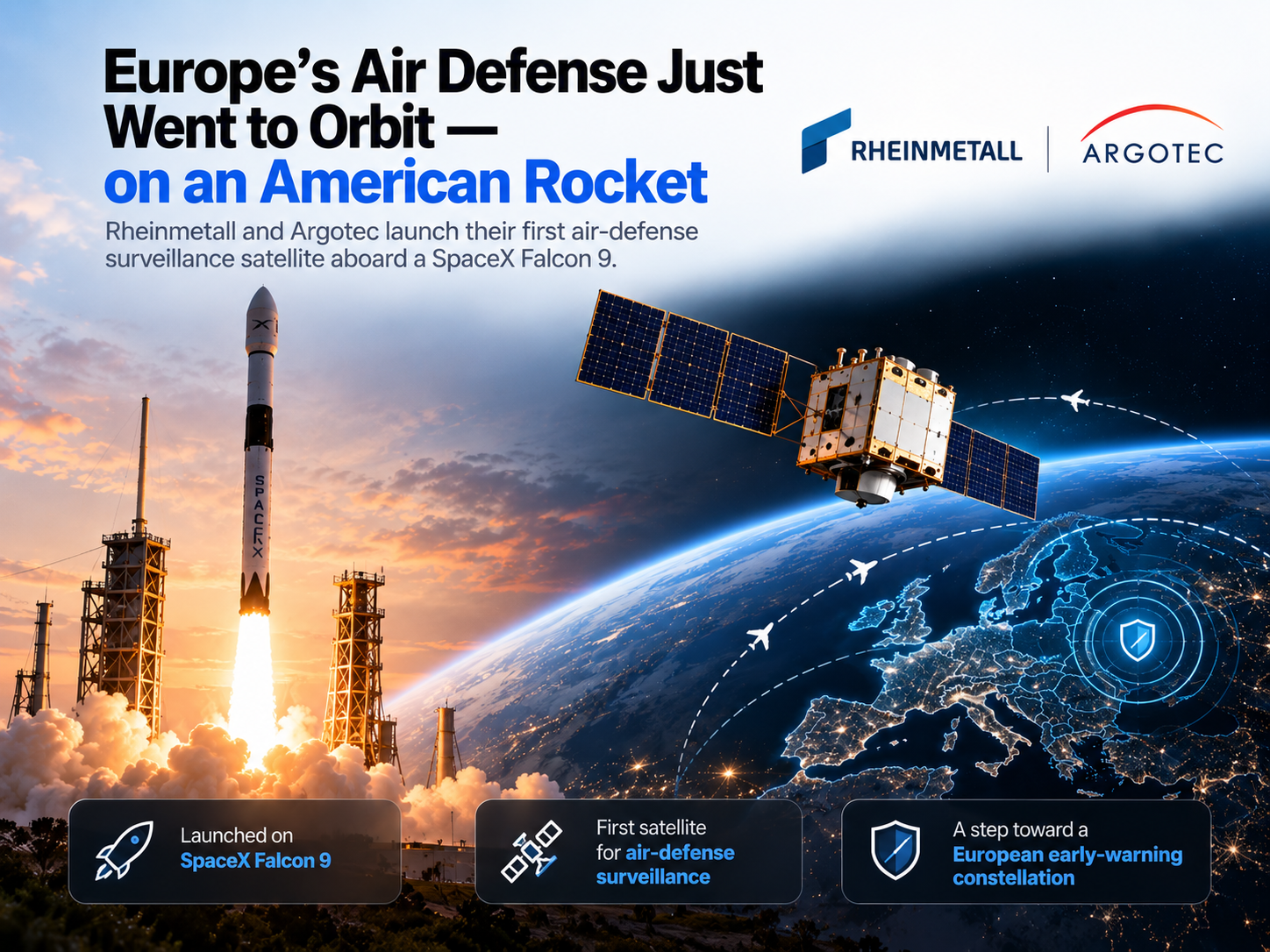
Rheinmetall and Argotec launched their first air-defense surveillance satellite aboard a SpaceX Falcon 9, the first step toward a future European early-warning constellation.
Rheinmetall Argotec satellite launch, SpaceX air defense satellite Europe, Rheinmetall space constellation, European early-warning satellite 2026
A German defense giant's first satellite, launched by an American rocket
On October 1, Rheinmetall Italia and Italian space company Argotec successfully launched their first jointly developed satellite into orbit — a system built specifically for military air-defense surveillance and early warning. The launch vehicle was a SpaceX Falcon 9, lifting off from Vandenberg Space Force Base in California. There's a real irony worth sitting with: a European defense program meant to strengthen the continent's own early-warning capability depended, for this first launch at least, on American commercial rocket infrastructure to get there. Rheinmetall
What the satellite is actually built to do
The system is designed to gather intelligence for military air defense, with ground-based sensors tuned to detect indicators of emerging airborne threats and feed early-warning data toward air-defense networks. Rheinmetall's own description frames the program around intelligence-gathering specifically, distinct from traditional satellite imaging focused on mapping ground objects. The acquired situational data and imagery will be processed with AI support, intended to integrate into national defense and air-defense systems for customers. The broader architecture links three layers — space-based observation, ground-based nodes, and tactical networks — managed through a dedicated Command and Control Post. Defence Industry Europe
Worth being precise about where this program actually stands: this launch begins in-orbit validation of the system — testing whether the technology performs as designed in space — not a fully operational capability feeding live targeting data into air-defense batteries today. Rheinmetall's own language describes the launch as establishing "the technological foundation for validating operational functionality in orbit," which is a meaningfully earlier stage than an active, combat-ready early-warning network. PR-Web
The roadmap, accurately stated
Rheinmetall and Argotec describe this satellite as the foundation for an eventual broader satellite constellation — but the only concrete next step confirmed so far is a second satellite launch, already scheduled for 2028. That's a meaningfully different claim than a full multi-satellite constellation being operational by that date; what's locked in is the second step of validation, not completed deployment of a defense-ready network. Tradingsat/BFM Bourse
Why the partnership itself is notable
Argotec brings genuine credibility to this specific niche: the Turin-based company has direct experience from NASA and other major international space programs, and opened its own highly automated satellite production facility, SpacePark, in Turin back in 2024. Rheinmetall CEO Armin Papperger called the launch "a milestone in strengthening national security and space capabilities," while Argotec's founder and CEO David Avino framed it as foundational to "building the next generation space infrastructures, designed for operational and defence needs." Pairing a traditional land-systems and munitions defense giant like Rheinmetall with a space-native satellite manufacturer is itself part of the story — a sign that European defense primes increasingly see space capability as something to build through specialized partnership rather than in-house from scratch.
Why it matters
This launch sits inside a much larger European push toward space-based defense infrastructure happening across the continent right now, as European militaries work to reduce dependence on US-provided early-warning and surveillance capability amid shifting transatlantic defense commitments. The use of a SpaceX rocket for this specific launch is a practical, near-term choice — SpaceX remains the most reliable, cost-effective launch provider available — but it also underlines the gap between Europe's ambitions for sovereign space-based defense capability and its current launch infrastructure reality.
If Europe's own air-defense early-warning satellites still need to launch on American rockets to reach orbit, how much "space-based defense sovereignty" does a program like this actually deliver — and does that gap close before or after the planned 2028 follow-up launch?

Vishal Sable
B.Tech AD @ shri balaji institute of technology and management
Engineering and tech journalist. I love exploring the impact of emerging technologies on global defense, sovereignty, and everyday life. Always looking for the real story behind the headlines.