Back to News
News AlertWorld Defence Tech
Germany Just Mass-Produced 5,000 Strike Drones — Not for Itself. Here's Who They're Actually For.
V
Author
Vishal Sable
Published
September 5, 2026
Reading Time
5 MIN READ
Spread the Word
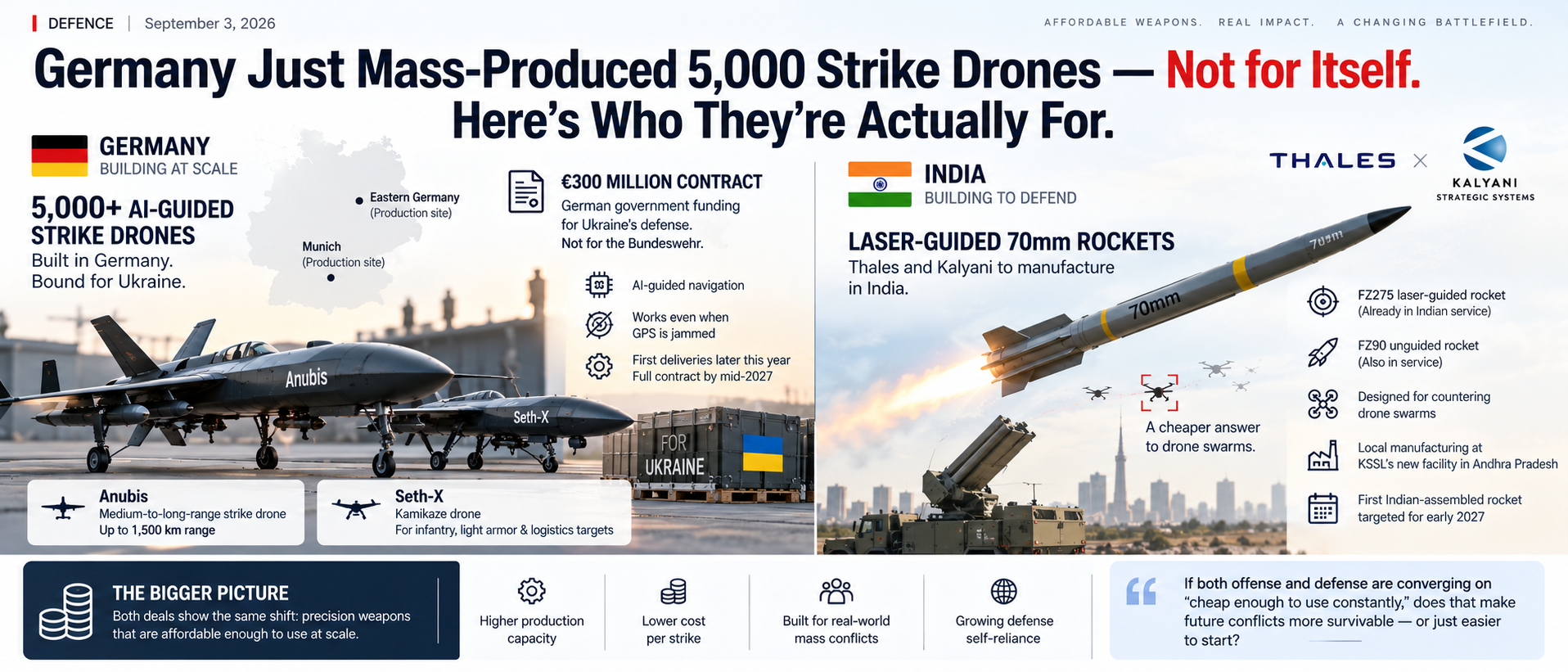
Germany began mass-producing 5,000+ AI-guided strike drones this week — bound for Ukraine, not the Bundeswehr. Meanwhile Thales and Kalyani signed to build laser-guided rockets in India.
Auterion Airlogix drone production, Anubis Seth-X drones Ukraine, Thales Kalyani 70mm rocket India, affordable mass precision weapons, counter-drone rocket systems
The headline detail everyone's about to get wrong
Germany began mass-producing more than 5,000 AI-guided strike drones this week — the first time precision-strike weapons have been manufactured on German soil at this scale. It's tempting to read that as Germany rearming its own military. It isn't. Every one of these drones is bound for Ukraine, built under a German government contract funding Ukraine's war effort, not the Bundeswehr's own arsenal. The "domestic manufacturing" part is real; the intended user is not Germany.
On the same day, a completely different kind of "affordable mass" precision weapon took a step forward in India, where Thales and Kalyani Strategic Systems signed a deal to build laser-guided 70mm rockets domestically — a system explicitly positioned for countering drone swarms, not launching them.
What's actually being built in Germany, and for whom
The joint venture between German-American company **Auterion** and Ukrainian drone maker Airlogix — formed in February 2026 — began serial production near Munich and at a second site in eastern Germany this week. The contract, worth roughly €300 million ($300-349 million), covers more than 5,000 drones across two models: the Anubis, a medium-to-long-range strike drone capable of hitting targets up to 1,500km away, and the Seth-X, a more compact kamikaze drone built for infantry, light armor, and logistics targets at shorter range. Both run on Auterion's AI-guided navigation, letting them operate and identify targets even when GPS is jammed — a direct response to the electronic warfare Russian forces have used against less capable drones.
Auterion CEO Lorenz Meier framed the achievement plainly: "Germany now has a production line for affordable precision weapons in large quantities." That's true, and it's genuinely significant for European defense manufacturing capacity. But the buyer here is the German government acting as a funder of Ukraine's defense, not the German military equipping itself — the drones are earmarked for Ukraine's armed forces, with first deliveries expected later this year and the full contract due by mid-2027.
What's happening in India, and why it's the mirror image
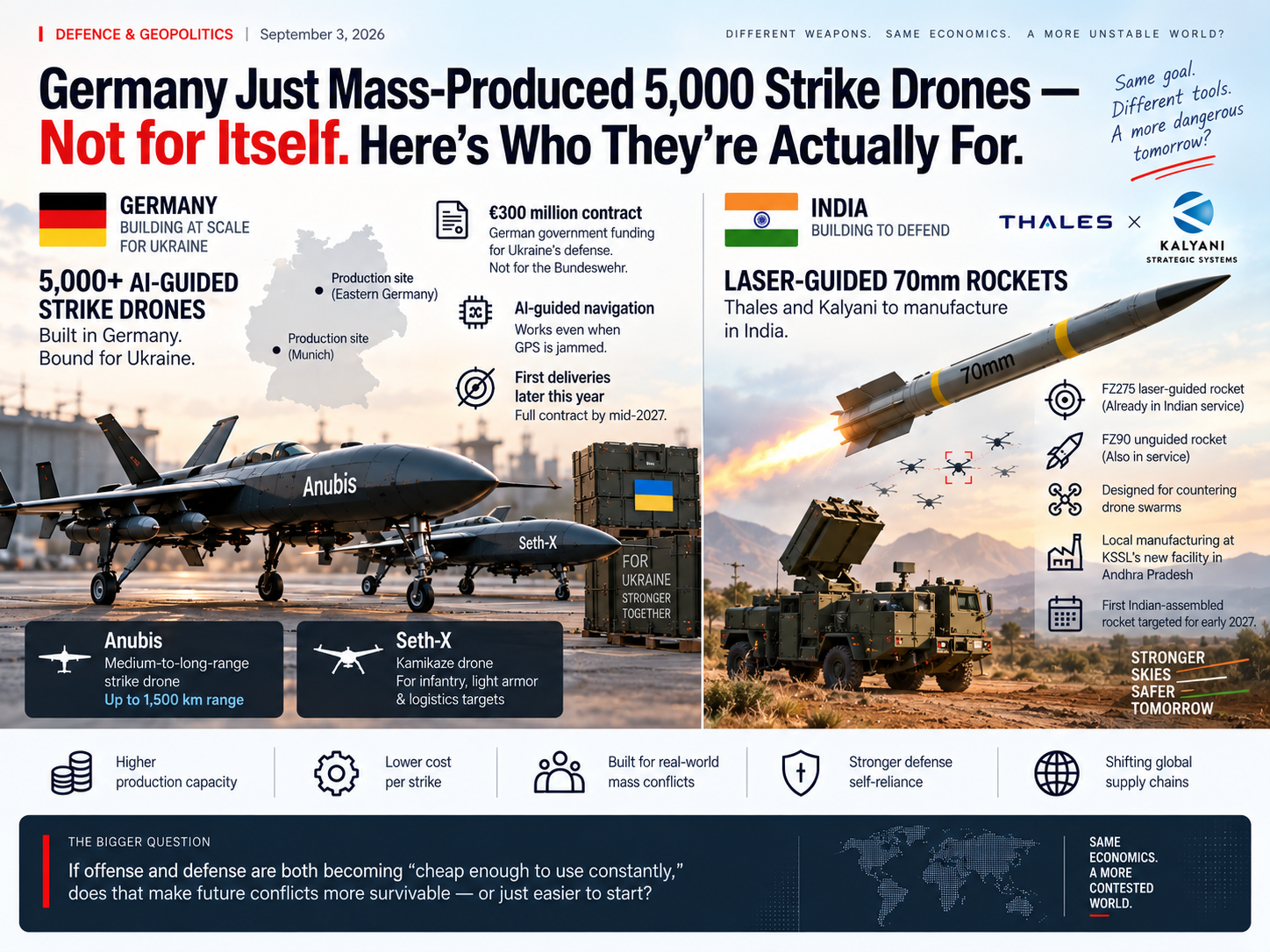
The Thales-Kalyani deal, signed the same week during a Belgian state visit to India, points the opposite direction: it's about defense, not offense. Thales — bringing Belgian-developed 70mm rocket technology already used by more than 70 armed forces in 55 countries — signed a Strategic Alliance Agreement with Kalyani Strategic Systems (KSSL), Bharat Forge's defence arm, to manufacture both unguided and laser-guided variants of its 70mm rocket family in India. The specific systems involved — the FZ275 laser-guided rocket and FZ90 unguided rocket — have actually been in Indian Army and Air Force service since the 2010s, integrated on the HAL Rudra and Prachand light combat helicopters; what's new here is building them domestically rather than importing them.
The counter-drone angle is the detail worth underlining: Thales explicitly frames its newer 70mm variants as suited for countering drone swarms, offering a far cheaper per-shot option than firing an expensive interceptor missile at a $500 quadcopter. KSSL is building an upcoming Energetics facility in Andhra Pradesh to support the work, with the first fully Indian-assembled rocket targeted for early 2027.
Why these are actually the same story
Both deals are examples of the same underlying economics reshaping modern weapons procurement: precision at a price point armies can actually afford to use repeatedly, rather than sparingly. A $1,500 AI-guided drone or a 70mm guided rocket costs a small fraction of the missile systems they're designed to replace or complement — which matters enormously when the fight involves absorbing or launching hundreds of low-cost threats rather than a handful of high-value ones. Auterion's own language — "affordable precision mass," "deterrence you can actually stockpile" — could apply just as easily to what Thales and Kalyani are building for counter-drone defense in India. One system is built to attack in volume; the other to defend against volume attacks. Both exist because traditional, expensive precision weapons don't scale to the number of engagements modern conflict now involves.
Why it matters
For Ukraine, German-made Anubis and Seth-X drones represent exactly the kind of sustained, affordable supply line that's been the harder problem in this war — not whether advanced weapons exist, but whether they can be produced fast and cheap enough to keep pace with consumption. For India, the Thales-Kalyani deal is less about a single new weapon and more about localizing production of something already in service — reducing dependency on imports for a system India's forces already rely on, while opening an export path Thales explicitly wants India to become a hub for.
If both offense and defense in modern warfare are converging on the same "cheap enough to use constantly" economics, does that make future conflicts more survivable for the sides that can out-manufacture the other — or does it just lower the threshold for entering one in the first place?

Vishal Sable
B.Tech AD @ shri balaji institute of technology and management
Engineering and tech journalist. I love exploring the impact of emerging technologies on global defense, sovereignty, and everyday life. Always looking for the real story behind the headlines.