Back to News
News AlertWorld Defence Tech
China Says It's Mass-Producing a Drone Killer. Here's What We Actually Know — and What We Don't.
V
Author
Vishal Sable
Published
September 6, 2026
Reading Time
4 MIN READ
Spread the Word
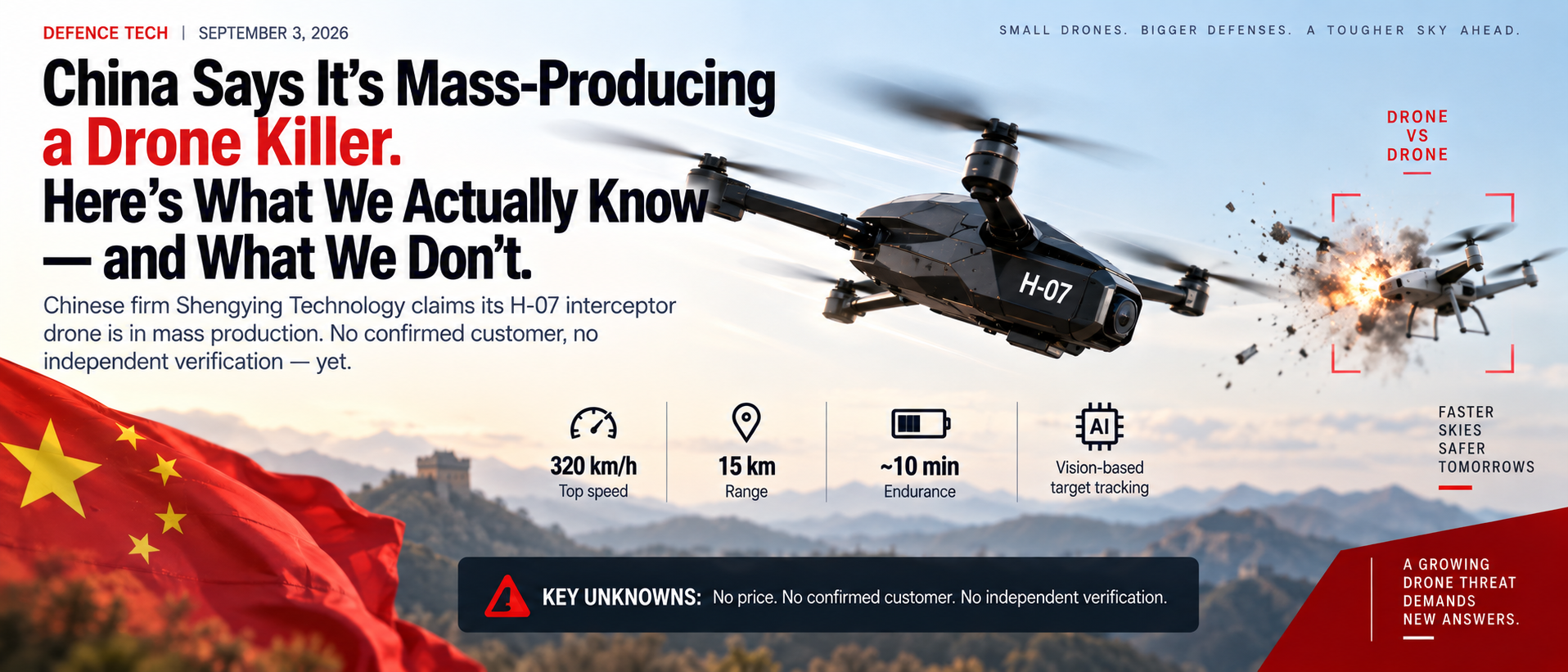
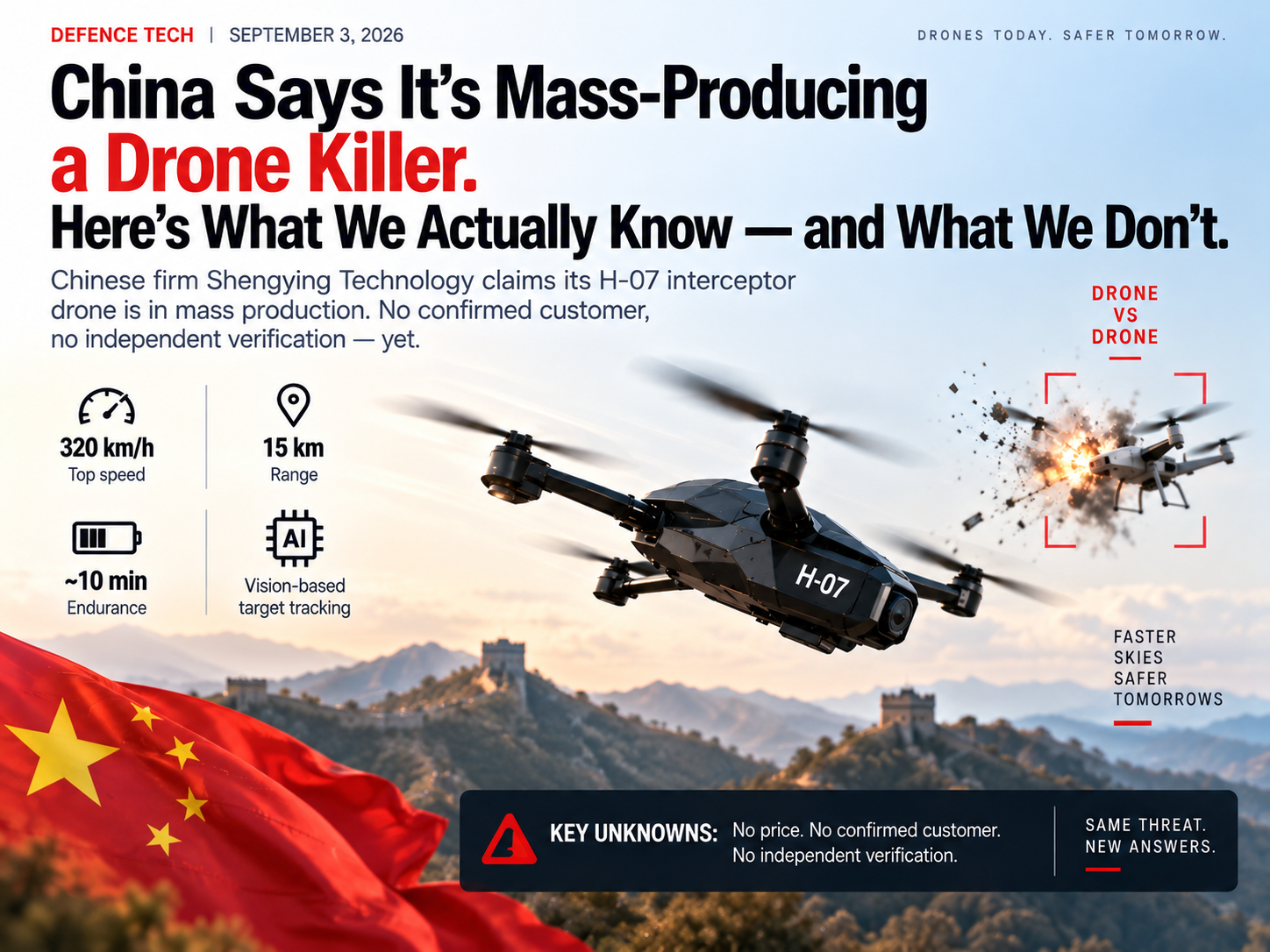
Chinese firm Shengying Technology claims mass production of its H-07 interceptor drone. No confirmed customer, no independent verification — but it fits a real, fast-growing global category.
China H-07 interceptor drone, Shengying Technology, kinetic drone interception, counter-UAS interceptor 2026, drone-on-drone warfare
China H-07 interceptor drone, Shengying Technology, kinetic drone interception, counter-UAS interceptor 2026, drone-on-drone warfare
A big claim, and an important asterisk
A Chinese company says it has begun mass-producing a drone built specifically to shoot down other drones. That's a genuinely significant category of weapon if true at scale — but "if true" is doing real work in that sentence, and it's worth being upfront about that before anything else.
What Shengying Technology is actually claiming
Shenzhen-based Shengying Technology announced on social media this week that its H-07 interceptor drone has entered mass production, with the company saying its injection-molded housing and manufacturing tooling are complete and the platform is ready for large-scale output. On paper, the specs are aggressive: a 7-inch airframe capable of 320 km/h top speed, a cruising speed of 100-200 km/h, up to 15km of range, an operating ceiling between 50 and 2,000 meters, and roughly 10 minutes of battery endurance. It's designed to be launched either from the ground or a handheld launcher, targeting fixed-wing aircraft, delta-wing drones, and multirotor UAVs alike. For guidance, the company says it uses a YOLO-based machine-vision tracking algorithm, capable of locking onto targets as small as 50×50 pixels in its camera frame.
Here's the caveat that matters: Shengying has not disclosed pricing, named a single customer, or confirmed any actual sale, test, or military deployment of the H-07. Independent defense outlets covering the story, including The Defence Blog, have explicitly stated they could not verify the specifications, production claims, or deployment status independently. This is, at this stage, a manufacturer's own announcement — not a confirmed capability in service anywhere.
Why the claim is still worth paying attention to
Even with that caveat, the H-07 fits a real and fast-growing weapons category, not a fabricated trend. Interceptor drones — small, fast, expendable aircraft built purely to physically destroy other drones — have grown rapidly since 2024, driven by one blunt economic reality: traditional air-defense missiles cost hundreds of thousands to millions of dollars each, and using one to shoot down a drone that costs a few thousand dollars to build is a losing trade every time it happens. Russia's mass Shahed loitering-munition strikes on Ukraine are the clearest real-world case that made this math impossible to ignore.
The category already has genuine, independently-verified activity behind it. German company TYTAN Technologies began actual mass production of its own interceptor drone in early 2026 after combat testing in Ukraine, targeting output of up to 3,000 units per month. Shenzhen-based SKYFEND has shown a competing interceptor, Thunder, at international defense expos, using AI-guided autonomous navigation and ground-sensor cueing to calculate its own interception routes. Whether or not Shengying's specific H-07 claims hold up to scrutiny, the underlying doctrine — using a cheap, fast, expendable drone as the primary defense against other cheap, fast, expendable drones — is now well-established and actively being fielded by multiple countries, not a hypothetical.
Why it matters
For any country weighing how to defend fixed infrastructure — airports, power plants, border posts — against swarming drone threats, the direction of travel is now fairly clear regardless of any single company's specific claims: kinetic, drone-on-drone interception is becoming a standard layer of air defense doctrine, sitting below traditional missile systems rather than replacing them entirely. What's genuinely uncertain is which specific manufacturers and platforms will actually reach real, verified deployment versus remaining social-media announcements — and China entering this race, even unconfirmed, adds another serious potential competitor to a field that, until recently, was led mostly by Ukrainian and European developers responding directly to real combat conditions.
If a growing share of "mass production" and "combat-ready" claims in this fast-moving category come from unverified company statements rather than confirmed military contracts, how should militaries and governments actually evaluate which interceptor systems are real and ready — versus which are marketing ahead of the product?
---
Sources : [Militarnyi]
(https://militarnyi.com/en/news/china-begins-mass-production-of-new-h-07-interceptor-drone/)
[The Defence Blog]
(https://defence-blog.com/chinese-firm-claims-mass-production-of-new-interceptor-drone/)
Unmanned Airspace
Militarnyi — TYTAN Technologies.
(https://militarnyi.com/en/news/china-begins-mass-production-of-new-h-07-interceptor-drone/)
[The Defence Blog]
(https://defence-blog.com/chinese-firm-claims-mass-production-of-new-interceptor-drone/)
Unmanned Airspace
Militarnyi — TYTAN Technologies.
Editor's note : This brief also included the Thales-Kalyani 70mm rocket deal — already covered in full in a prior article. Recommend running this China H-07 piece standalone rather than duplicating that coverage.

Vishal Sable
B.Tech AD @ shri balaji institute of technology and management
Engineering and tech journalist. I love exploring the impact of emerging technologies on global defense, sovereignty, and everyday life. Always looking for the real story behind the headlines.