Back to News
News AlertWorld Defence Tech
AUKUS Pillar II Proves Subsea Autonomy; DARPA Funds Quantum Defense
V
Author
Vishal Sable
Published
August 14, 2026
Reading Time
5 MIN READ
Spread the Word
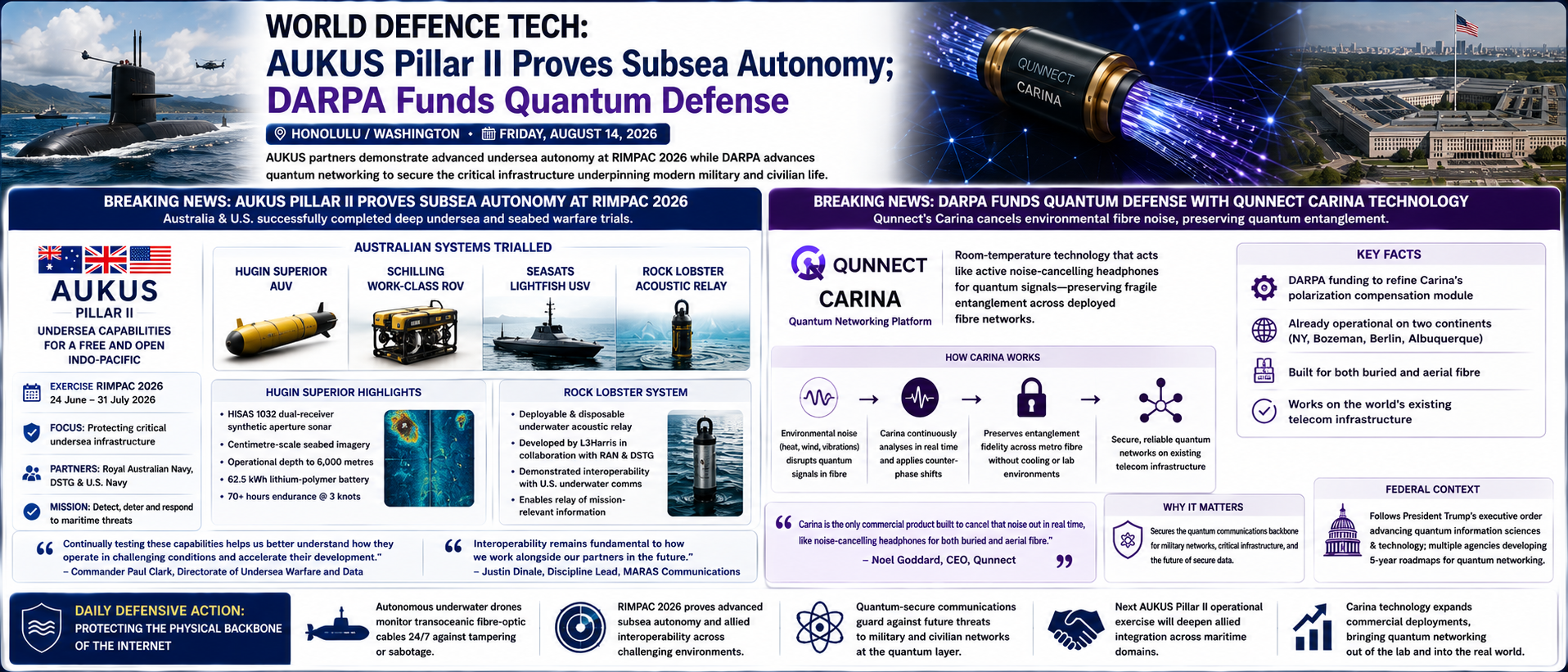
The future of undersea warfare has taken a decisive leap forward, as AUKUS partners successfully demonstrated advanced autonomous seabed warfare capabilities during the world's largest maritime exercise, while the Pentagon's premier research agency simultaneously moved to secure the quantum backbone of future military networks. These parallel developments underscore a strategic shift toward protecting the physical and quantum infrastructure that underpins modern military and civilian life.
BREAKING NEWS: AUKUS Pillar II Proves Subsea Autonomy at RIMPAC 2026
Under AUKUS Pillar II, Australia and the United States successfully completed deep undersea and seabed warfare trials during Exercise Rim of the Pacific (RIMPAC) 2026, held from 24 June to 31 July in and around the Hawaiian Islands. The activity brought together personnel from the Royal Australian Navy, Defence Science and Technology Group (DSTG), and the United States Navy to test and demonstrate Pillar II subsea and seabed warfare capabilities as part of mission scenarios focused on protecting critical undersea infrastructure.
Australian systems trialled during the exercise included a Kongsberg HUGIN Superior autonomous underwater vehicle (AUV), a Schilling work-class remotely operated vehicle (ROV), a Seasats Lightfish unmanned surface vehicle (USV), and the Rock Lobster deployable underwater acoustic communication relay system. The HUGIN Superior and the Schilling ROV were deployed together to conduct a complex undersea navigation and search mission within the exercise area, demonstrating how AUKUS partners are improving their ability to detect, deter and respond to maritime threats.
The HUGIN Superior is a proven AUV system that has been in active use by both commercial and military customers since 2019. It carries a HISAS 1032 dual-receiver synthetic aperture sonar — a sensor system capable of producing centimetre-scale imagery of the seabed at operational depths reaching 6,000 metres — and runs on a 62.5 kWh pressure-tolerant lithium-polymer battery, providing over 70 hours of endurance at 3 knots. The Rock Lobster system, developed by L3Harris in collaboration with the Royal Australian Navy and DSTG, is a deployable and disposable underwater acoustic communication relay system that demonstrated interoperability between Australian and United States underwater acoustic communications technologies. It enabled the relay of mission-relevant information from the United States to an underwater system, showcasing the ability to communicate across allied platforms in challenging underwater environments.
Directorate of Undersea Warfare and Data Commander Paul Clark said RIMPAC demonstrated how AUKUS Pillar II was helping its partners work together to rapidly develop and integrate advanced capabilities. "Continually testing these capabilities helps us better understand how they operate in challenging conditions," Commander Clark said. "We are able to accelerate their development through collaboration with AUKUS partners". Discipline Lead Maritime Robotic and Autonomous Systems Communications Justin Dinale added that interoperability remained a key focus: "The ability for technologies and systems to operate together is fundamental to how we work alongside our partners in the future".
BREAKING NEWS: DARPA Funds Quantum Defense with Qunnect Carina Technology
In a parallel development for the security of military communications, the Defense Advanced Research Projects Agency (DARPA) has awarded new funding to quantum networking company Qunnect to advance its Carina technology. The system operates at room temperature to cancel environmental fibre noise in real time, preserving fragile quantum entanglement across military data networks.
Quantum information is inherently fragile — qubits are easily diminished by temperature fluctuations, wind, and other environmental conditions present in telecommunications networks. Unlike classical data, which tolerates interference, quantum information is carried by photons whose states are physically fragile and degrade during transmission. Carina addresses this by acting like active noise-cancelling headphones for quantum signals, executing continuous real-time analysis and automated counter-phase shifts to preserve quantum entanglement fidelity across deployed metropolitan fibre without requiring dedicated cooling or laboratory environments.
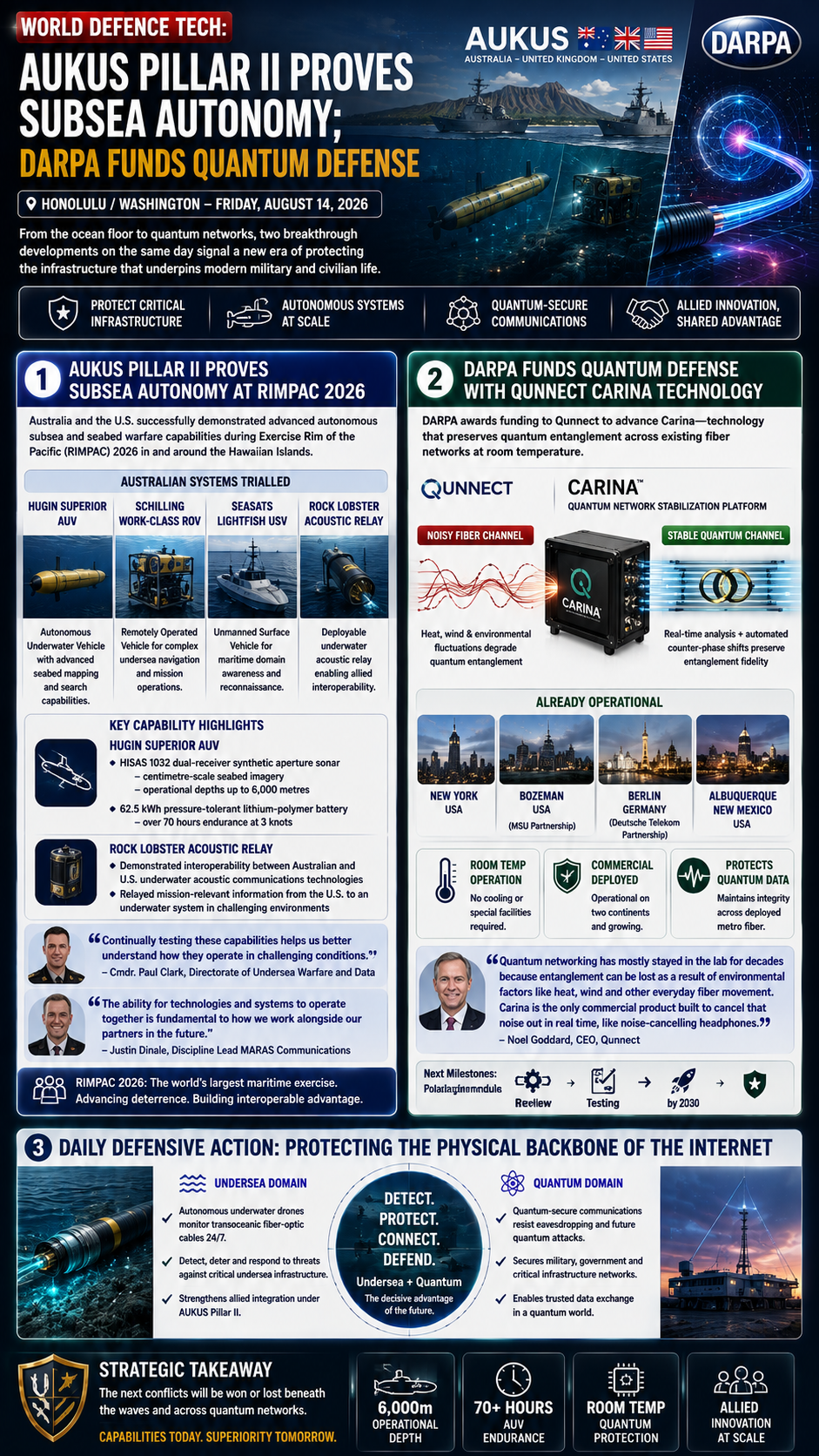
Noel Goddard, CEO of Qunnect, told Nextgov/FCW: "Quantum networking has mostly stayed in the lab for decades because entanglement can be lost as a result of environmental factors like heat, wind and other everyday fibre movement. Carina is the only commercial product built to cancel that noise out in real time, like noise-cancelling headphones for both buried and aerial fibre". The platform is already operational on two continents, anchoring quantum networks in New York, Bozeman (in partnership with Montana State University), Berlin (in partnership with Deutsche Telekom), and Albuquerque, New Mexico.
The DARPA contract specifically focuses on refining Carina's polarization compensation module, the internal system that continuously analyses and corrects for conditions that would otherwise corrupt quantum signals in transit. Goddard emphasised the practical orientation: "We made an early commitment to designing instruments that operate on the same infrastructure the world already uses. For the past five years, we focused on making quantum networking practical, and we've validated it through deployments in cities". The award comes amid growing federal focus on quantum networking, following President Trump's executive order earlier this year advancing quantum information sciences and technology research, tasking multiple agencies to craft five-year roadmaps for expanding quantum networking.
DAILY DEFENSIVE ACTION: Protecting the Physical Backbone of the Internet
Geopolitical defence is increasingly focusing on the physical backbone of the internet. Naval commands are using autonomous underwater drones to monitor transoceanic fibre-optic cables 24/7 against tampering or sabotage. The successful testing of AUKUS Pillar II capabilities at RIMPAC 26 strengthens Defence's ability to protect its critical undersea infrastructure and further advances the development and integration of undersea warfare capabilities across the partnership.
The convergence of autonomous underwater systems and quantum-secure communications reflects a broader strategic recognition: the next conflicts will be won or lost beneath the waves and across quantum networks, where the ability to detect, track, and protect critical infrastructure in real time has become the decisive operational advantage. Planning is already underway for the next AUKUS Pillar II operational exercise, which will extend allied and partner integration across maritime domains, while Qunnect's Carina technology continues to expand its commercial deployments, bringing quantum networking out of the laboratory and into the real world.

Vishal Sable
B.Tech AD @ shri balaji institute of technology and management
Engineering and tech journalist. I love exploring the impact of emerging technologies on global defense, sovereignty, and everyday life. Always looking for the real story behind the headlines.