Back to News
News AlertWorld Defence Tech
Australia Unveils 2026 Defence Strategy as Autonomous AI Summit Approaches
V
Author
Vishal Sable
Published
August 7, 2026
Reading Time
6 MIN READ
Spread the Word
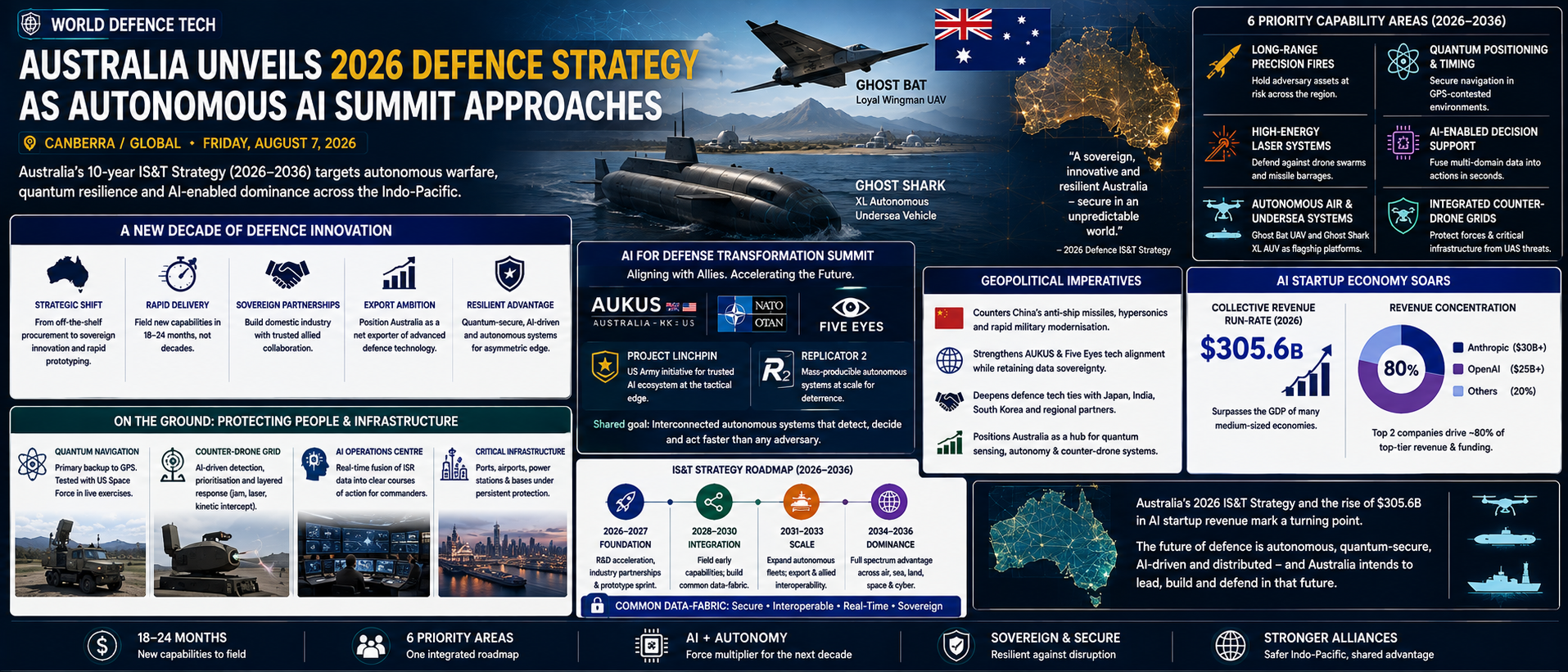
Australia has laid down a marker for the next decade of military capability with the official launch of its 2026 Defence Innovation, Science and Technology (IS&T) Strategy, a comprehensive ten-year blueprint that positions the country as a Pacific power broker in autonomous warfare and quantum-enabled resilience. Released by the Department of Defence, the strategy identifies six critical capability areas that will absorb the lion's share of research and procurement funding through 2036: long-range precision fires capable of holding adversary assets at risk across the South China Sea and beyond; high-energy laser systems for point-defence against drone swarms and incoming missile barrages; autonomous undersea and aerial systems, explicitly citing the locally developed Ghost Bat loyal-wingman drone and the Ghost Shark extra-large autonomous underwater vehicle as flagship platforms; quantum positioning technologies to ensure secure navigation and timing in GPS-contested environments; AI-enabled decision-support platforms that fuse intelligence from disparate sensors into coherent operational pictures within seconds; and integrated counter-drone grids that protect both deployed forces and civilian infrastructure from the proliferating threat of low-cost unmanned aerial systems. The strategy represents a significant departure from Australia's traditional reliance on off-the-shelf US procurement, emphasising domestic research, sovereign industrial partnerships, and rapid prototyping cycles that can field new capabilities within eighteen to twenty-four months rather than the decade-long timelines of major platforms like submarines or frigates.
The timing of the strategy's release is no accident, coming just weeks before the AI for Defense Transformation Summit, where military alliances including AUKUS, NATO, and the Five Eyes are expected to accelerate the integration of intelligence, surveillance, and reconnaissance platforms into cohesive autonomous decision-making architectures. Project Linchpin, the US Army's effort to establish a trusted AI ecosystem for tactical edge computing, and Replicator 2, the Pentagon's follow-on to its inaugural mass-producible autonomous systems initiative, are both set to feature prominently at the summit, with Australian officials signaling that Canberra will seek to align its IS&T roadmap with these American-led programmes while retaining sovereignty over data and deployment decisions. The convergence of these initiatives points to a shared vision among Western militaries: an interconnected mesh of autonomous air, land, and sea systems that can detect, track, and engage targets with minimal human intervention, relying on AI to parse sensor noise, identify threat priorities, and recommend or execute kinetic responses within engagement windows that are too brief for traditional command-and-control loops. Australia's particular emphasis on undersea autonomy, through Ghost Shark, reflects its strategic geography as a continental island nation with vast maritime approaches, where traditional submarine fleets are expensive and slow to build, making unmanned underwater vehicles an increasingly attractive complement for seabed warfare, anti-submarine screening, and critical undersea cable protection.
For defence personnel and civilian infrastructure operators on the ground, the strategy's provisions are already translating into tangible protective measures. Defence infrastructure across northern Australia, from Darwin to the Cocos Islands, is embedding quantum navigation systems as a primary backup to GPS, ensuring that military aircraft, naval vessels, and land-based missile batteries can maintain precise positioning even under full-spectrum jamming or space-based denial attacks, a capability that has been tested in recent exercises with the US Space Force. Concurrently, automated counter-drone air defence networks are being deployed around both military installations and major civilian targets such as ports, power stations, and international airports, using a layered approach that combines radar, radio-frequency detection, and electro-optical tracking with kinetic and non-kinetic effectors, including directed-energy lasers and electronic warfare jammers. These networks operate on AI-driven threat prioritisation algorithms that can distinguish between commercial drones, hobbyist quadcopters, and hostile loitering munitions within milliseconds, triggering response protocols that range from soft-jamming to hard-kill intercepts, all without requiring a human operator to approve every engagement, though human oversight remains mandatory for lethal actions under current Australian rules of engagement. For a port manager in Sydney or a power-grid controller in Brisbane, these systems offer a new layer of reassurance against asymmetric attacks, even as they raise questions about civil-liberties surveillance and the potential for automated misidentification.
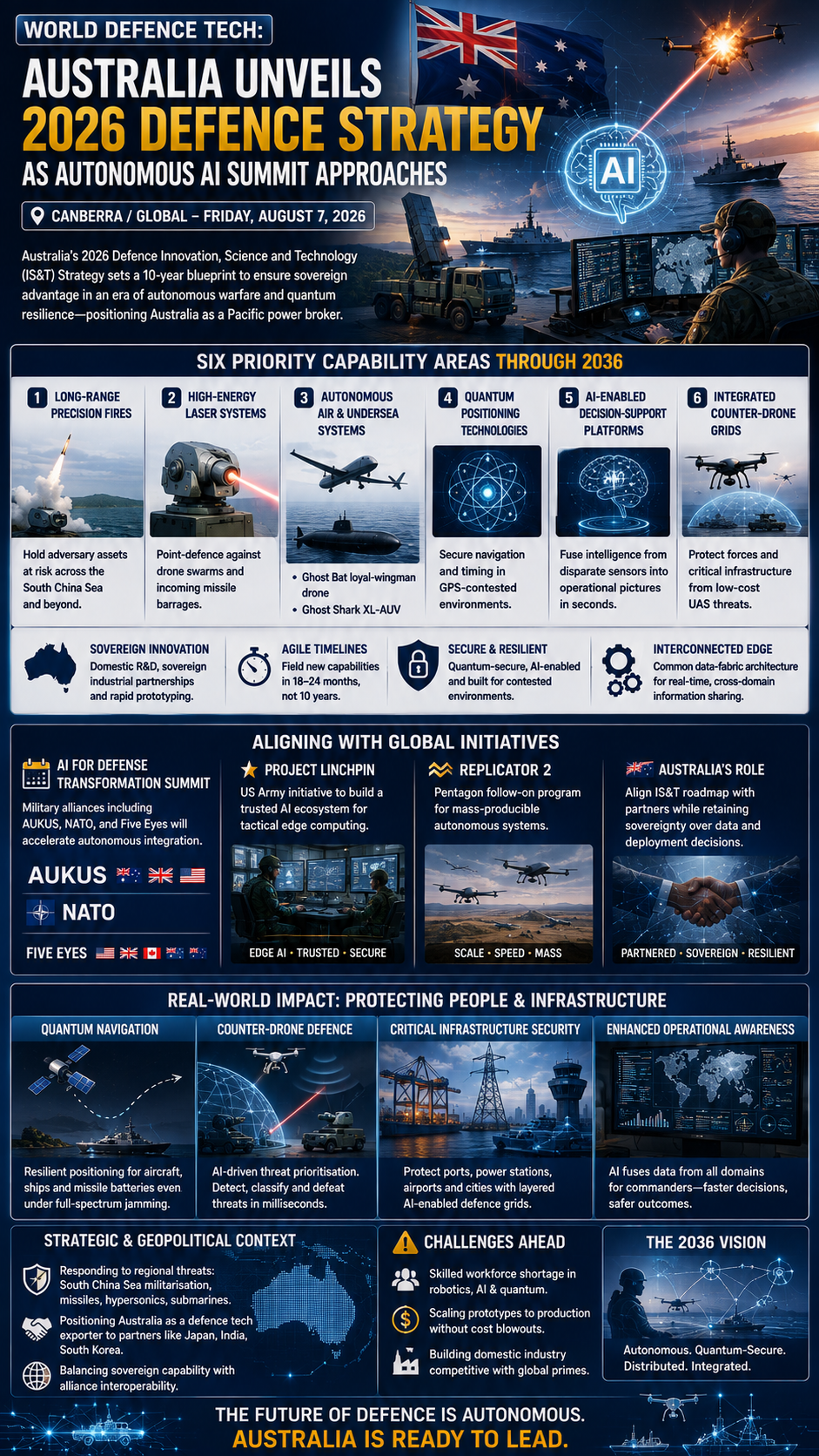
Geopolitically, Australia's IS&T strategy is being read in regional capitals as a direct response to China's rapid militarisation of the South China Sea and its growing arsenal of anti-ship ballistic missiles, hypersonic glide vehicles, and submarine-launched cruise missiles that could threaten Australian shores and sea lines of communication. By prioritising long-range fires and autonomous undersea systems, Canberra is effectively betting that asymmetric, unmanned, and dispersed capabilities can offset Beijing's numerical advantages in traditional platforms like destroyers and fighter squadrons, a calculus that resonates with the broader AUKUS submarine programme but extends it to a wider array of unmanned systems. The strategy also signals Australia's intention to become a net exporter of defence technology, particularly in quantum sensing and counter-drone systems, to regional partners such as Japan, India, and South Korea, thereby deepening security ties and reducing dependence on US supply chains for niche components. At the upcoming AI for Defense Transformation Summit, Australian defence officials are expected to present Ghost Bat and Ghost Shark as case studies in agile, coalition-friendly innovation, potentially securing additional funding and technical collaboration from partners who see these platforms as cost-effective alternatives to fully manned systems. However, the strategy's ambitious timelines and sovereign-development goals face internal hurdles, including a domestic defence industry that has historically been overshadowed by US prime contractors, a skilled-labour shortage in robotics and quantum engineering, and the perennial challenge of translating prototype success into production scale without cost overruns that have plagued major Australian projects like the Hunter-class frigates.
Looking ahead, the convergence of Australia's blueprint, the broader AUKUS innovation pipeline, and the accelerating pace of autonomous warfare suggests that the decade to 2036 will witness a fundamental restructuring of how Western militaries organise, equip, and deploy force. The six priority areas are not siloed capabilities but interdependent nodes: long-range fires rely on quantum positioning for accuracy, AI decision platforms ingest data from autonomous aerial and undersea sensors, and high-energy lasers depend on counter-drone grids for target cueing. Australia's strategy explicitly recognises this interdependence, mandating that all six areas be developed within a common data-fabric architecture that enables real-time information sharing across platforms and domains, a technical requirement that also serves as a political hedge against any single capability failing to deliver on its promises. For the soldiers, sailors, and aviators who will operate these systems, the daily experience will increasingly resemble that of a fleet commander in a strategy game, with live dashboards, automated threat evaluations, and recommended courses of action that they can accept, modify, or override, rather than the manual, voice-radio-driven coordination of previous conflicts. The AI for Defense Transformation Summit will likely refine these concepts further, but Australia has already cast its vote: the future of defence is autonomous, quantum-secure, and distributed, and Canberra intends to be both a customer and a creator of that future.

Vishal Sable
B.Tech AD @ shri balaji institute of technology and management
Engineering and tech journalist. I love exploring the impact of emerging technologies on global defense, sovereignty, and everyday life. Always looking for the real story behind the headlines.