Back to News
News AlertWorld Defence Tech
Autonomous Underwater Vehicles (AUVs) Explode as Raytheon Doubles Production
V
Author
Vishal Sable
Published
July 9, 2026
Reading Time
4 MIN READ
Spread the Word
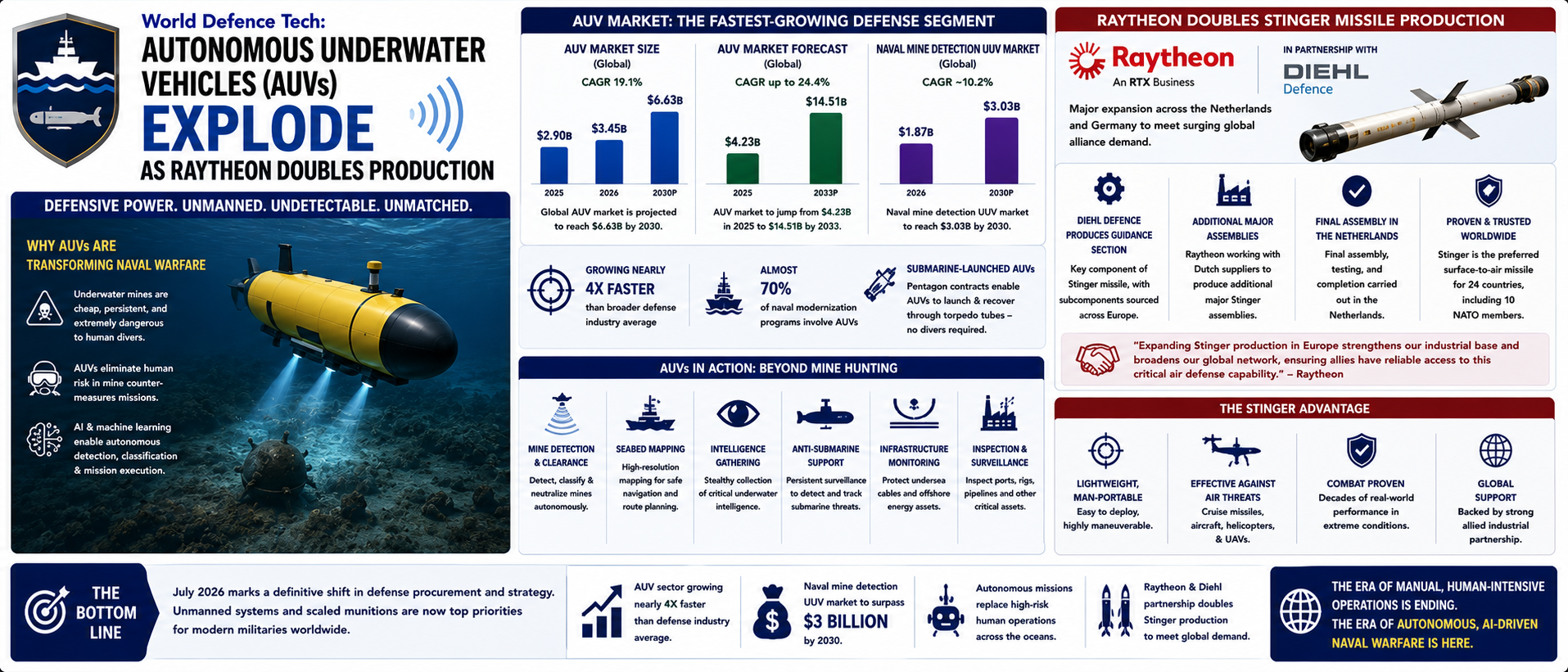
Modern national security is prioritizing unmanned maritime defense, cutting human risk out of volatile border zones and rapidly scaling ammunition infrastructure. The first full week of July 2026 has confirmed a decisive pivot in defense strategy—with the Autonomous Underwater Vehicle (AUV) sector emerging as the fastest-growing segment in naval technology, even as Raytheon doubles Stinger missile production to meet surging global demand.
The Latest News
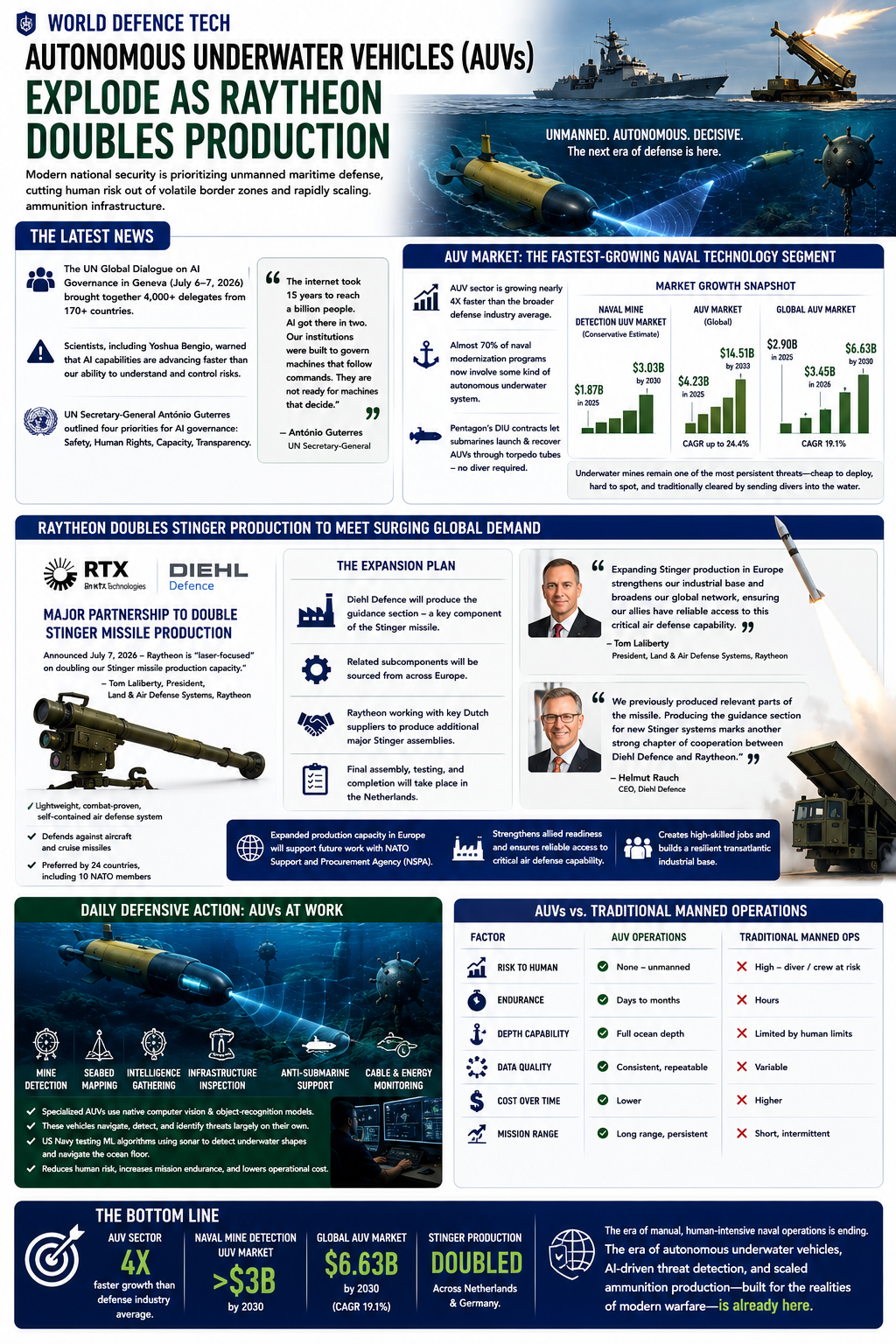
Fresh market analysis reveals that the AUV sector is currently growing nearly four times faster than the broader defense industry average. The naval mine detection UUV market alone is on track to grow from $1.87 billion this year to $3.03 billion by 2030—and that is one of the more conservative estimates. The broader AUV market is projected to jump from $4.23 billion in 2025 to $14.51 billion by 2033, with some analysts projecting growth rates as high as 24.4% annually. The global AUV market size has grown from $2.9 billion in 2025 to $3.45 billion in 2026 at a CAGR of 19.1%, and is expected to reach $6.63 billion by 2030.
The surge reflects a fundamental shift in naval strategy. Underwater mines remain one of the most persistent threats—cheap to deploy, hard to spot, and traditionally cleared by sending divers into the water, a task "about as risky as it sounds". That is finally changing. Almost 70% of naval modernization programs now involve some kind of autonomous underwater system. The Pentagon's Defense Innovation Unit has awarded contracts to build systems that let Navy submarines launch and recover AUVs straight through torpedo tubes, with no diver required.
Raytheon Doubles Stinger Production
Concurrently, Raytheon (an RTX business) announced a major partnership with Europe's Diehl Defence to double global Stinger missile production across the Netherlands and Germany to meet surging alliance demands. The announcement, made on July 7, confirms that Raytheon is "laser-focused on doubling our Stinger missile production capacity," according to Tom Laliberty, president of Land & Air Defense Systems at Raytheon.
Under the expansion plan, Diehl Defence will produce the guidance section—a key component of the Stinger missile—and source related subcomponents from across Europe. Raytheon is also working with key Dutch suppliers to produce additional major Stinger assemblies, with final assembly, testing, and completion taking place in the Netherlands. Helmut Rauch, CEO of Diehl Defence, noted that his company "previously produced relevant parts of the missile," adding that "producing the guidance section for new Stinger systems marks another strong chapter of cooperation between Diehl Defence and Raytheon".
The Stinger missile is a lightweight, combat-proven, self-contained air defense system deployed against cruise missiles and aircraft. It remains the preferred surface-to-air missile for 24 countries, including 10 NATO members. The expanded production capacity in Europe will support future work with the NATO Support and Procurement Agency (NSPA) to meet regional demand. Raytheon emphasized that "expanding Stinger production in Europe strengthens our industrial base and broadens our global network, ensuring our allies have reliable access to this critical air defense capability".
Daily Defensive Action
Navies globally are moving away from manual, dangerous human mine-clearing. In daily operations, specialized AUVs powered by native computer vision and object-recognition models navigate and identify underwater threats completely on their own. These vehicles can "navigate, detect, and identify threats largely on their own instead of needing a person steering by joystick". The US Navy has been testing machine learning algorithms that rely on sonar sensors to detect underwater shapes and navigate the ocean floor. Beyond mine detection, AUVs are increasingly deployed for seabed mapping, intelligence gathering, infrastructure inspections, anti-submarine support, and monitoring underwater communication cables and offshore energy facilities.
The Bottom Line
July 2026 marks a definitive shift in defense procurement and strategy. The AUV sector is expanding at nearly four times the rate of the broader defense industry, driven by naval modernization programs prioritizing unmanned systems for mine countermeasures and seabed warfare. The naval mine detection UUV market alone is projected to surpass $3 billion by 2030. Simultaneously, Raytheon's partnership with Diehl Defence and Dutch suppliers to double Stinger missile production underscores the urgent need to scale air defense capabilities for allied forces. The era of manual, human-intensive naval operations is ending. The era of autonomous underwater vehicles, AI-driven threat detection, and scaled ammunition production—built for the realities of modern warfare—is already here.

Vishal Sable
B.Tech AD @ shri balaji institute of technology and management
Engineering and tech journalist. I love exploring the impact of emerging technologies on global defense, sovereignty, and everyday life. Always looking for the real story behind the headlines.