Back to News
News AlertWorld Defence Tech
NATO Summit Unveils "Drone Edge" Initiative & Massive Triton Procurement
V
Author
Vishal Sable
Published
July 13, 2026
Reading Time
2 MIN READ
Spread the Word
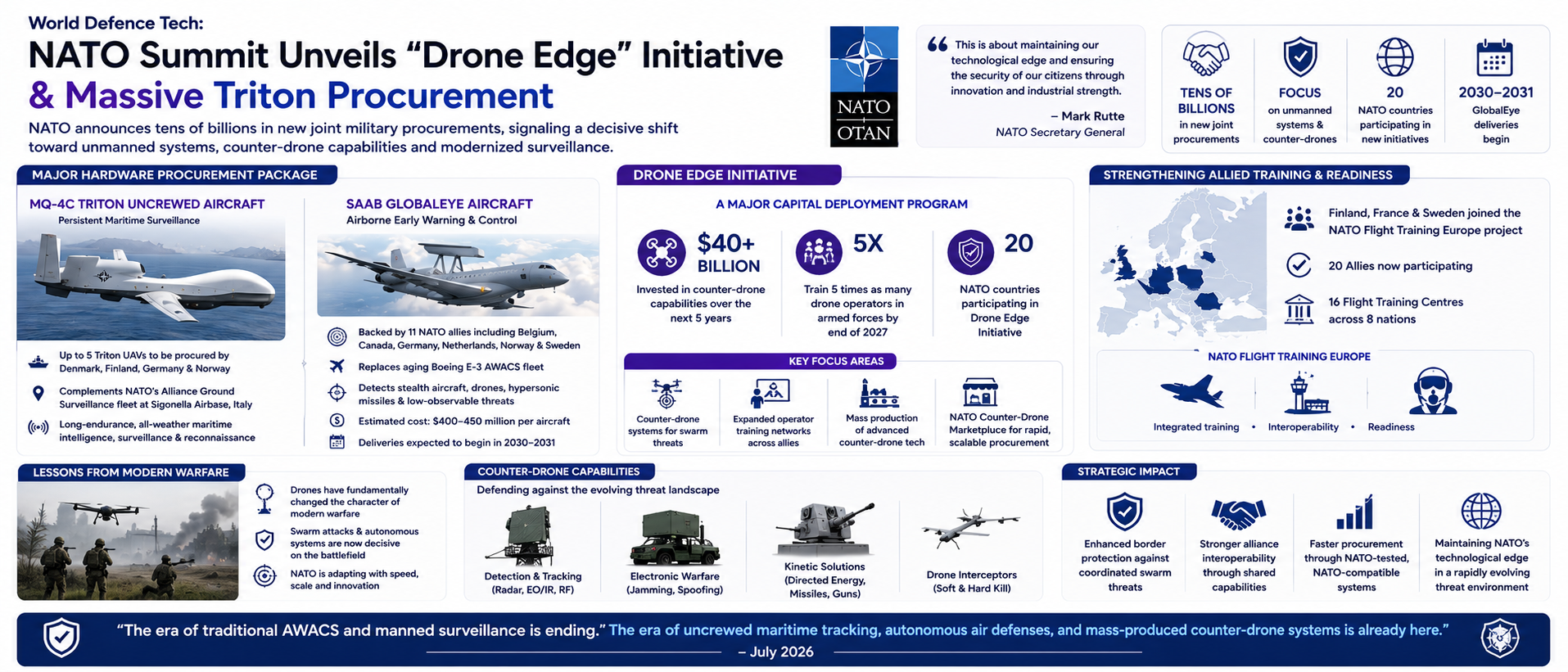
Modern defense alliances are bypassing traditional military supply chains to prioritize uncrewed long-range maritime tracking and autonomous air defenses. Live from the NATO Summit Defence Industry Forum in Ankara on July 7, Secretary General Mark Rutte officially announced tens of billions in new joint military procurements, signaling a decisive shift in alliance strategy toward unmanned systems and counter-drone capabilities .
The major hardware package features the purchase of Northrop Grumman MQ-4C Triton uncrewed aircraft for persistent maritime surveillance alongside Saab GlobalEye aircraft to modernize airborne early warning networks. Denmark, Finland, Germany, and Norway have signed letters expressing their intention to procure up to five Triton UAVs, which will complement NATO's existing Alliance Ground Surveillance fleet operating from Sigonella Airbase in Italy . The GlobalEye procurement, backed by 11 NATO allies including Belgium, Canada, Germany, the Netherlands, Norway, and Sweden, will replace the alliance's aging Boeing E-3 AWACS fleet that has served for decades, with the new aircraft delivering long-range detection capable of identifying low-observable and stealthy threats, as well as drones and hypersonic missiles, even in complex environments . Each GlobalEye is estimated to cost around $400-450 million, with deliveries expected to begin in 2030-2031 .
Crucially, NATO launched the Drone Edge Initiative, a major capital deployment program explicitly built to expand drone operator training networks and mass-produce advanced counter-drone systems to secure borders against coordinated swarm threats . Under this initiative, NATO allies are investing over $40 billion in counter-drone capabilities over the next five years, with 20 NATO countries participating . Allies have also committed to training five times as many drone operators in their armed forces by the end of 2027 . To accelerate procurement, NATO will establish a dedicated counter-drone marketplace to help member states procure NATO-tested, NATO-compatible systems rapidly and at scale . Finland, France, and Sweden joined the NATO Flight Training Europe project, bringing the total number of participating Allies to 20, with 16 flight training centres across eight nations . The initiative reflects clear lessons from the Russia-Ukraine conflict, where drones have fundamentally altered the character of modern warfare and become a decisive factor on the battlefield . July 2026 marks a definitive shift in NATO defense strategy. The era of traditional AWACS and manned surveillance is ending. The era of uncrewed maritime tracking, autonomous air defenses, and mass-produced counter-drone systems is already here.

Vishal Sable
B.Tech AD @ shri balaji institute of technology and management
Engineering and tech journalist. I love exploring the impact of emerging technologies on global defense, sovereignty, and everyday life. Always looking for the real story behind the headlines.