Back to News
News AlertWorld Defence Tech
Rheinmetall and MBDA Secure Deal for German Navy Laser Weapon
V
Author
Vishal Sable
Published
July 11, 2026
Reading Time
2 MIN READ
Spread the Word
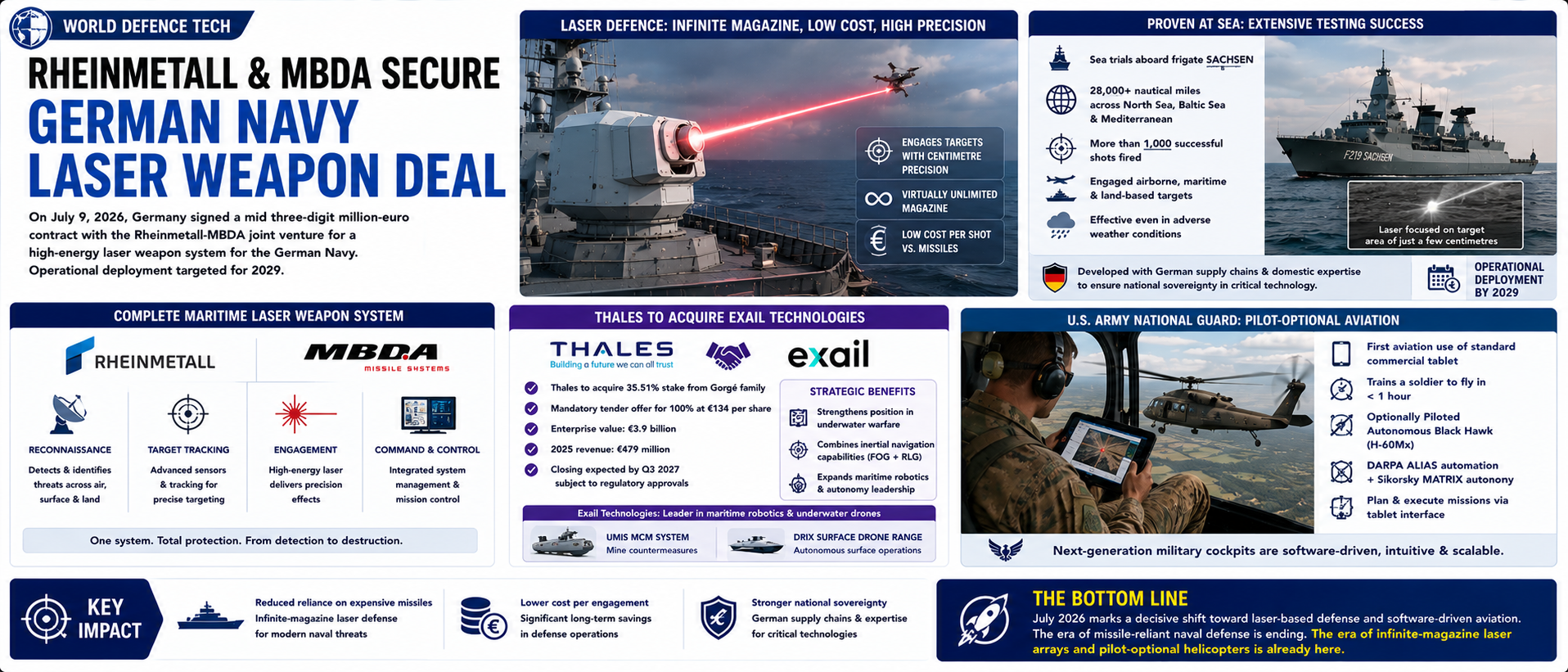
Modern naval warfare is moving away from expensive, limited-round missile interceptors toward infinite-magazine, cost-effective laser defense arrays. On July 9, the German Federal Office of Bundeswehr Equipment (BAAINBw) signed a contract with the Rheinmetall-MBDA joint venture for the development of a high-energy laser weapon system for the German Navy . The deal, valued in the mid three-digit million-euro range, covers a complete maritime system including reconnaissance, target tracking, and engagement, with operational deployment expected by 2029 .
The weapon system builds on a demonstrator that completed a year of sea trials aboard the frigate Sachsen, covering 28,000 nautical miles across the North Sea, Baltic Sea, and Mediterranean, while proving its effectiveness even in adverse weather conditions . During testing, the system successfully fired more than 1,000 shots at airborne, maritime, and land-based targets, demonstrating its ability to focus laser power onto an area measuring just a few centimetres for precision engagement . The system will be developed with German supply chains and domestic expertise to secure national sovereignty in the technology .
Simultaneously, industrial giant Thales agreed to acquire a 35.51% stake in Exail Technologies from the Gorgé family, with a view to launching a mandatory tender offer for 100% of the company at €134 per share, implying an enterprise value of €3.9 billion . The acquisition aims to increase Thales' scale in the underwater warfare market and expand its inertial navigation capabilities, combining Exail's fibre-optic gyroscope expertise with Thales' ring-laser gyroscope products . Exail, with €479 million in 2025 revenue, is a leader in maritime robotics and underwater drones, including the UMIS mine countermeasures system and the DriX surface drone range . Closing is expected by Q3 2027 following regulatory approvals .
Military operations are scaling down reliance on physical ammunition. The US Army National Guard successfully conducted an aviation first—using a standard commercial tablet to train a soldier to fly an optionally piloted autonomous Sikorsky Black Hawk helicopter in less than an hour . The H-60Mx, equipped with DARPA's ALIAS automation system and Sikorsky's MATRIX autonomy software, allows a non-pilot to plan and execute missions via tablet interface, demonstrating that next-gen military cockpits are completely software-driven . July 2026 marks a decisive shift toward laser-based defense and software-driven aviation. The era of missile-reliant naval defense is ending. The era of infinite-magazine laser arrays and pilot-optional helicopters is already here.

Vishal Sable
B.Tech AD @ shri balaji institute of technology and management
Engineering and tech journalist. I love exploring the impact of emerging technologies on global defense, sovereignty, and everyday life. Always looking for the real story behind the headlines.