Back to News
News AlertWorld Defence Tech
China Successfully Tests Sea-Based Rocket Net-Recovery System
V
Author
Vishal Sable
Published
July 10, 2026
Reading Time
3 MIN READ
Spread the Word
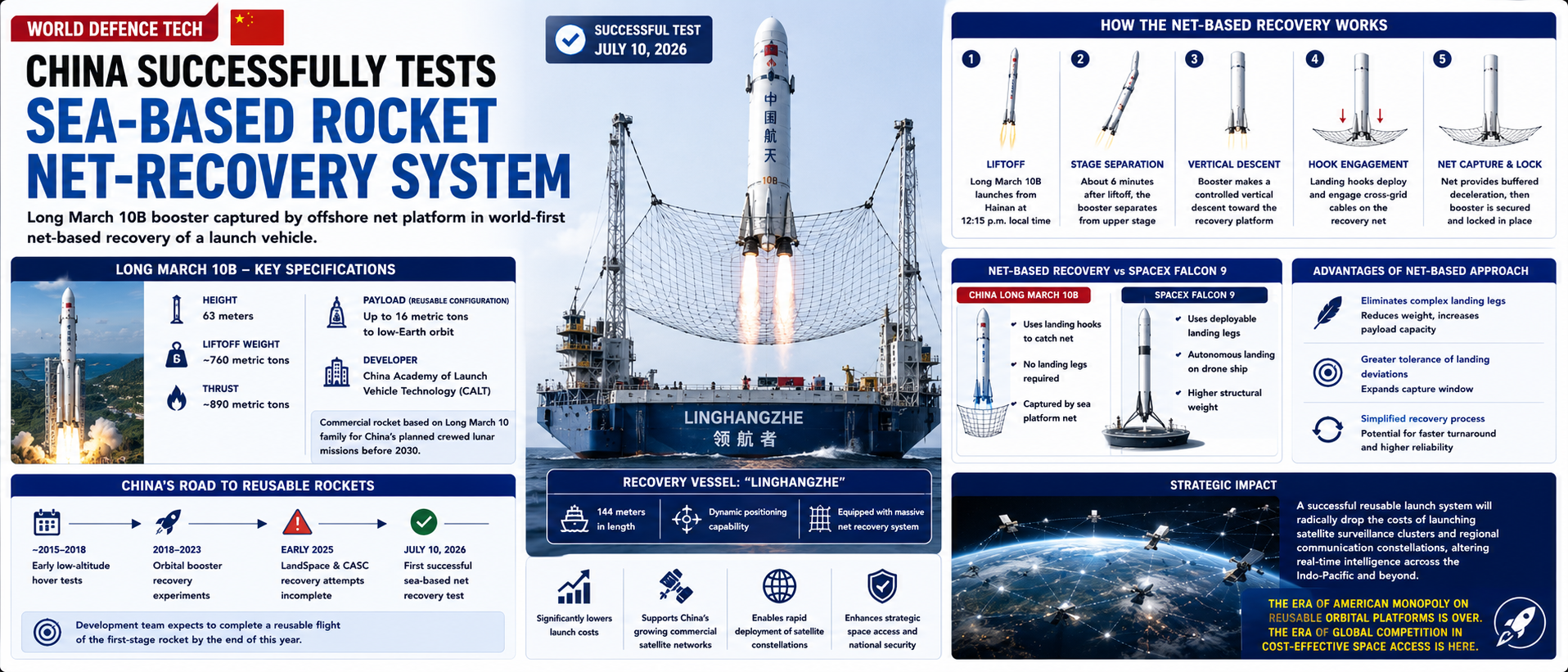
Aerospace technology and automated military hardware are converging, with global superpowers rushing to compress launch costs and scale orbital infrastructure. Breaking records in aerospace engineering, China successfully conducted its very first sea-based rocket booster net-recovery system using the Long March 10B. The rocket lifted off from the Hainan commercial space launch site at 12:15 p.m. local time on July 10. About six minutes after the booster separated from the upper stage, it made a controlled vertical descent and was securely captured by a massive net suspended from an offshore maritime platform, eliminating the need for landing legs in what engineers are calling a world-first net-based recovery of a launch vehicle.
The Long March 10B stands about 63 meters tall with a liftoff weight of approximately 760 metric tons, generating around 890 metric tons of thrust. In its reusable configuration, it can carry payloads of up to 16 metric tons to low-Earth orbit. It was developed by the China Academy of Launch Vehicle Technology as a commercial rocket based on technology from the Long March 10 family being developed for China's planned crewed lunar missions before 2030. Unlike SpaceX's Falcon 9, which lands autonomously on drone ships using deployable legs, China's Long March 10B uses landing hooks to catch a net suspended on a sea platform. The net-based recovery system was executed by the "Linghangzhe" recovery vessel, a 144-meter platform with dynamic positioning capability. As the rocket descends, its hooking mechanism deploys and engages with cross-grid cables on the recovery net, which provides buffered deceleration before the rocket is secured and locked into place.
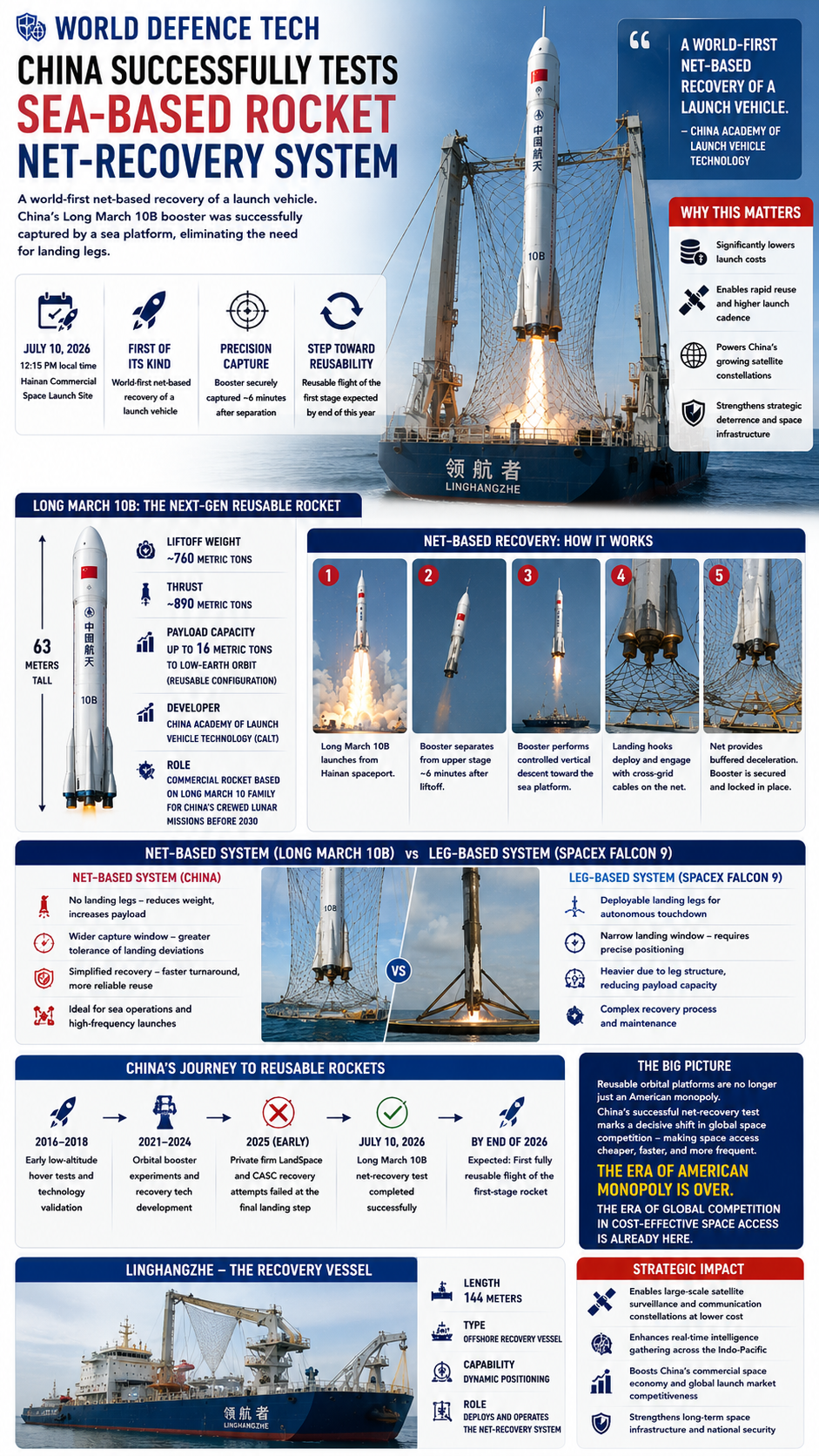
The net-based approach offers several strategic advantages over traditional leg-based landing, including eliminating complex landing legs to reduce rocket weight and increase payload capacity, greater tolerance of landing deviations to expand the capture window, and simplified recovery processes that could make rapid reuse more reliable. China has spent nearly a decade developing reusable rocket technologies through early low-altitude hover tests and orbital booster recovery experiments. Previous recovery attempts by private firm LandSpace and state-owned CASC in 2025 failed to complete the crucial final landing step. The development team now expects to complete a reusable flight of the first-stage rocket by the end of this year.
Reusable orbital platforms are no longer just an American monopoly. This milestone will radically drop the costs of launching satellite surveillance clusters and regional communication constellations, altering how real-time intelligence is gathered across the Indo-Pacific. A successful reusable launch system is expected to significantly lower launch costs, supporting China's rapidly expanding commercial satellite networks. The era of American monopoly on reusable orbital platforms is officially over. The era of global competition in cost-effective space access is already here.

Vishal Sable
B.Tech AD @ shri balaji institute of technology and management
Engineering and tech journalist. I love exploring the impact of emerging technologies on global defense, sovereignty, and everyday life. Always looking for the real story behind the headlines.